Pittsburgh Cemeteries

The Art and Architecture of Death

This mausoleum and its stone mourner are doubtless both standard catalogue items. But they are picturesque, and much more so because of the deep blackness of the stone. Most stone buildings in Pittsburgh used to look like this, but few of them have escaped cleaning.

The other thing that makes the mausoleum stand out, of course, is the delightful name “Sunshine” over the door.

A row of Haxes and McCulloughs rests in front of this angel under identical slabs. C. C. Hax died in 1927, and this monument was put up in 1928 (according to the cemetery’s Web site). The Haxes made their money in leather goods and the McCulloughs in electric equipment, so this was what you would call a mixed marriage.

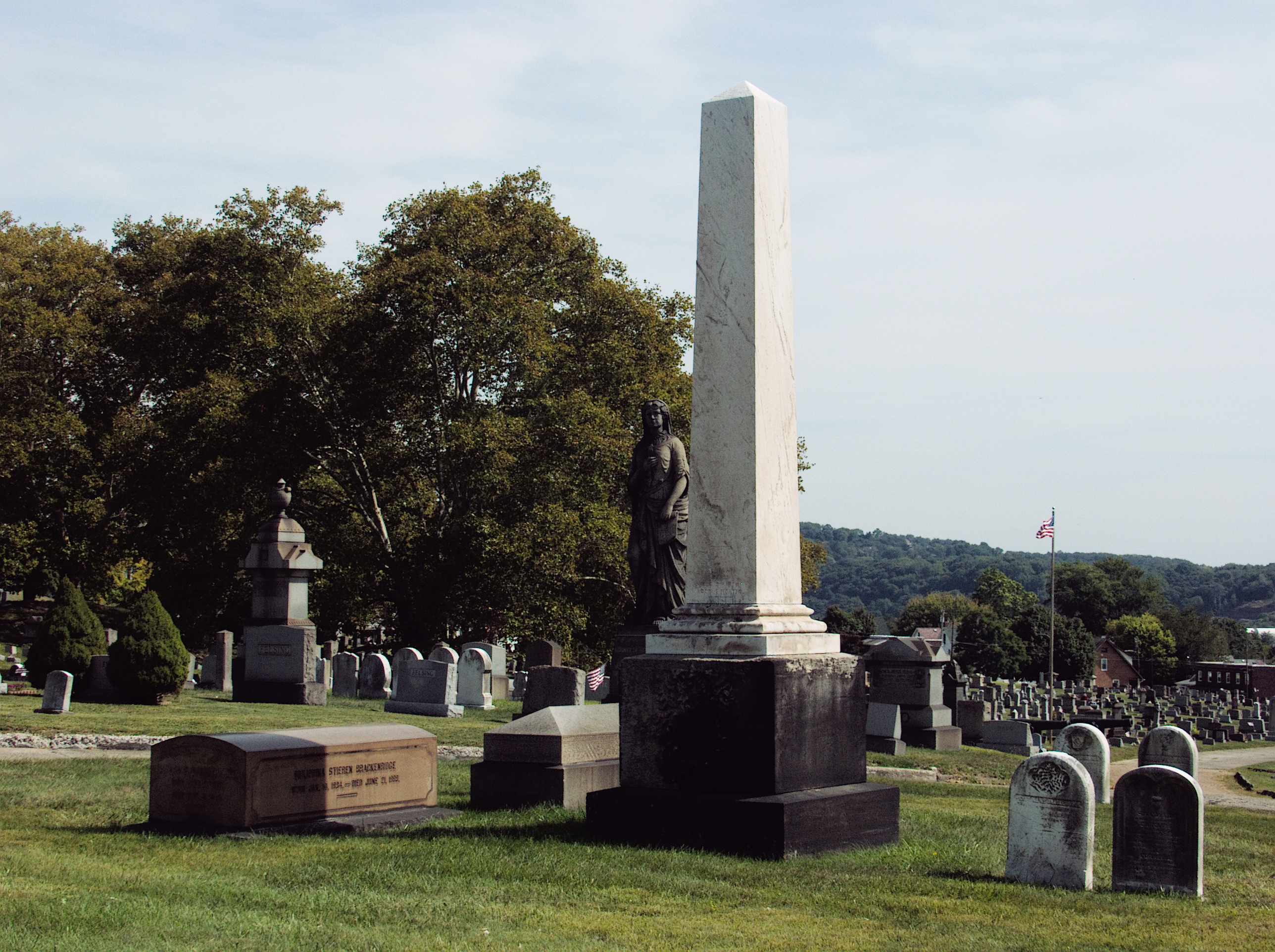
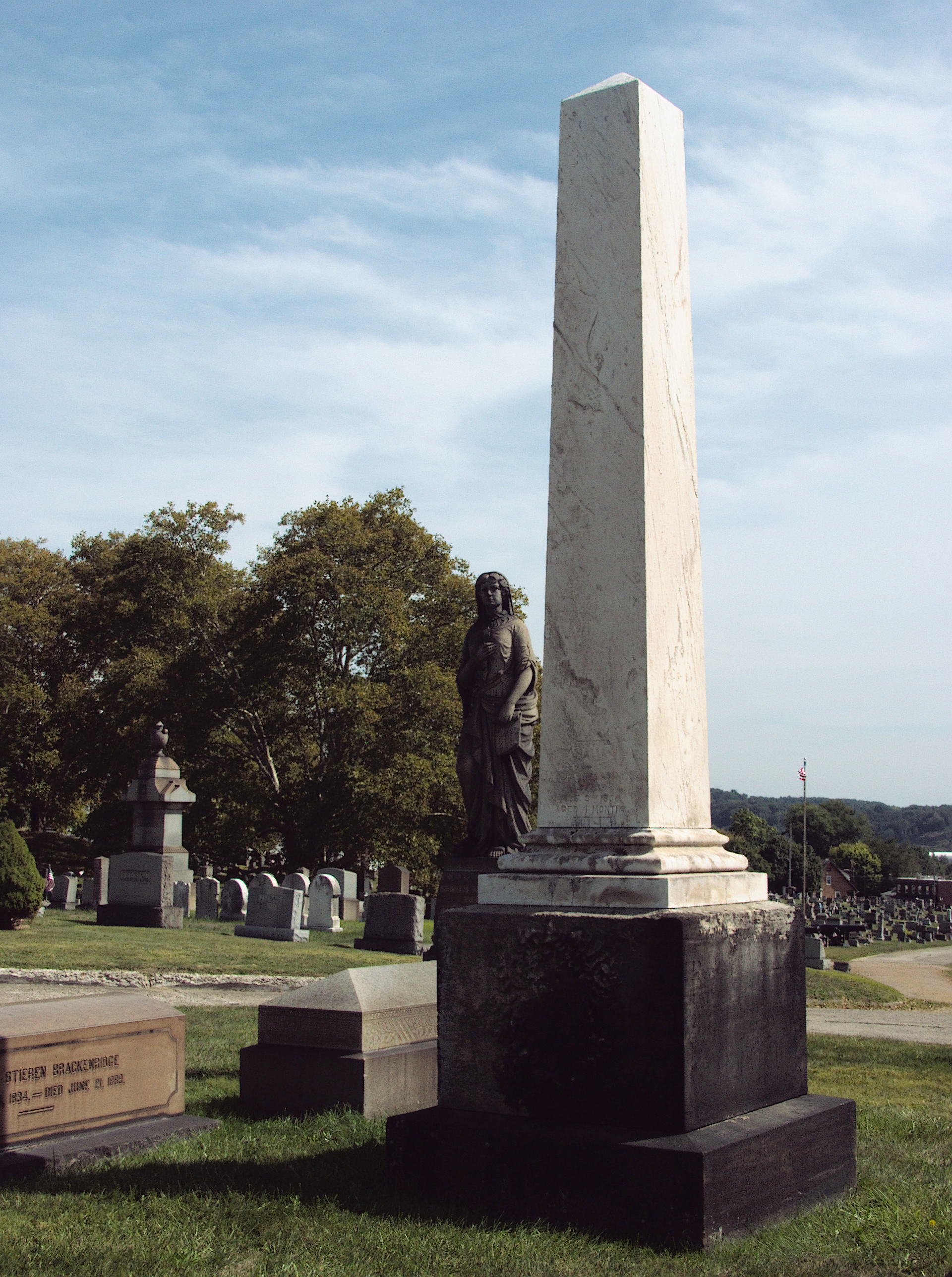
Henry Marie Brackenridge, son of the famous Hugh Henry Brackenridge, founded the borough of Brackenridge, and his family has an honored place in the middle of the circle at the entrance to Prospect Cemetery.

The obelisk once bore a number of inscriptions, but they are almost obliterated by time.

Henry Marie’s own grave is marked by a very modest headstone. Father Pitt was not able to read the epitaph, although it might be clearer in morning light.

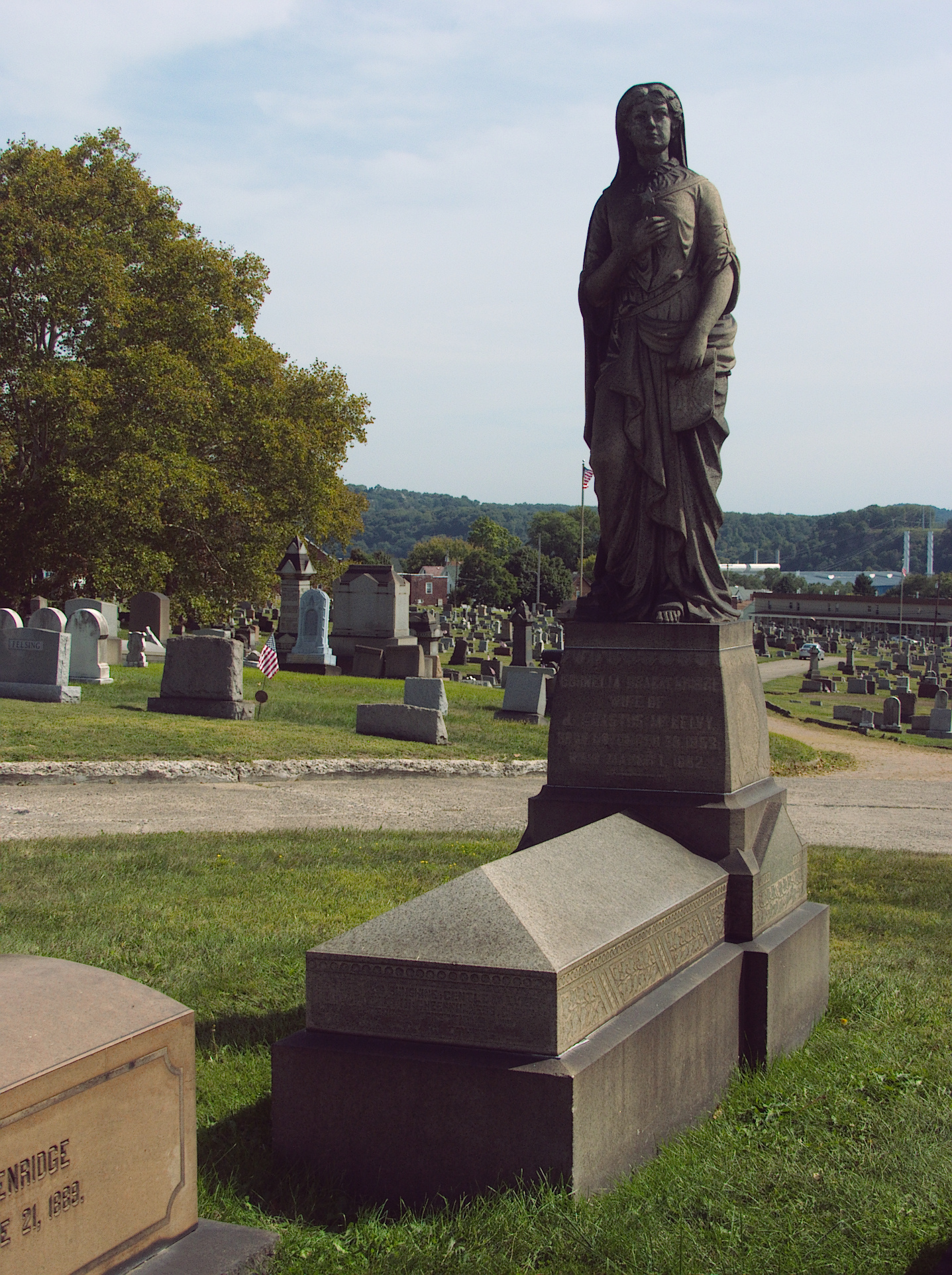
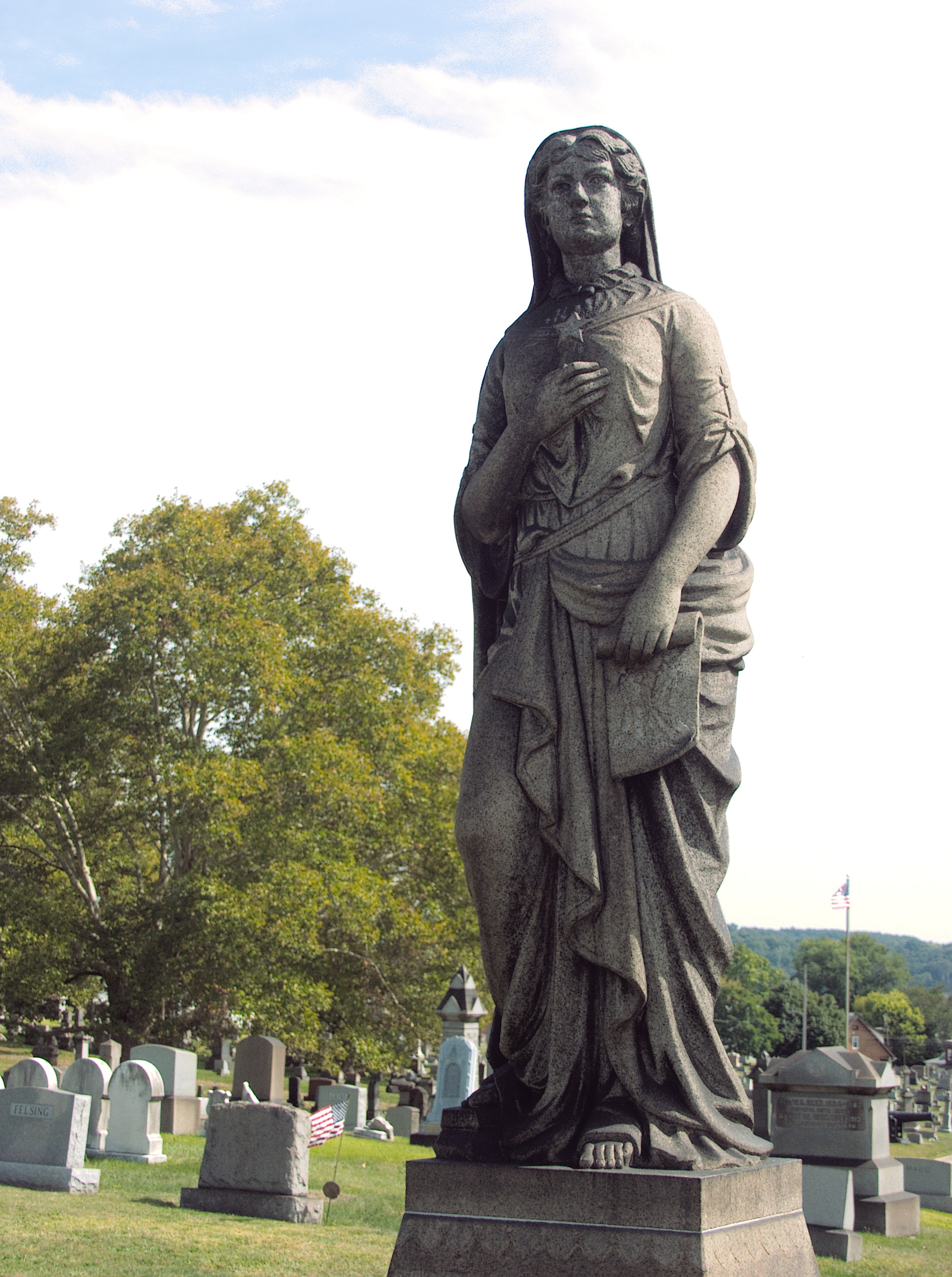
Cornelia Brackenridge McKelvy, on the other hand, who died in 1882 at the age of 29, has a very expensive grave with a life-size statue. Is it meant to be a portrait of the deceased?

A small but rich-looking mausoleum in a kind of classicized Gothic style, topped by Hope clutching her anchor. The bronze doors are particularly worth looking at. The mausoleum and statue are nearly identical to the J. P. Ober mausoleum in Allegheny Cemetery, with only very slight alterations in the details.

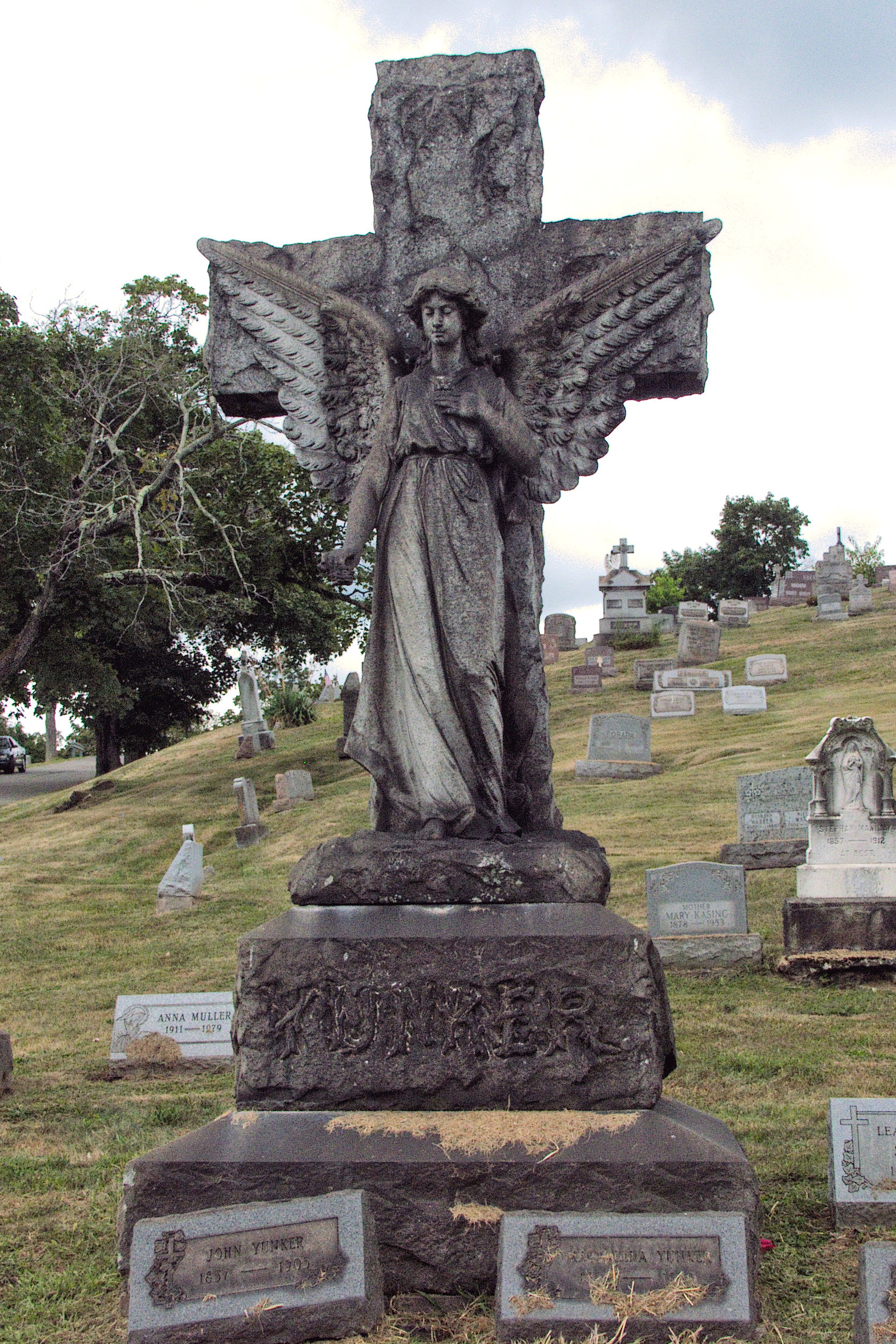
A rustic stone cross with a very good flower-dropping angel standing on a rock, and the family name spelled out in twigs on the base. It probably dates from about 1905, when John Yunker was buried here.

As Father Pitt has mentioned earlier, Ridgelawn Cemetery preserves its stone-fenced family plots, once a feature of every “rural” cemetery, more perfectly than any other cemetery in the area. Here we have a typical plot, except for its unusual shape: a main monument in the rear center is surrounded by various smaller monuments for individual members of the family, and the stone wall breaks for an entrance inscribed with the name of the patriarch of the family.

A marble recording angel whose businesslike attitude suggests to Father Pitt that she is checking boxes on a printed form. There are no inscriptions on the monument and no Bayer grave markers near it, so Father Pitt cannot date it except to say that it looks like the sort of thing that would have been put up in the beginning of the twentieth century. It is even possible that the plot was never used; we have seen examples of families that bought cemetery plots and put up monuments to themselves, and then moved elsewhere.

A certain strain of romanticism is common in monuments of the 1800s, but few go to such extremes of romanticism as this. The profusion of vine-covered vines overwhelms the composition so much that at first it is hard to make any visual sense of the thing. How many different kinds of vines can you identify? Father Pitt finds at least passionflowers, morning glories, and ivy, and the top may be roses, although the erosion makes it hard to tell. If the enormous urn-flower at the foot end came from a vine, it was a vine that wants to eat you.

If there was ever an inscription, it is illegible now; but since the monument occupies a space in the Lewis family plot, we may presume that it belongs to some Lewis or other.

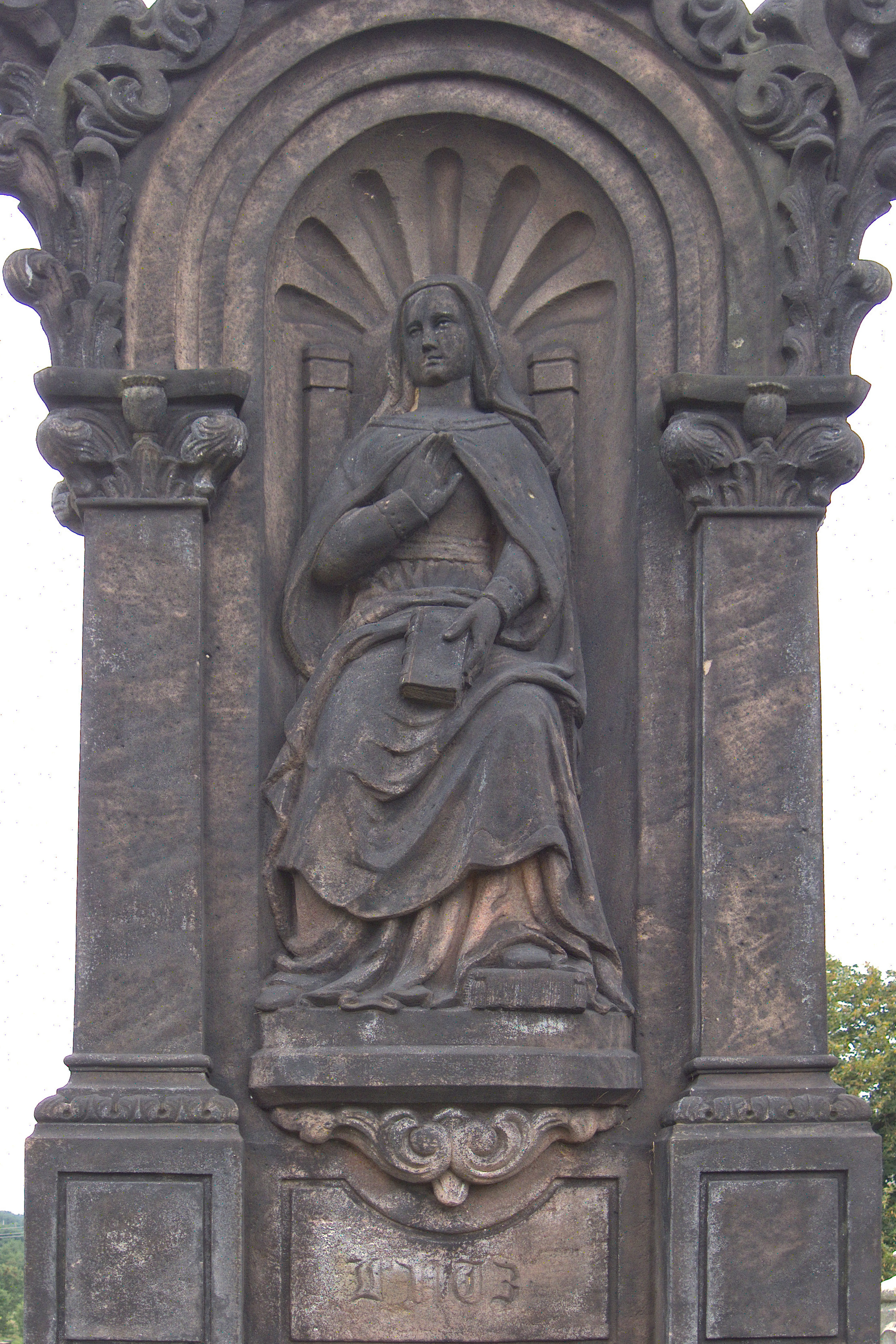
This towering monument is in a style all its own. What shall we call it? Pittsburgh German Rococo? The inscription, cut by a local stonecutter (a tradition that survived among the Germans here decades longer than it did among English-speakers) quotes from Job: in the words of the King James Version, “Seeing his days are determined, the number of his months are with thee, thou hast appointed his bounds that he cannot pass.” The German translation of the first line would be more closely rendered as “Short are the days of man,” which is a more striking sentiment that seems tailor-made for an epitaph.

The relief is a bit elementary, like something that would have been turned out by the second-best student in a community-college sculpture class. The overall composition, however, is unforgettable. The blackness of industry has only added to the impression that this monument is something colossal and important.

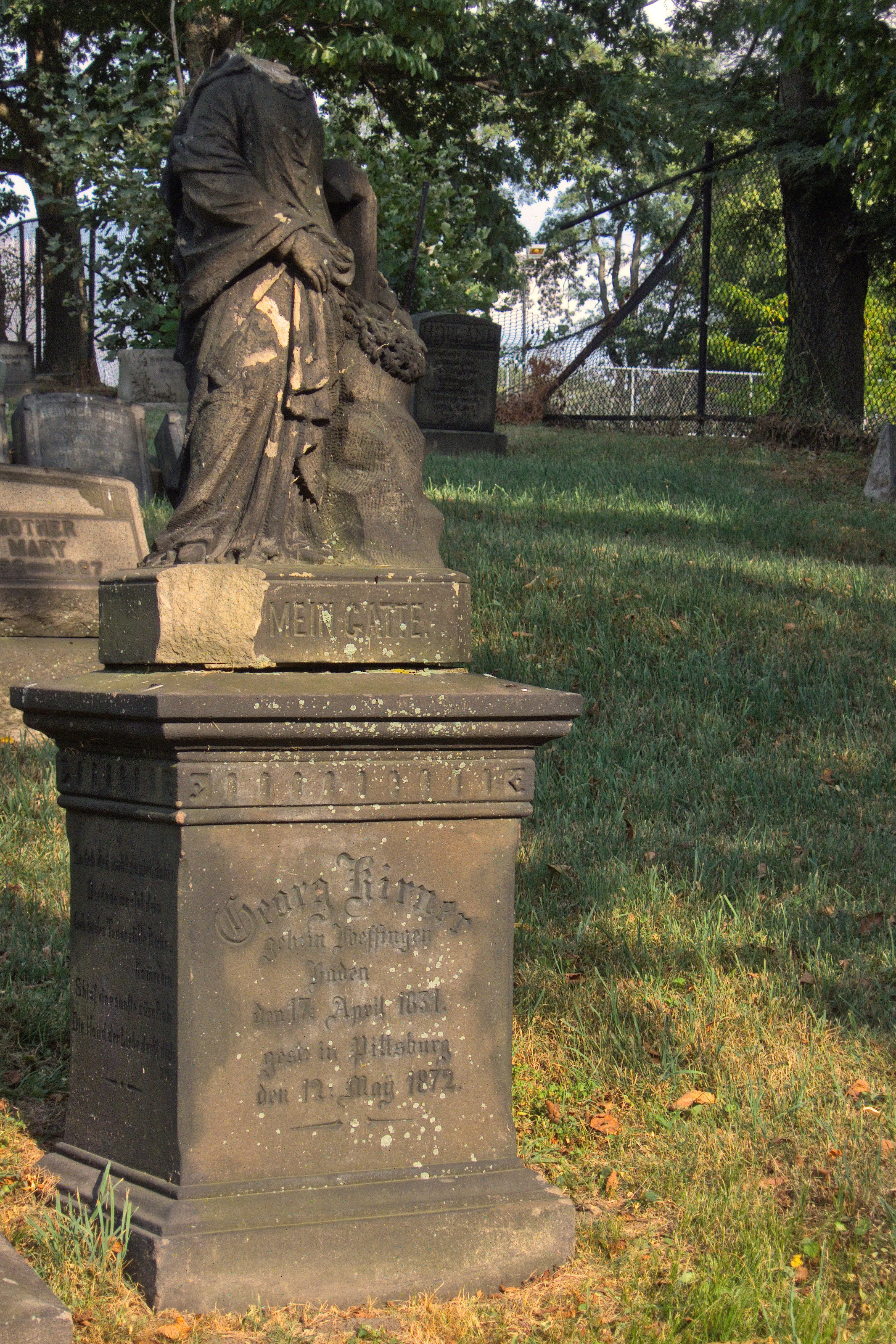
In spite of the damaged statue, this is an unusually beautiful monument, and the inscriptions are very good examples of German stonecutting in Pittsburgh.

Georg Kirner
Born Hoeffingen, Baden,
April 17, 1831.
Died in Pittsburg
May 12, 1872.

The language does not seem to be standard German (note, for example, the spelling “Maÿ” rather than “Mai”). Is it some Alemannic dialect? Perhaps someone more familiar with German can help old Pa Pitt by identifying the dialect and translating the other inscriptions:

So leb denn wohl so zieh dahin
Die Erde wartet dein
Geh in des Todes stille Ruhe-Kammerein
Shlaf eine sanfte süse Ruh’
Die Hand der Liebe deckt dich zu,

In his transcription, Father Pitt has made the assumption that a horizontal line over an N or M doubles the letter.

Jeh empfand an deiner Seite
Lebensfroh der Erde Glück
Jinner geh mir dein Geleite
Einen frohen augenblick.

The base of the statue is marked “Mein Gatte” (“My Husband).” The statue is probably ordered from a monument-dealer’s catalogue, with the simple Gothic letters already on the base. They are not nearly as elegant as the beautiful lettering by the local stonecutter.

An update: Old Pa Pitt suspects that the dialect is some form of the Alemannic spoken in Baden.