Pittsburgh Cemeteries

The Art and Architecture of Death

Smaller Graveyards

Churchyards and family burying-grounds often hold hidden treasures, especially gravestones of early settlers, placed in the days when stonecutting was a local craft.

A monument to a pastor of the Voegtly Church and his son, both killed in a railroad accident near Altoona in 1864. The polished-granite monument seems to be later than that date, and probably dates from after the time when the Voegtly Church moved its cemetery from the churchyard in Dutchtown to the top of Troy Hill.

A romantic (and diminutive, though the picture does not convey the small scale of it) tombstone for a little girl who died at not quite ten years old. The single rose and foliage are still well preserved. It is in or next to the Voegtly family plot, and the inscription is in German; but the name Adams is not very German at all. Perhaps this was a granddaughter of Mathias Voegtly; he might have had a daughter who married outside the Swiss-German community.

Father Pitt has not sorted out the whole history of the Voegtly Cemetery. The style of the tombstone is right for 1864, and it may have been moved from the original churchyard in Dutchtown when the cemetery on Troy Hill was established. Not every grave was moved; in fact, more than seven hundred were left to be discovered under a city parking lot. If this was moved, it suggests that the little girl came from a family with money (like the Voegtly family).

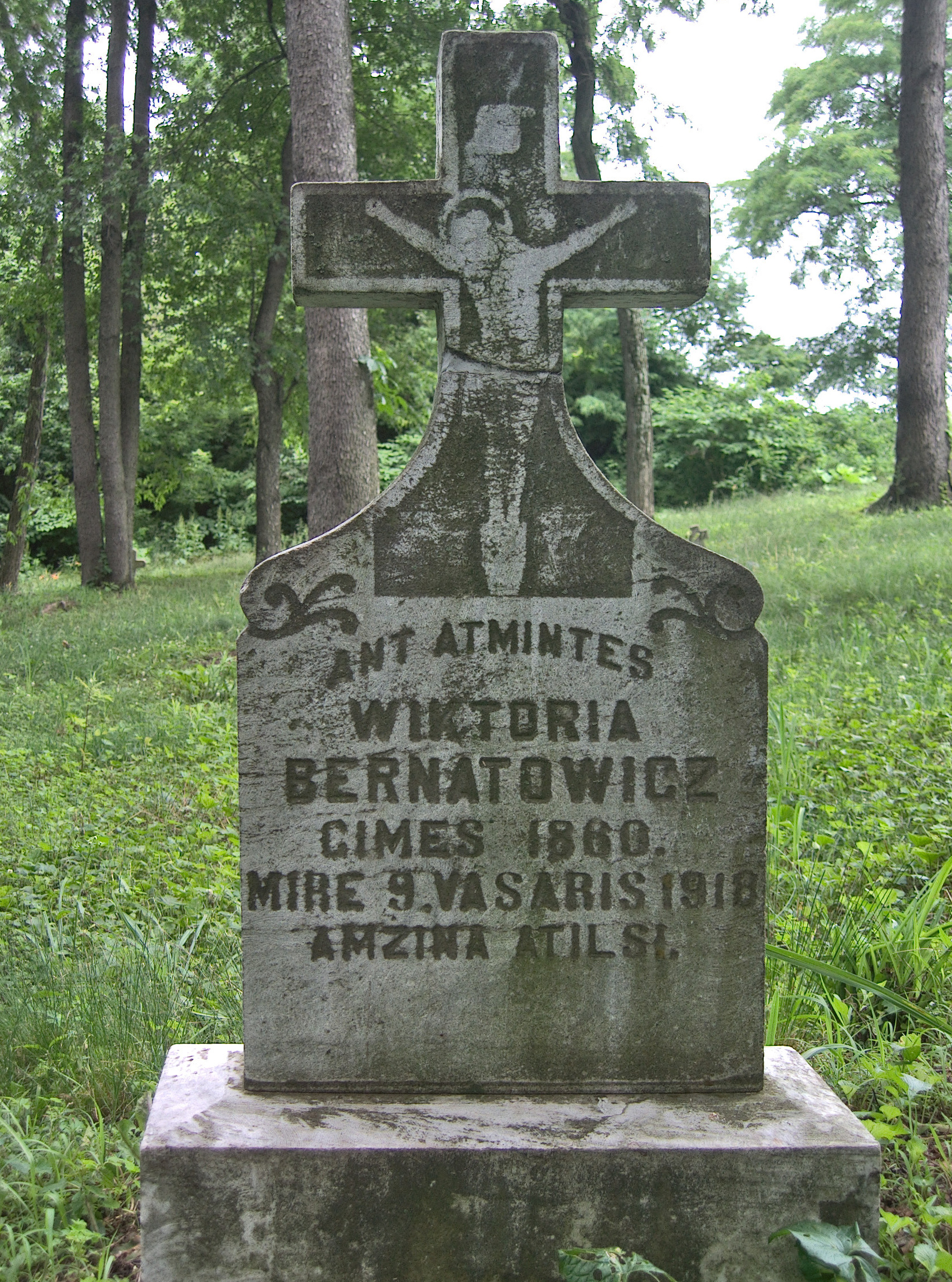
A Lithuanian tombstone in a good state of preservation. European immigrants tended to bring with them their memories of what a gravestone should look like, so we find very different styles in different ethnic groups. This is a common East European style. The East European tombstones here were often decorated in very shallow relief, much of which has vanished in a century or so of erosion; but this crucifix is still visible in outline, though the details are lost.

With the help of Google Translate, here is the inscription:

IN MEMORY OF
WIKTORIA BERNATOWICZ
BORN 1860
DIED FEBRUARY 9, 1918
ETERNAL REST

Three different burials in the same family plot show us three different styles of early-settler tombstones.

Jacob Bell lived the longest of the three: he was buried in 1842. Shortly after that, local stonecutters would begin to be replaced by more centralized businesses, so this is one of the last of what Father Pitt would call the early-settler tombstones. It does not seem as elegantly cut or proportioned as the earlier tombstones, which makes us wonder whether the stonecutter’s craft was already fading. The inscription reads:

SACRED to the MEMORY OF JACOB BELL, Who departed this life, Nov. 18th 1842 in the 75th year of his age.

Elizabeth Bell, Jacob’s “consort” (the stonecutters’ preferred term for “wife”), died in 1829, and her tombstone is typical of the time. It is not as elaborately cut as some other 1820s tombstones, but compare it to Jacob’s and see how much better formed the individual letters are, and how much more carefully laid out the lines are in the inscription.

IN Memory of ELIZABETH BELL, Consort of JACOB BELL Who departed this life January 13th A.D. 1829 in the 58th year of her age.

Finally, Charity Bell, who was probably a daughter of Jacob and Elizabeth, died in 1832, and was given a tombstone of the Gothic shape popular in the 1830s. The lettering is done very well (non-standard spelling of the month notwithstanding), and the stonecutter has added the tree ornament—probably intended as a weeping willow—that we commonly see on early-settler tombstones.

IN MEMORY OF CHARITY BELL Who departed this life Aprile the 6th A.D. 1832 in the 35 year of her age

This triple tombstone, the only one of its kind from its era that Father Pitt has ever seen, remembers three Allison children who all died in January of 1836. The cause of death is not stated, but it must have been some childhood disease that carried them off one after another. Scarlet fever is a likely candidate.

“Pastor Russell,” as his followers called him, founded the Watch Tower Bible and Tract Society and the International Bible Students Association, the organization that—after various schisms and defections—came to be known as Jehovah’s Witnesses. He was born in Allegheny (now the North Side), and when he died he was buried in what is now (after a number of changes of ownership) the Rosemont, Mt. Hope, & Evergreen United Cemeteries in Ross Township.

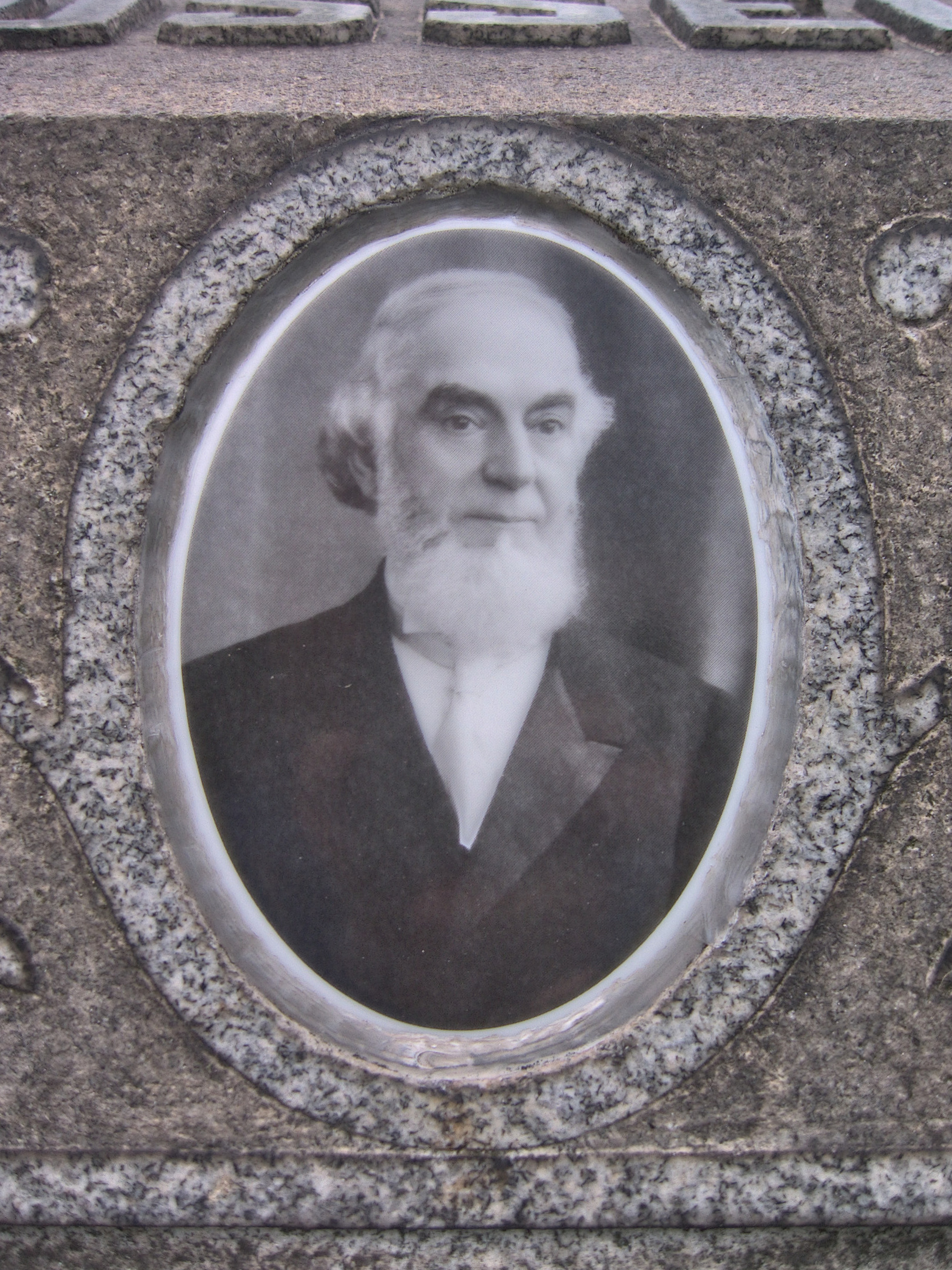
His fairly modest grave monument includes a photograph of Pastor Russell, lovingly preserved (and perhaps replaced more than once over the years).

Note the inscription identifying Pastor Russell as the Laodicean Messenger, or “the angel of the church of the Laodiceans,” as the King James Bible translates it (Revelation 3:14). Russell’s followers believed that he himself was that messenger.

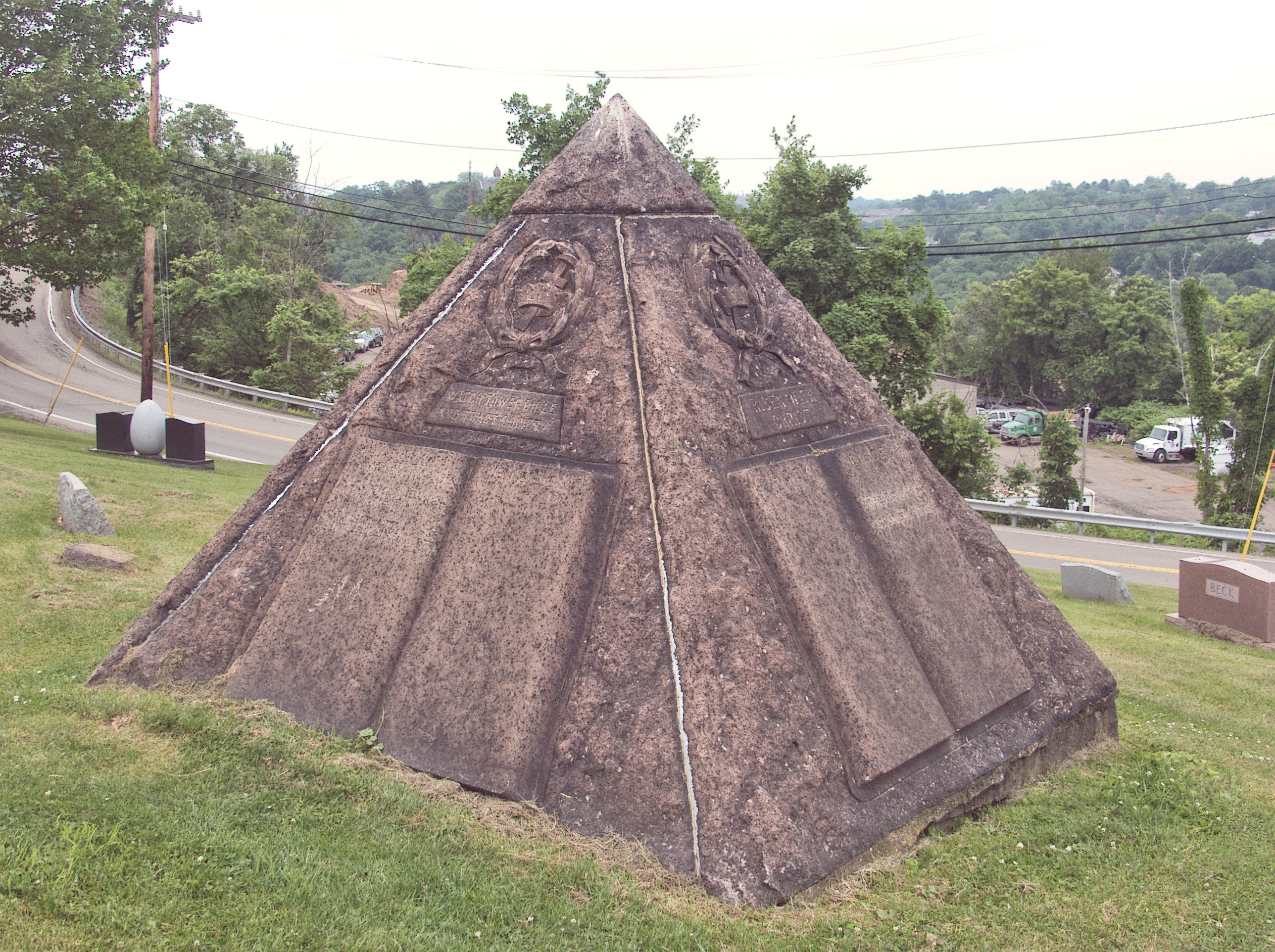
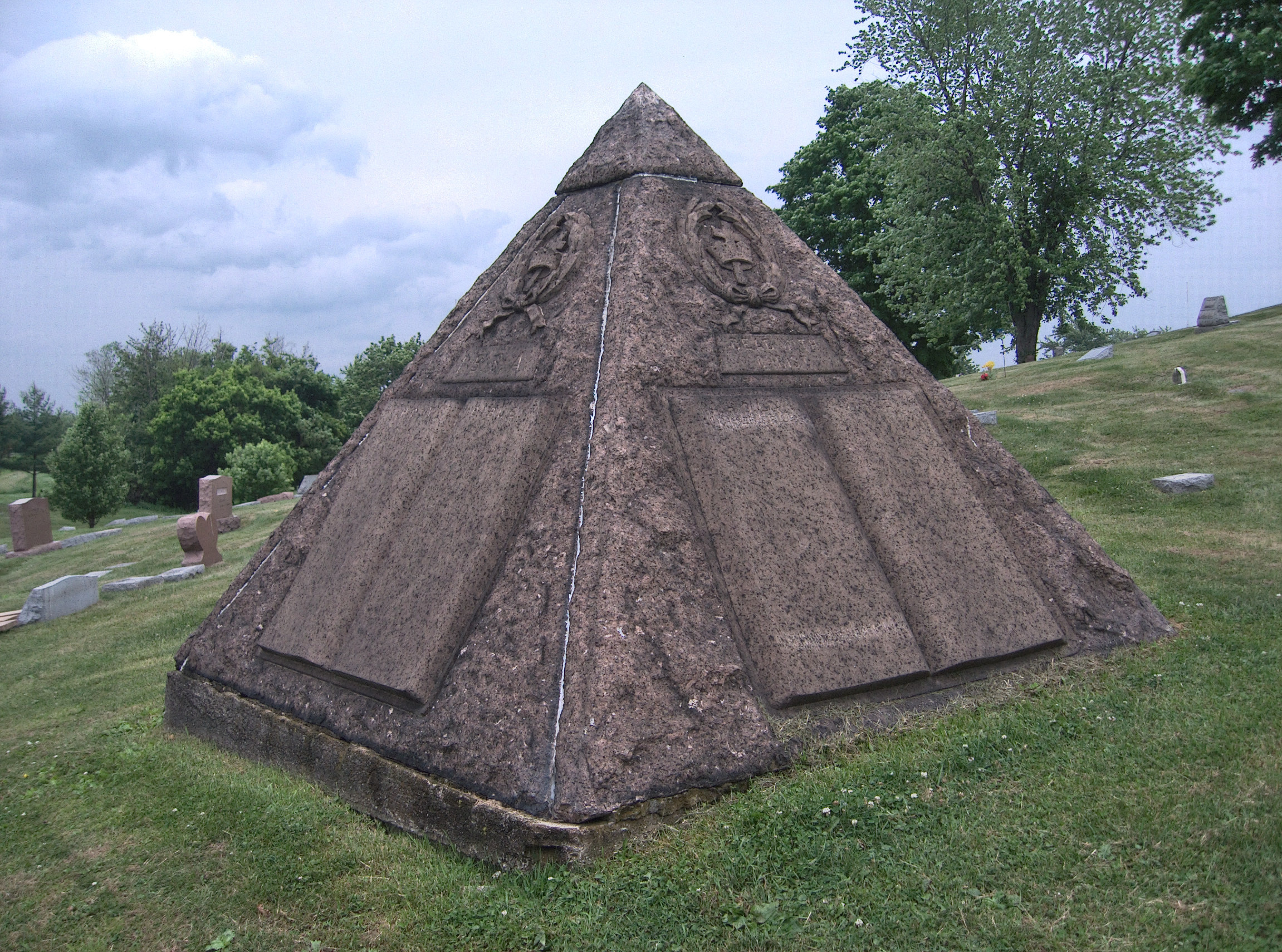
Russell died in 1916. In 1921, some of his followers erected a showier monument in the form of a pyramid. One of Russell’s odd beliefs was that the Great Pyramid in Egypt was designed by God himself as a prophecy in stone. Like most such prophecies, it was meant to be uninterpretable until the correct clever interpreter came along—in this case, Pastor Russell.

This is actually one of the few cemetery pyramids in the Pittsburgh area whose proportions are Egyptian rather than classical Roman. It is meant to have the same proportions as the Great Pyramid, and in particular the capstone is carefully proportioned to match the Great Pyramid’s capstone, which in Pastor Russell’s interpretation represents the Christ.

The pyramid was meant as a marker not only for Russell, but for a number of other members of the Watch Tower Bible and Tract Society, who owned this plot in the cemetery. A few names are inscribed in the open Bibles on the four sides of the pyramid, but most of the blank space was never used. It seems that the separate ownership of this plot has been preserved through the various changes of ownership the rest of the cemetery has gone through.