Pittsburgh Cemeteries

The Art and Architecture of Death

A priceless piece of folk art, this memorial to two children who died in the late 1800s was carefully carved by a barely literate family member or friend who makes the letter N backwards. The carver could not carve delicately enough to spell out the names, so we get only initials, which doubtless were enough for the family as long as memory endured.

Old Pa Pitt calls this “priceless” not necessarily because of the skill involved—it is not an especially skillful work—but because it documents how ordinary people of the late 1800s imagined a tombstone should look. It is clearly an imitation of the tombstones of fifty years or more before, complete with a little tree laboriously scratched into the stone for each of the two deceased.

Father Pitt is having a little trouble working out the dates. The obvious way of reading the stone is to divide it in left and right halves:

C. H.
BORN AUGUST
26 • DIED
OCT • 6
1881

W. H.
BORN
FEB • 19
DIED•FEB
1
1891

You can see the difficulty: this reading has W. H. dying before he was born. Perhaps the stonecutter has recorded only the birthdays and omitted the years of birth, in which case we do not know for certain even that these were children.

The picture was taken when the stone was strongly backlit. Father Pitt has boosted the local contrast and used various other manipulations to make the inscription more legible.

You might have trouble finding this stone if you went looking for it. It is well into the overgrown woods section of the Mount Pisgah Cemetery, and Father Pitt actually used his foot to hold back a hickory seedling in order to get an unobstructed picture.

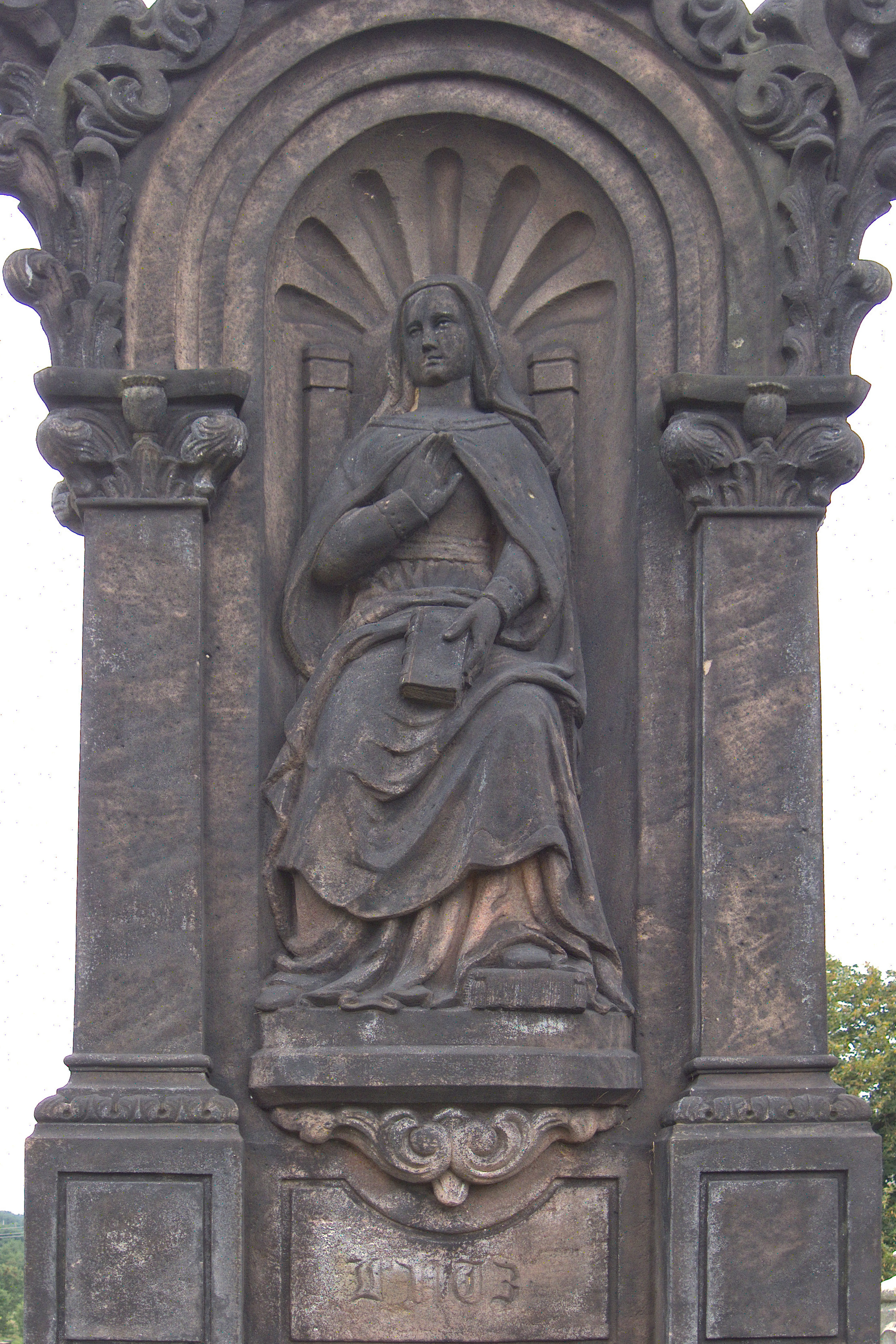
This towering monument is in a style all its own. What shall we call it? Pittsburgh German Rococo? The inscription, cut by a local stonecutter (a tradition that survived among the Germans here decades longer than it did among English-speakers) quotes from Job: in the words of the King James Version, “Seeing his days are determined, the number of his months are with thee, thou hast appointed his bounds that he cannot pass.” The German translation of the first line would be more closely rendered as “Short are the days of man,” which is a more striking sentiment that seems tailor-made for an epitaph.

The relief is a bit elementary, like something that would have been turned out by the second-best student in a community-college sculpture class. The overall composition, however, is unforgettable. The blackness of industry has only added to the impression that this monument is something colossal and important.

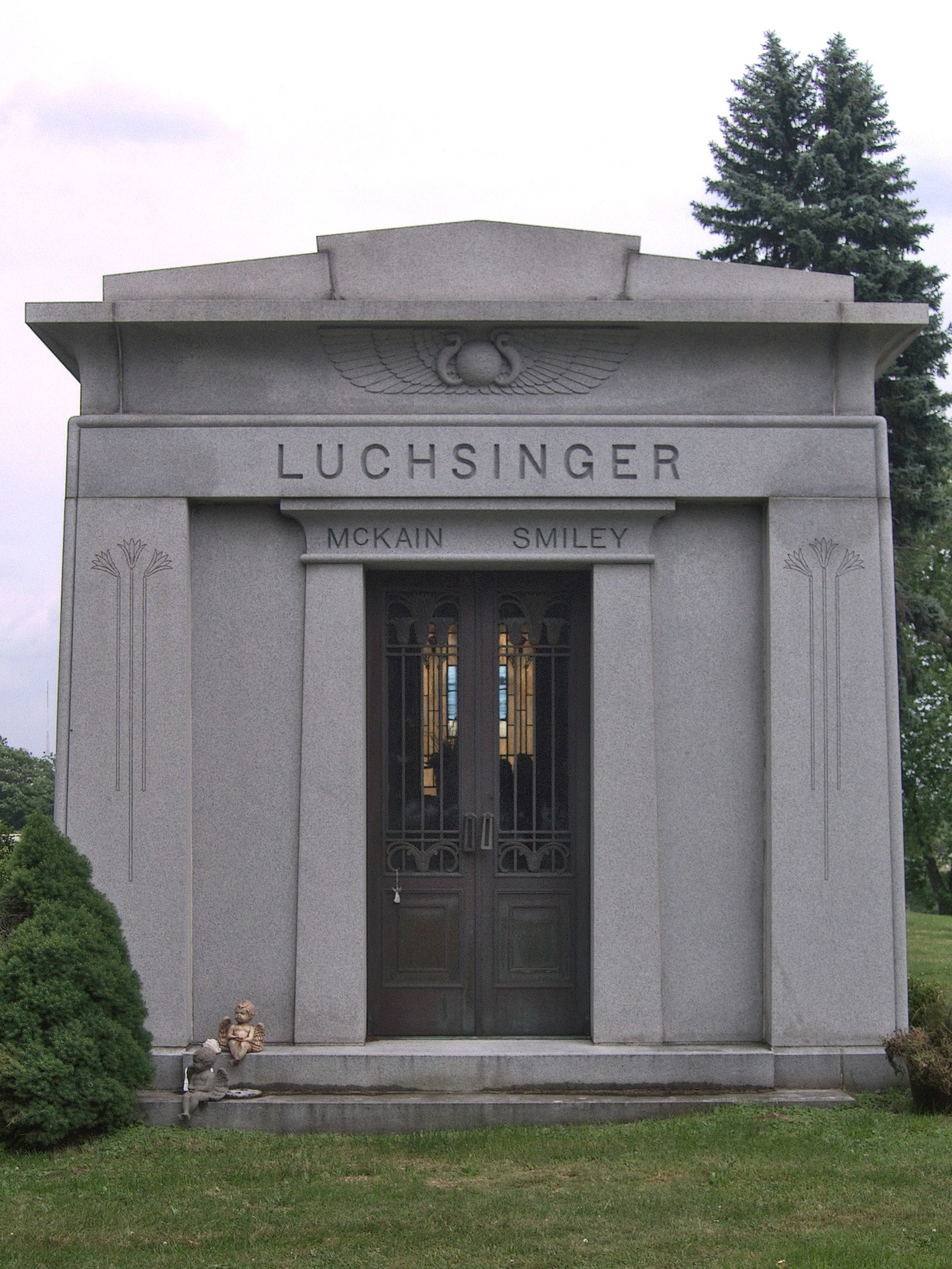
A smallish but still thoroughly Egyptian mausoleum; Father Pitt guesses it is fairly late in the era of the second Egyptian Revival. Inside is a simple but effective stained-glass view of a pyramid.

These two stones are immense, the largest vertical stones of their era that Father Pitt has seen. Indeed, he wonders whether they were originally meant to lie flat, and later set up like this. —Addendum: Comparing these to other “ledger” stones of the same era, old Pa Pitt is almost completely convinced that these were ledger stones, meant to lie flat. Compare, for example, the Moses Coulter stone, and note the almost identical beveling. These have been much better preserved by raising them perpendicular to the ground.

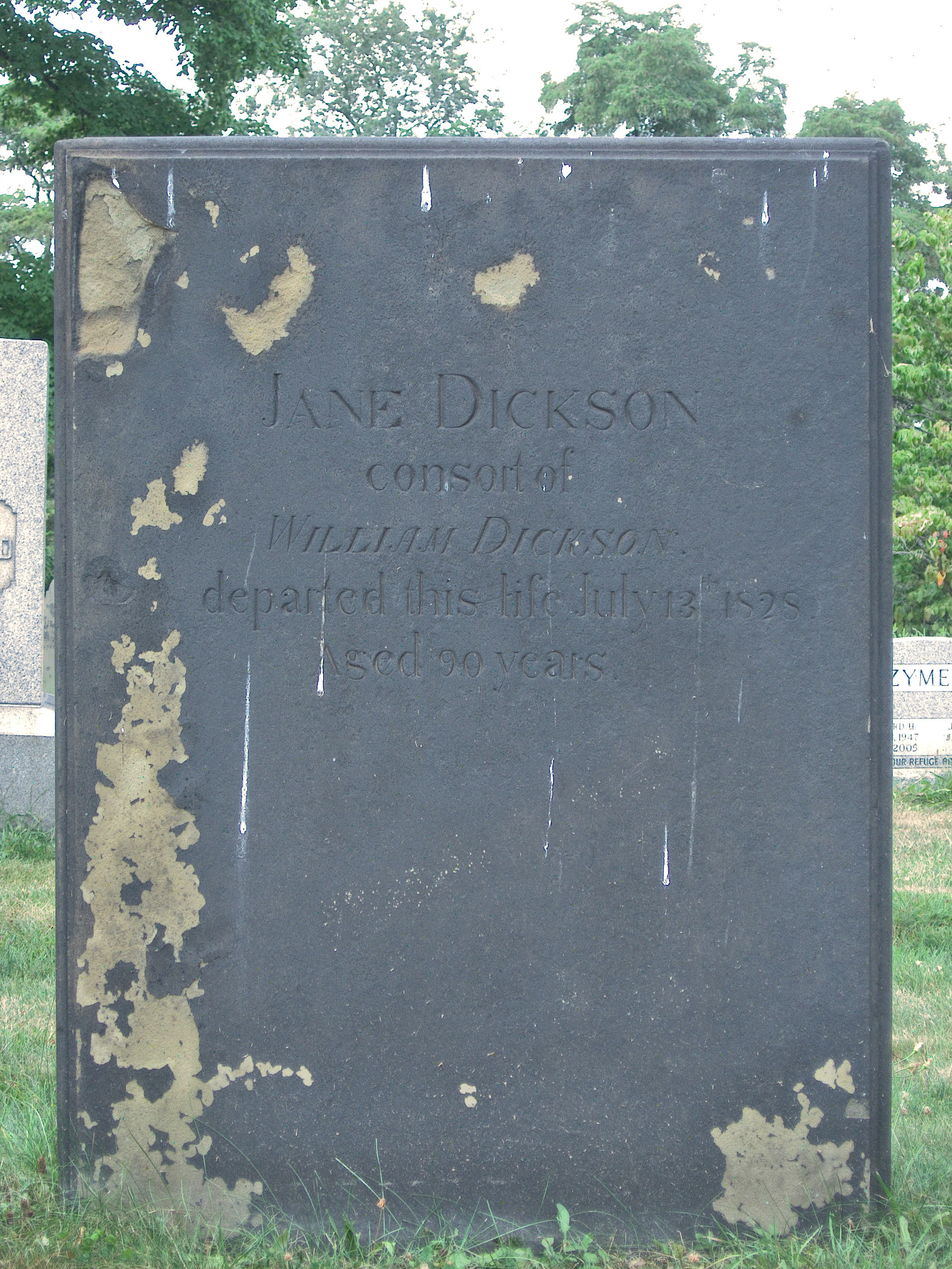
JANE DICKSON
consort of
WILLIAM DICKSON
departed this life July 13th 1828
Aged 90 years

Jane Dickson, “consort” of William Dickson, lived to the fine old age of ninety. She thus outlived her husband by three years, but only because she was eight years younger.

In
memory
of
WILLIAM DICKSON
who departed this life
october 31st 1825
Aged 101 years

As you can see, outliving William Dickson was a considerable feat for anybody, and Jane is to be commended for an outstanding effort.

Father Pitt is inclined to attribute both these stones to our friend the Master of the Erratic Centering. He is sure about William’s stone: note the avoidance of capitalization (“october”), the spelling of the deceased’s name in large and small capitals, and the trademark erratic centering. Old Pa Pitt is only slightly less sure about Jane’s: the letters are in the same style, and though the work looks very slightly neater, we are inclined to attribute that to the stonecutter’s being slightly more experienced or slightly less drunk.

REBECCA RITCHEY
departed this life,
December 27, 1838.
Aged 42 years 11 months
& 4 days.

Here is a work by a stonecutter whom we shall call the Master of the Italic Months, from one of the most distinctive features of his style. He also writes the name of the deceased in all capitals (not small capitals), and he places a comma after the words “departed this life.” He adds an ornamental dash below the inscription. His lettering is not nearly as neat as that of the Master of the Erratic Centering, who also cut many stones in the Hiland Cemetery; but, on the other hand, his centering is a bit better.

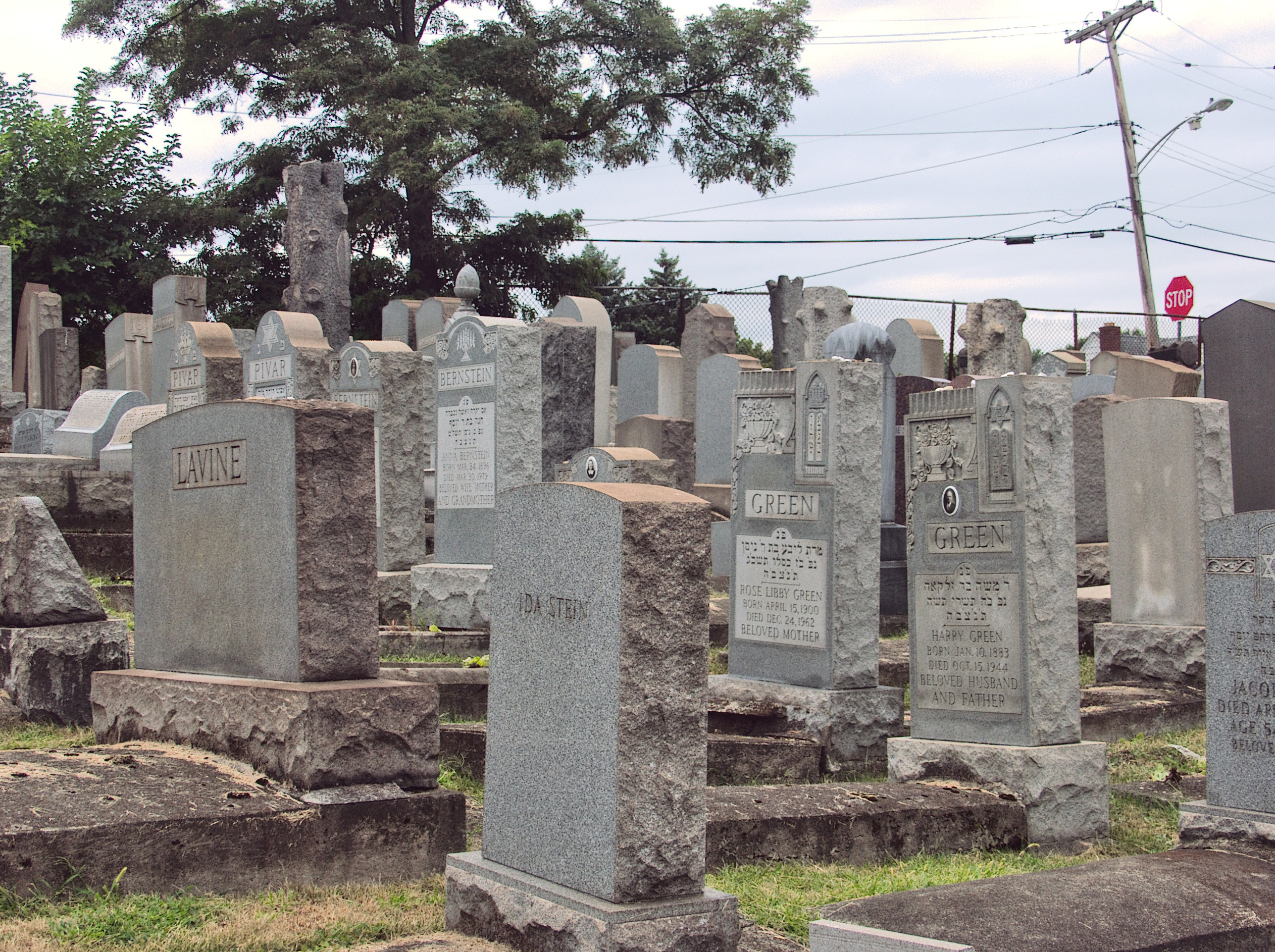
This is what a typical Jewish cemetery looks like in Pittsburgh: straight rows of graves with foot-wide alleys between, each grave given just enough space for the coffin and no more. They look like crowded urban neighborhoods, and they are designed to make the most use of the least space.

For some reason, a large number of Jewish congregations in the city bought land for cemeteries in Reserve and Ross Townships north of the Allegheny. Many of them are not marked on maps, but a satellite view will reveal the distinctive tight rows of graves.

Because of frequent vandalism, many Jewish cemeteries are gated and locked, with “NO TRESPASSING” signs on the gates—a sorry reminder that, even today, it is not always easy being Jewish. This cemetery, however, was open (Father Pitt would never walk past a “NO TRESPASSING” sign without permission of the owners).

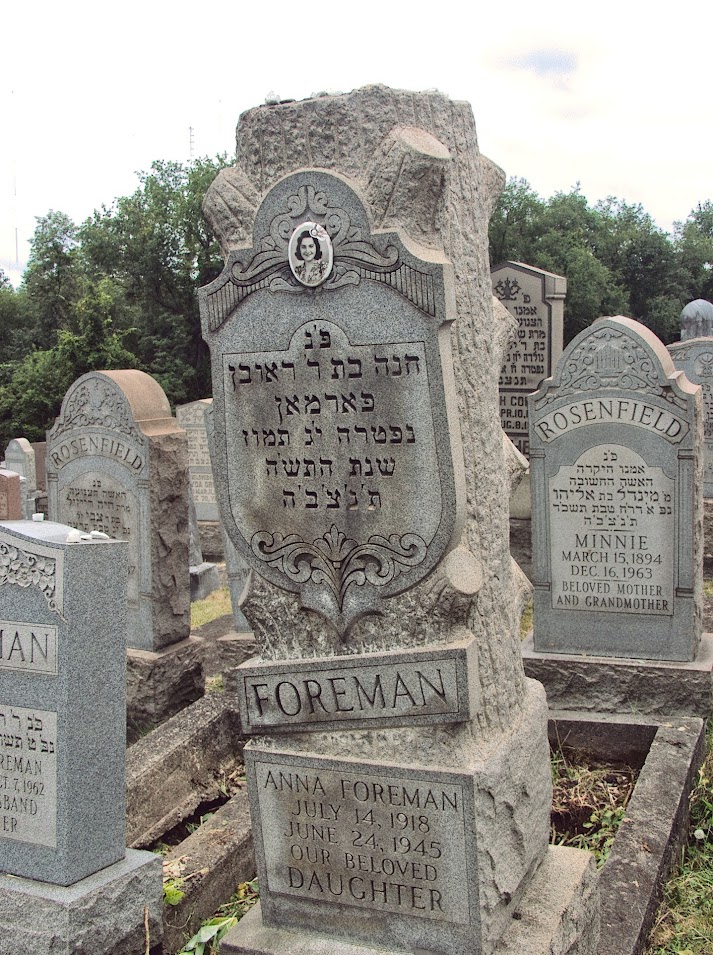
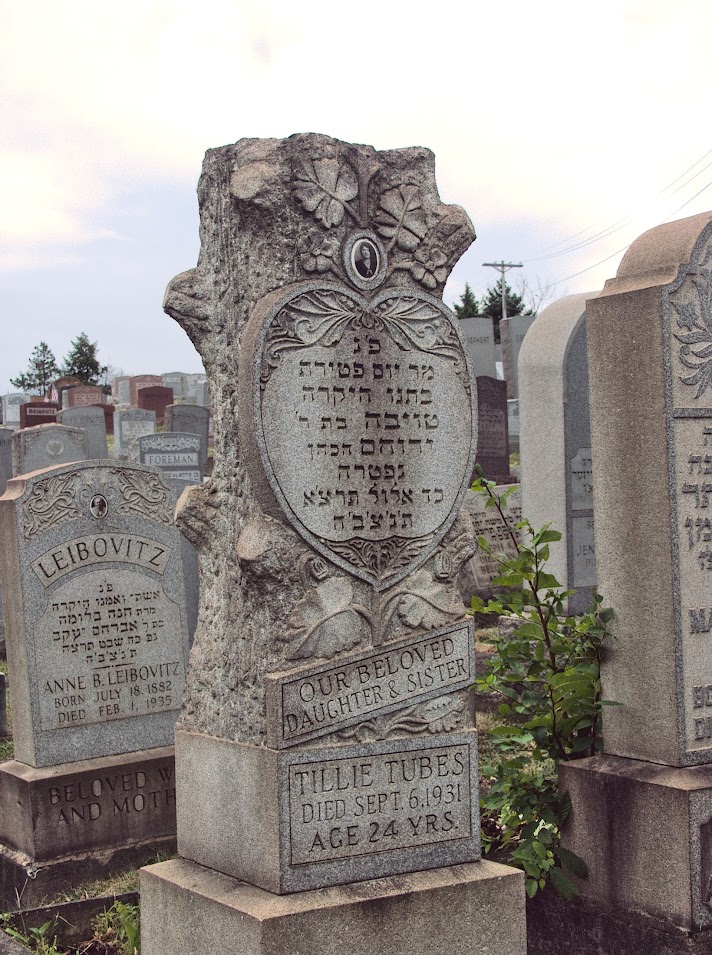
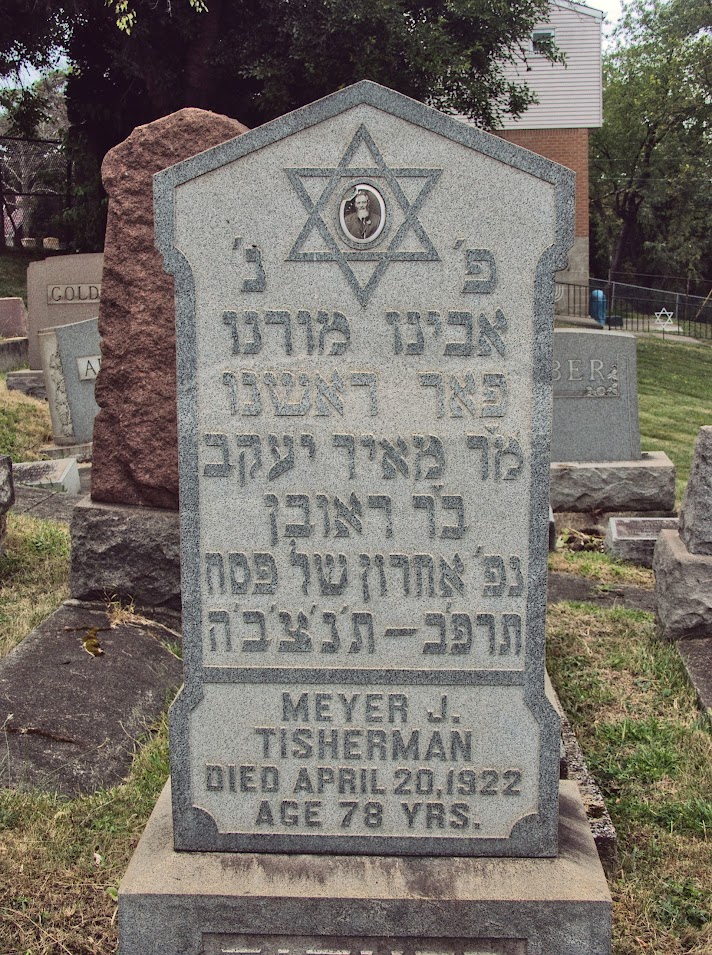
This cemetery is notable for the large number of stones with embedded photographs, and for a good number of rustic stumps crowded in with the rest of the monuments.

Ridgelawn Cemetery in Reserve Township began in 1888 as St. Peter’s Lutheran Cemetery. The oldest section is in the far back, and here it reveals its distinctive feature, one that definitely makes it worth a visit: it preserves the style of the old rural cemeteries, with stone-fenced family plots carefully maintained. Even the Allegheny Cemetery, our most famous cemetery of the “rural” movement, has got rid of most of the stone walls, and those that remain are often broken down or half missing. Groundskeepers hate them, after all, and it is much easier to keep the cemetery looking neat if the walls go away.

So we generally see these old family plots in small half-overgrown cemeteries where no one has cared enough to remove the walls. But here the walls are not only preserved, but scrupulously maintained. Paradoxically, Ridgelawn Cemetery may give us a better idea of what the Allegheny Cemetery looked like a century ago than the Allegheny Cemetery itself does.

The Volz plot is typical. It is surrounded by a low stone wall; it has an entrance with the family name on the threshold; and it has a large family monument toward the rear surrounded by individual graves.

In
memory
of
NANCY OWENS
who departed this life
july 31st 1824,
aegd 19 years

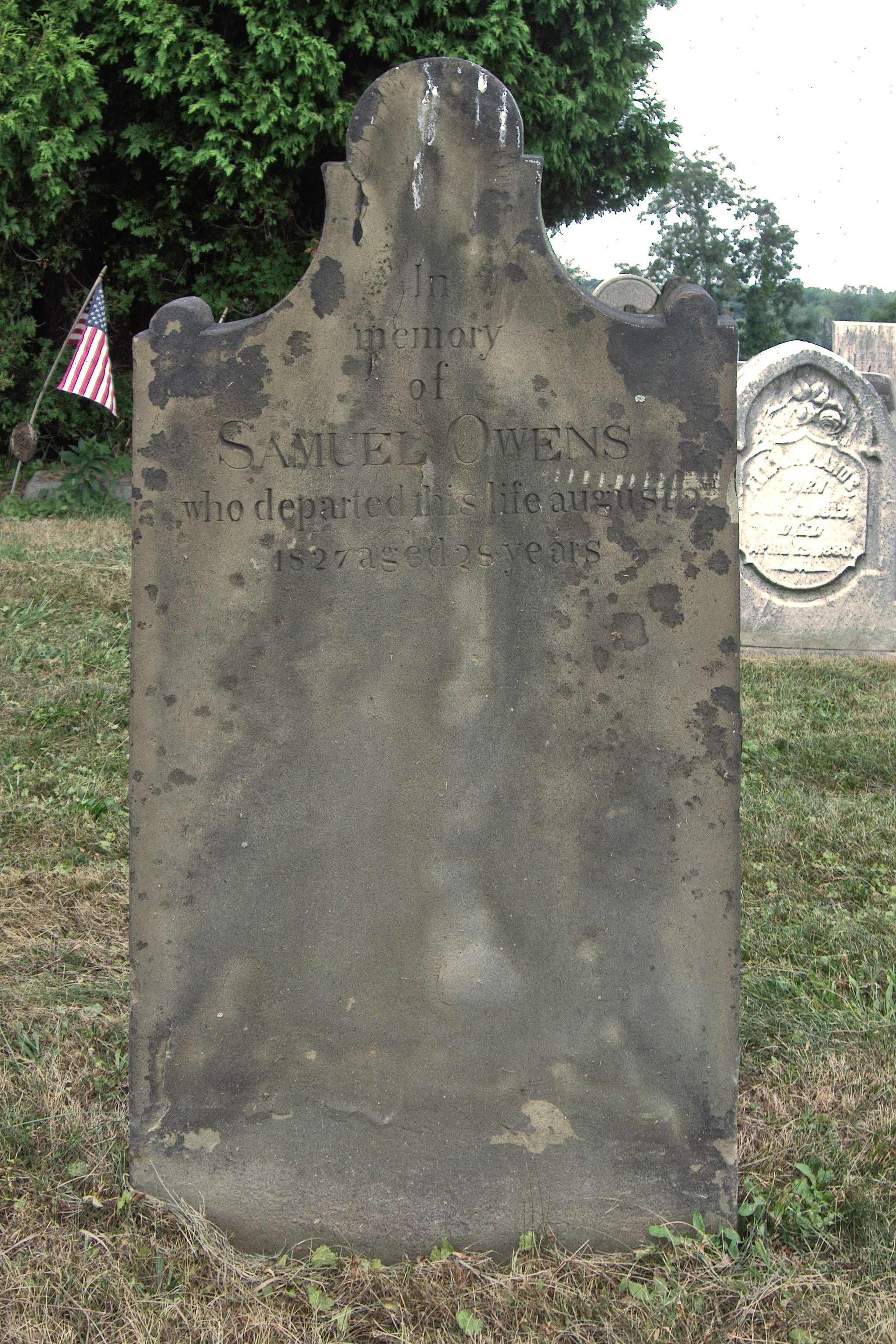
Two more works of the stonecutter we identify as the Master of the Erratic Centering, whose erratic centering and aversion to capitalization are both on display here. Both Nancy and Samuel died as young adults. Were they a young married couple, or were they brother and sister?

In
memory
of
SAMUEL OWENS
who departed this life august 2nd
1827 aged 28 years

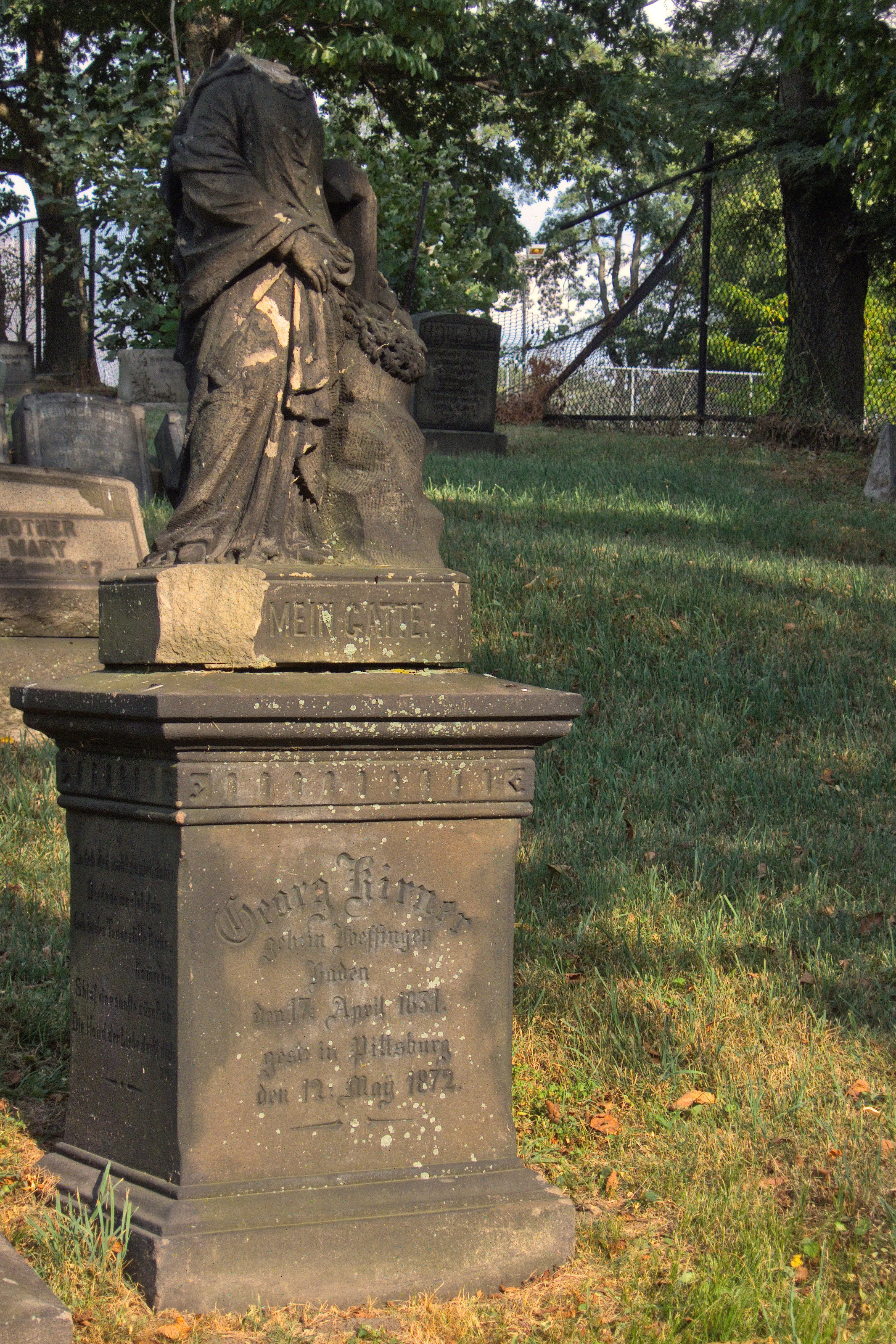
In spite of the damaged statue, this is an unusually beautiful monument, and the inscriptions are very good examples of German stonecutting in Pittsburgh.

Georg Kirner
Born Hoeffingen, Baden,
April 17, 1831.
Died in Pittsburg
May 12, 1872.

The language does not seem to be standard German (note, for example, the spelling “Maÿ” rather than “Mai”). Is it some Alemannic dialect? Perhaps someone more familiar with German can help old Pa Pitt by identifying the dialect and translating the other inscriptions:

So leb denn wohl so zieh dahin
Die Erde wartet dein
Geh in des Todes stille Ruhe-Kammerein
Shlaf eine sanfte süse Ruh’
Die Hand der Liebe deckt dich zu,

In his transcription, Father Pitt has made the assumption that a horizontal line over an N or M doubles the letter.

Jeh empfand an deiner Seite
Lebensfroh der Erde Glück
Jinner geh mir dein Geleite
Einen frohen augenblick.

The base of the statue is marked “Mein Gatte” (“My Husband).” The statue is probably ordered from a monument-dealer’s catalogue, with the simple Gothic letters already on the base. They are not nearly as elegant as the beautiful lettering by the local stonecutter.

An update: Old Pa Pitt suspects that the dialect is some form of the Alemannic spoken in Baden.

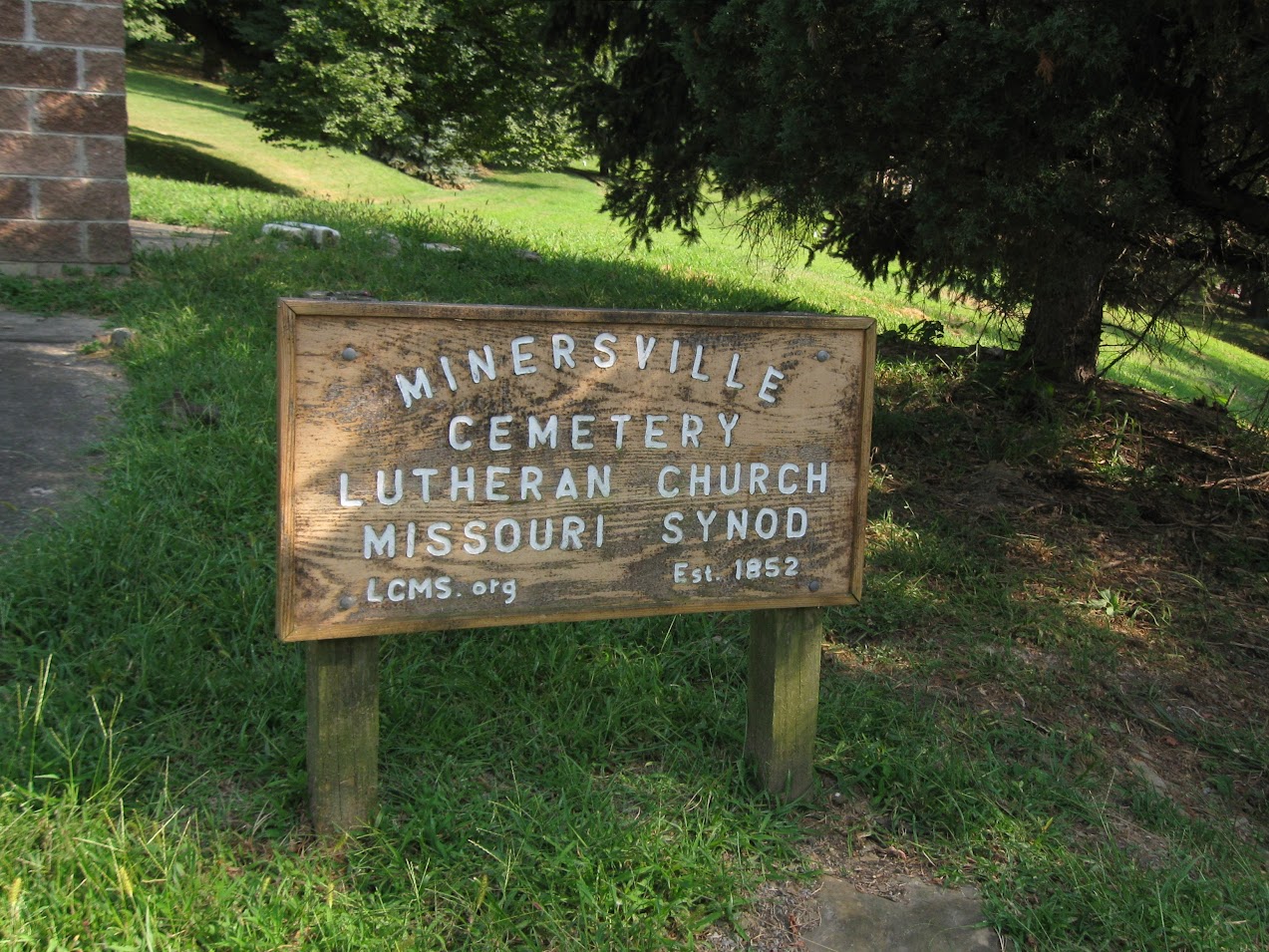
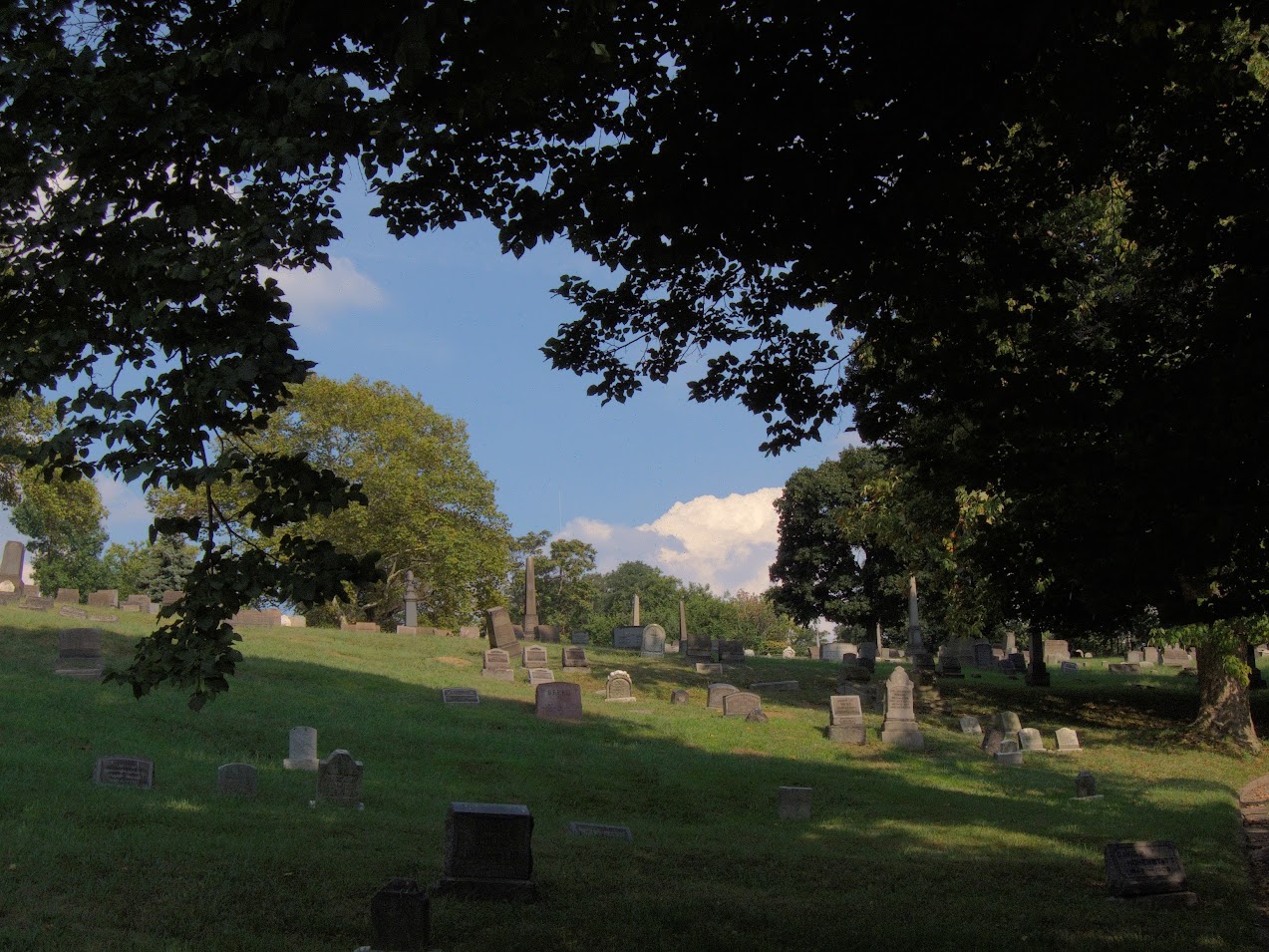
For literally decades it has been a small local scandal: the once-beautiful Minersville Cemetery, a German Lutheran burying ground in the Hill District, was overgrown with weeds and vandalized, and no one would step forward to take care of it.

Now, at last, a group of Lutheran volunteers has taken on the cemetery. With the help of a bit of money from the cemetery’s upkeep fund and some more from Pittsburgh Area Lutheran Ministries, they have cleared the weeds, righted as many of the monuments as possible, and built a fine new iron gate to keep contractors with pickups from driving in to dump their garbage. (Pedestrians without garbage are still welcome.) The cemetery is beautiful again, an oasis of quiet repose in the middle of Herron Hill.

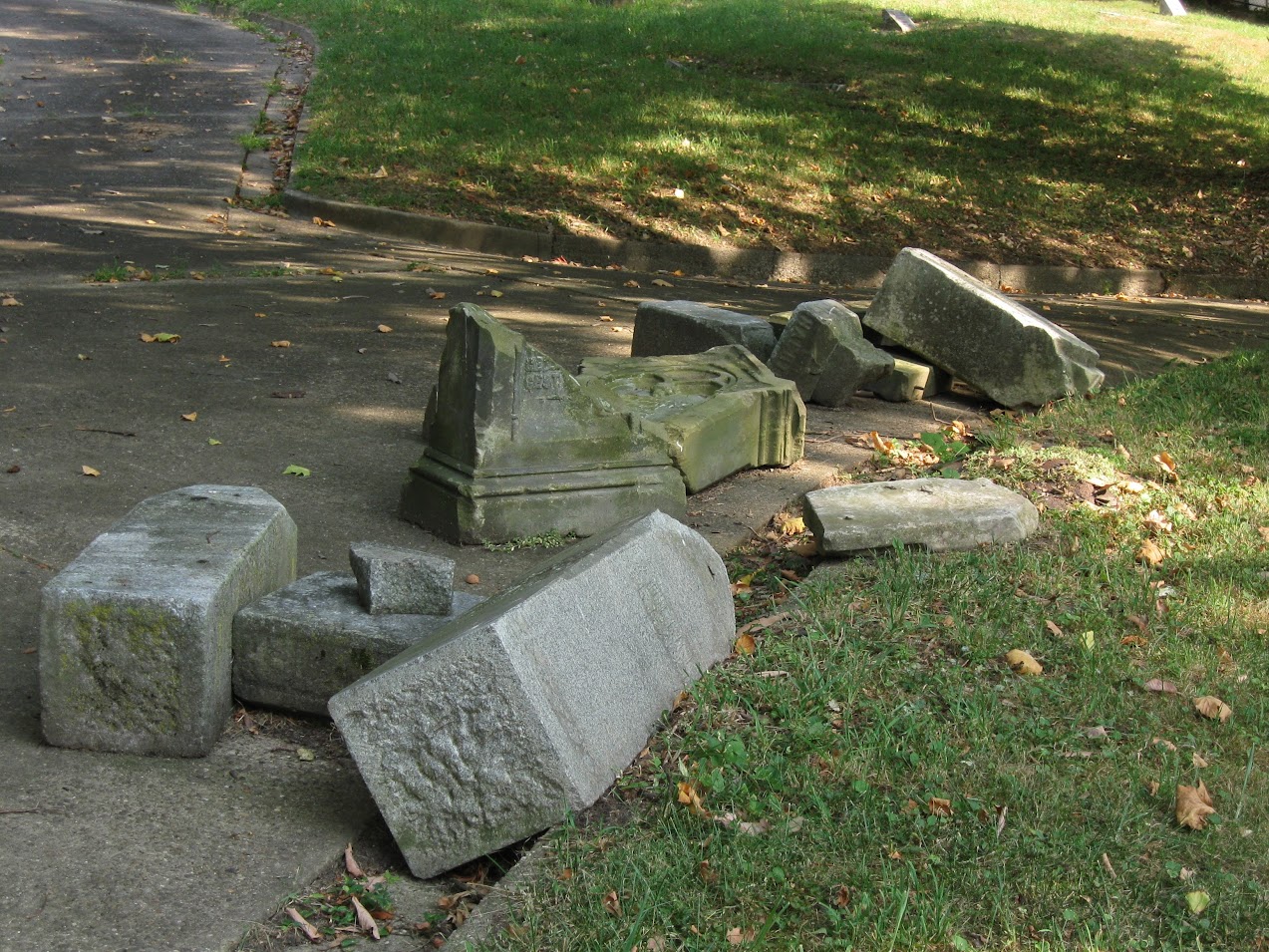
Some work still to be done: toppled and broken monuments gathered on one of the cemetery drives.