Pittsburgh Cemeteries

The Art and Architecture of Death

An 1829 tombstone typical of the Hiland Cemetery. We can identify this particular stonecutter by two very distinctive traits: his erratic centering and his avoidance of capital letters and punctuation. We shall call him the Master of the Erratic Centering.

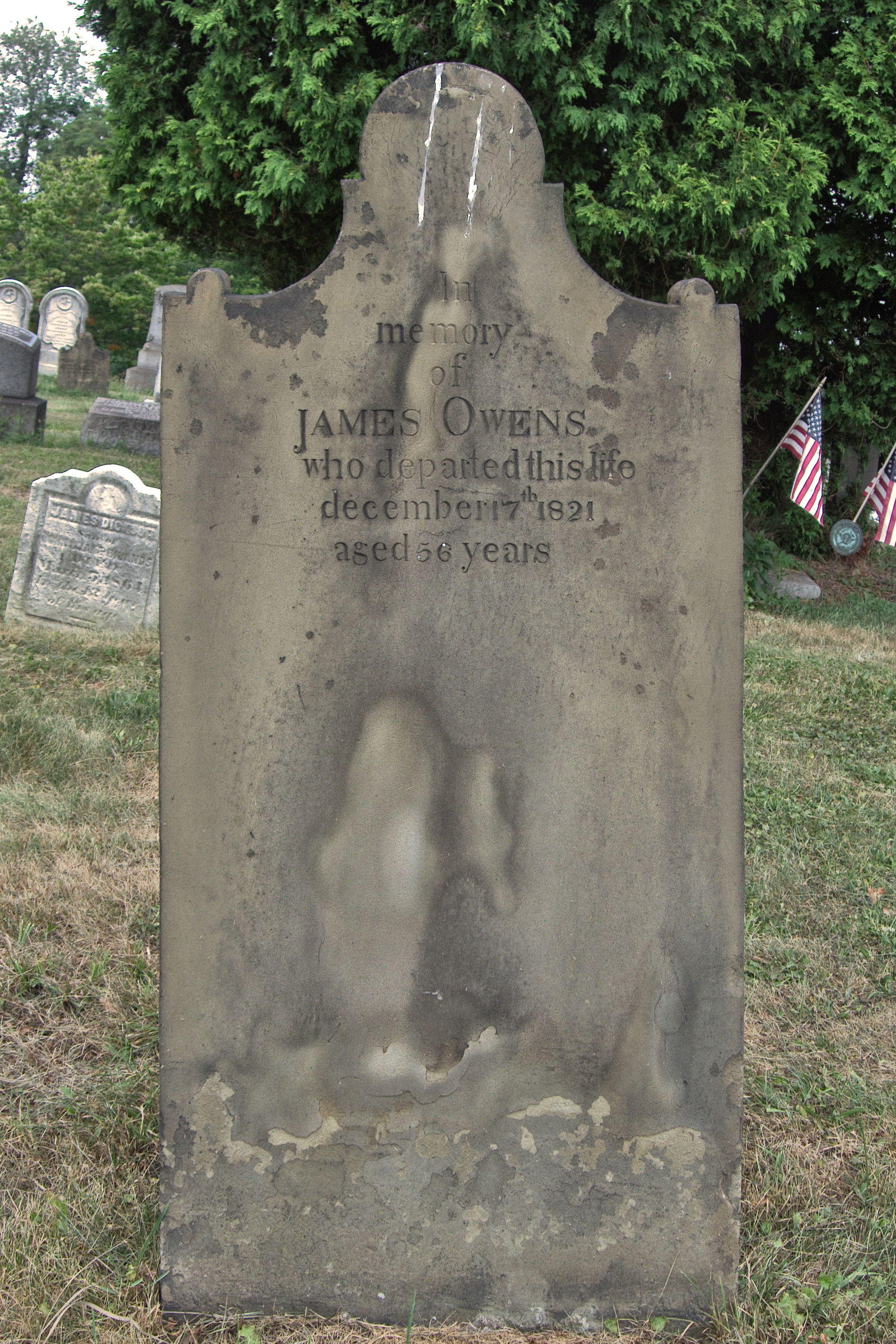
An 1821 tombstone that appears to be another work of the Master of the Erratic Centering, whom we identify by his erratic centering and his aversion to capitalization—note, for example, the spelling “december.”

In
memory
of
JAMES OWENS
who departed this life
december 17th 1821
aged 56 years

Greentree Cemetery is a German cemetery on Greentree Road in Green Tree. (After a century of indecision, the borough seems finally to have decided to spell its name as two words—which is wrong, since the name is universally pronounced as one word. But Father Pitt digresses.)

Here are three tombstones in a row remembering three sons of Sebastian and Maria Hotz. Louis August’s stone in the center has a small alcove that shelters a sleeping child, now quite eroded and almost unrecognizable. The dates are hard to read, and Father Pitt is not sure that he believes the dates these volunteer transcribers found in cemetery records. Georg Philipp’s stone is the most legible; he seems to have died in 1876 at the age of seven. Louis August’s is nearly hopeless. Heinrich was born in 1867 and died either in 1867 or—as the records apparently say—1887. That would make him a young adult, but everything about this triple tombstone suggests three children. Might the handwritten cemetery records have said 1867, and a later transcriber misread the date?

Note, incidentally, that the triple tombstone appears to be one monument all set up at the same time. It is possible that the three stones were bought separately and later arranged in a row, but the whole looks too much like a carefully arranged composition to Father Pitt.

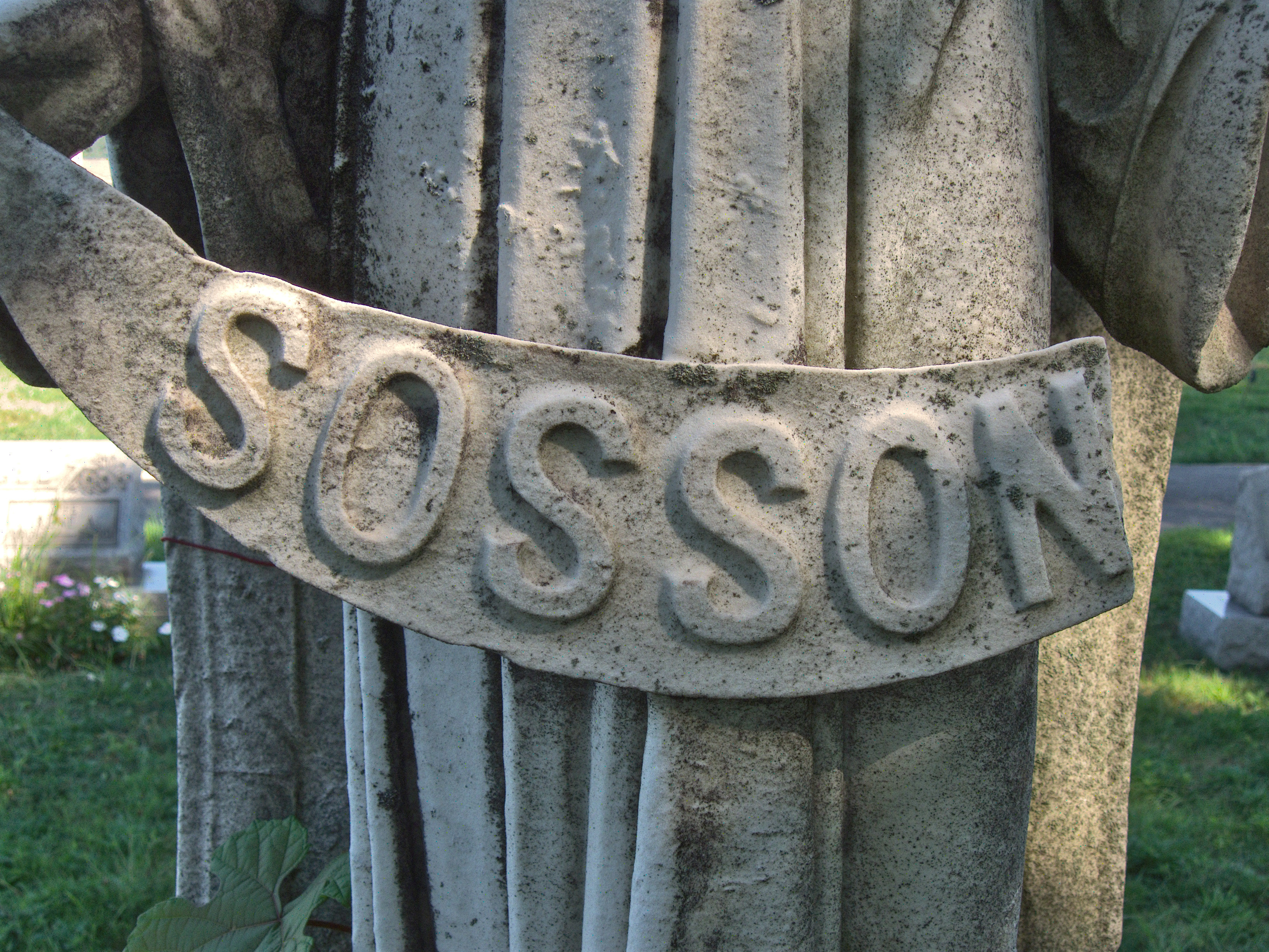
“Sossong” is not a very common name, yet in this small cemetery in Glendale (Scott Township) there are at least four different Sossong family plots. It must have been a large interconnected group of cousins. This particular plot has a marble angel as its guardian, possibly erected in 1893 when Philipp Sossong died. The angel is well preserved, though the left hand and part of the scroll with the family name are missing.

The Sossongs’ descendants still keep up this plot, and all the Sossongs buried here have relatively recent granite headstones, possibly to replace inscriptions that became illegible. One of them was a priest, Fr. William B. Sossong, who was born in 1891, but for whom no death date has been filled in.

Old Pa Pitt liked this angel well enough to come twice in the same day and photograph it in two different lights. That is how dedicated he is to bringing you the finest possible illustrations.

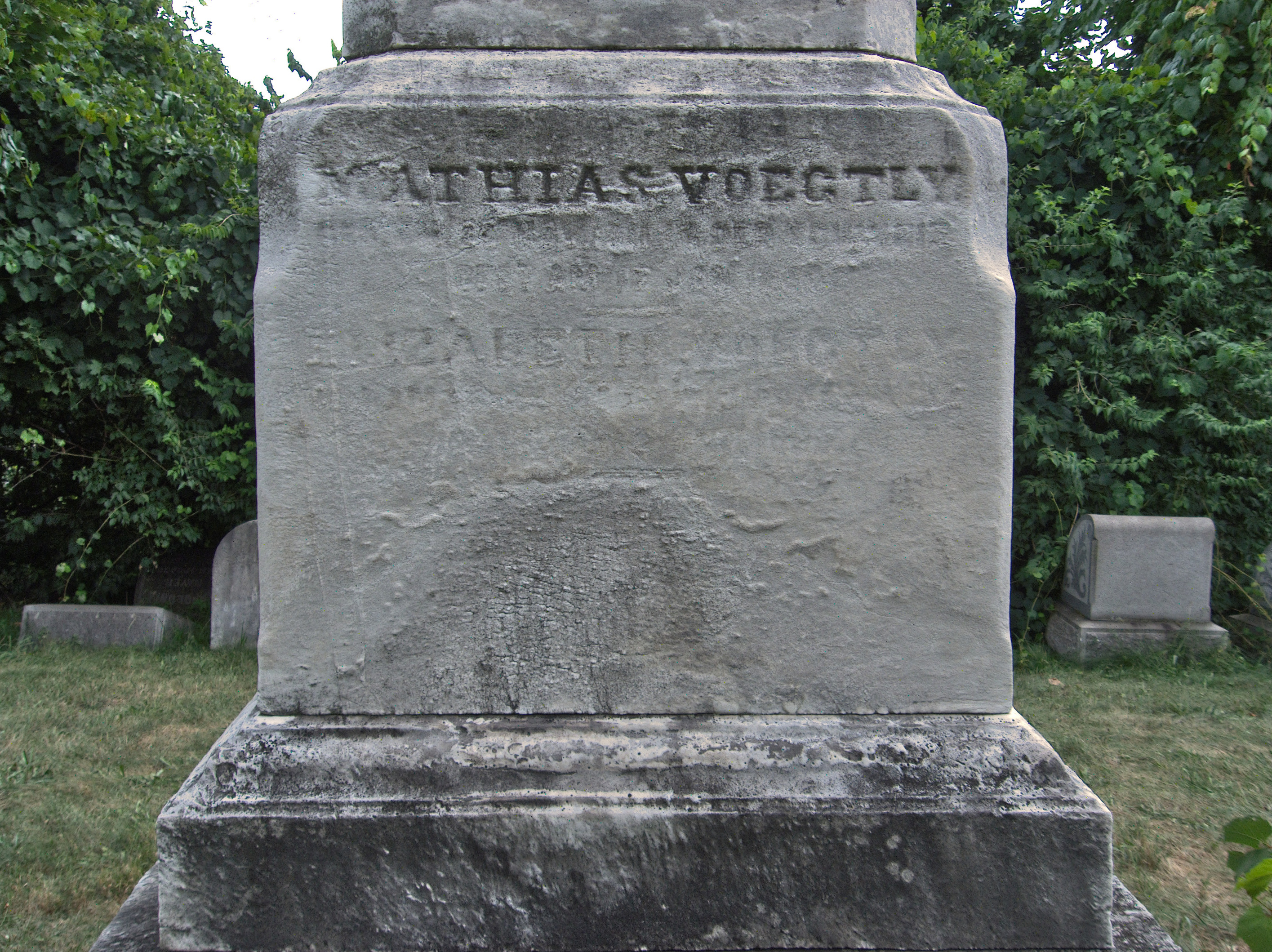
Father Pitt assumes that this is a descendant or other relative of the Voegtly who donated the land for the original Voegtly Church in Dutchtown, whose name this cemetery perpetuates. The name of Mathias Voegtly is still quite visible, but the rest of the inscription is badly eroded. We can just make out the name of Elizabeth Voegtly, but the rest is difficult.

However, the graves of the Voegtlys are also marked with expensive granite memorials, and though they are overgrown with wild grapes (you can see the mound of grape vines to the right of the obelisk), Father Pitt pushed back the grapes enough to collect these data:

Mathias Voegtly: Born November 26, 1811; died January 17, 1884

Elizabeth Voegtly: Born July 28, 1805; died October 2, 1890.

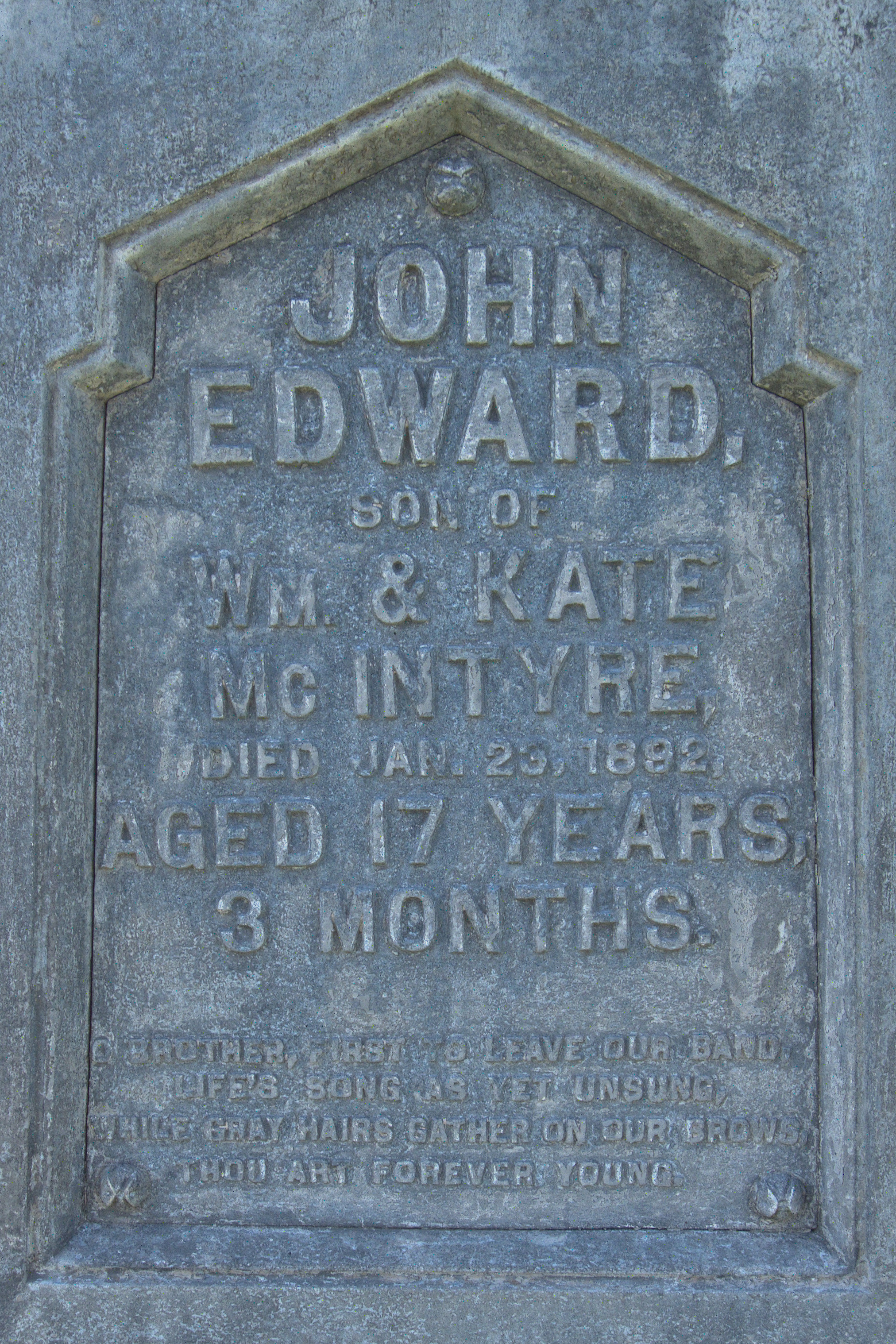
A typical zinc monument adapted to Catholic tastes by adding a big cross on top. It remembers a seventeen-year-old boy who died in 1892; it may have been bought with the intention of adding other McIntyres as they moved in, but no other names were ever added, and most of the monument is taken up with the interchangeable filler designs offered in the monument company’s catalogue.

The Voegtly Cemetery in Troy Hill has an unusually fine wrought-iron fence and gate—and, because the ironworker left his name in the iron itself, we know exactly who is responsible for it.

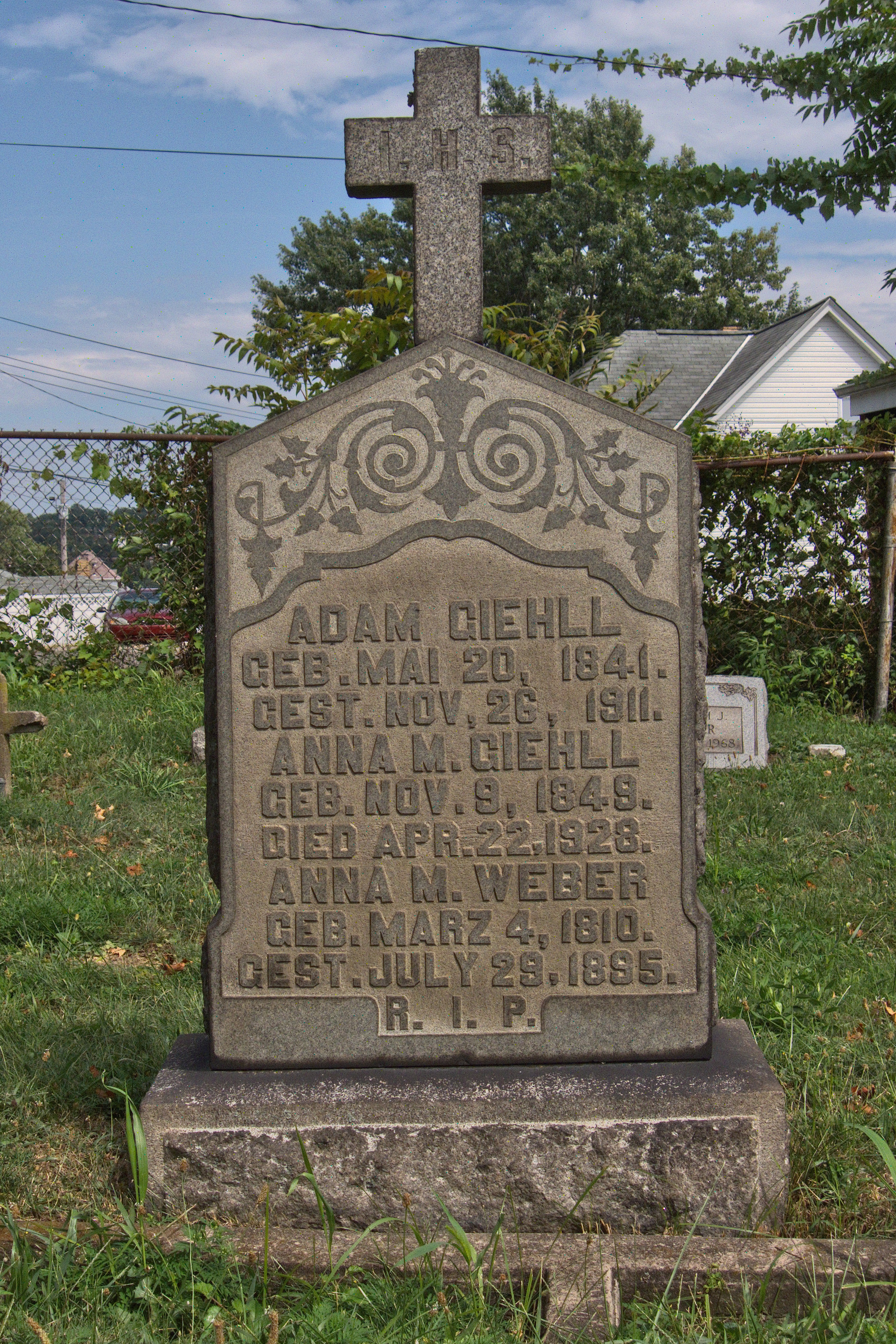
Here is an interesting little document of the American immigrant experience from a small cemetery in the Glendale neighborhood of Scott Township. Father Pitt reconstructs the story this way:

When Adam Giehll died in 1911, his wife Anna M. (Anna Maria? Very likely, since this is a Catholic cemetery) bought a monument with space for his name, her name, and the name of her mother, Anna M. Weber. The birth and death dates of Adam and his mother-in-law were filled in, but—as is commonly done when a living spouse buys the monument—Anna M. Giehll’s death date was left as a blank line, ready to be cut when the time came. (You can see the rougher, less skillful cutting of her death date quite clearly on the stone.)

So far the whole thing is written in German. But when Anna M. Giehll died sixteen and a half years after her husband, her death date was filled in in English—the only line of English on the stone.

For this German Catholic family, then, the line between German and English was somewhere around the First World War—which is hardly surprising. Probably the children of Adam and Anna spoke English as their first language. This is the pattern Father Pitt sees in current immigrants to Pittsburgh: the first generation speaks the language of home and only broken English, but the second generation grows up speaking English and is perhaps only marginally fluent in the parents’ language.

A grave of a girl who did not quite live to eleven years old. The Nixon family was prominent in the congregation of Old St. Luke’s, and this is one of the more elaborate memorials in the churchyard. The epitaph, which takes up both sections of the base of the headstone, seems to be original, not one of those circulating funerary poems we usually find on graves of the late 1800s: an Internet search finds the poem mentioned only in connection with this particular monument—transcribed in a text tour of the burial ground by Mr. Charles Nixon, and now here.

Her form is missing from its place,
And will not come for calling;
God only calleth back his own,
Why should our tears be falling?

The echo of the childish notes,
Have ceased their happy ringing.
We cannot catch a sound that floats,
From where she now is singing.

A marble monument in what we might call folk-romantic style. The recording angel has been eroded by pollution and time, but it does not look as though it was ever a very skillful carving, Nevertheless, the whole effect of the monument is very pleasing.

The epitaph (a poem commonly found on monuments of the era) reads:

Dear mother, rest in quiet sleep,
While friends in sorrow o’er thee weep,
And here their heartfelt offerings bring
And near thy grave thy requiem sing.