Pittsburgh Cemeteries

The Art and Architecture of Death

Hidden on the left side of the cathedral is a narrow arm of the churchyard with a few old monuments, with the massive bulk of the Oliver Building towering over them. Most people who visit Trinity Churchyard never find their way to this side of it, but it’s worth a few moments of contemplation.

HERE
RESTETH IN GOD
CHRISTINA WEGL
WAS BORN 23 MAY 18—
DIED 23 DEC. 1811

[The birth date is obscured in the picture. Sorry about that.]

Is “amateur” the word we are looking for? There are tombstones in the Brush Creek Cemetery that are remarkable works of folk art—and then there are these, some of which appear to have been made by craftsmen who were quite good at scratching letters in stone, but none of which seem to rise to the level of professional stonecutting.

There were a fair number of Germans among the early settlers. Some of the families have some of their tombstones in English and others in German. Father Pitt earnestly solicits corrections to his German translations.

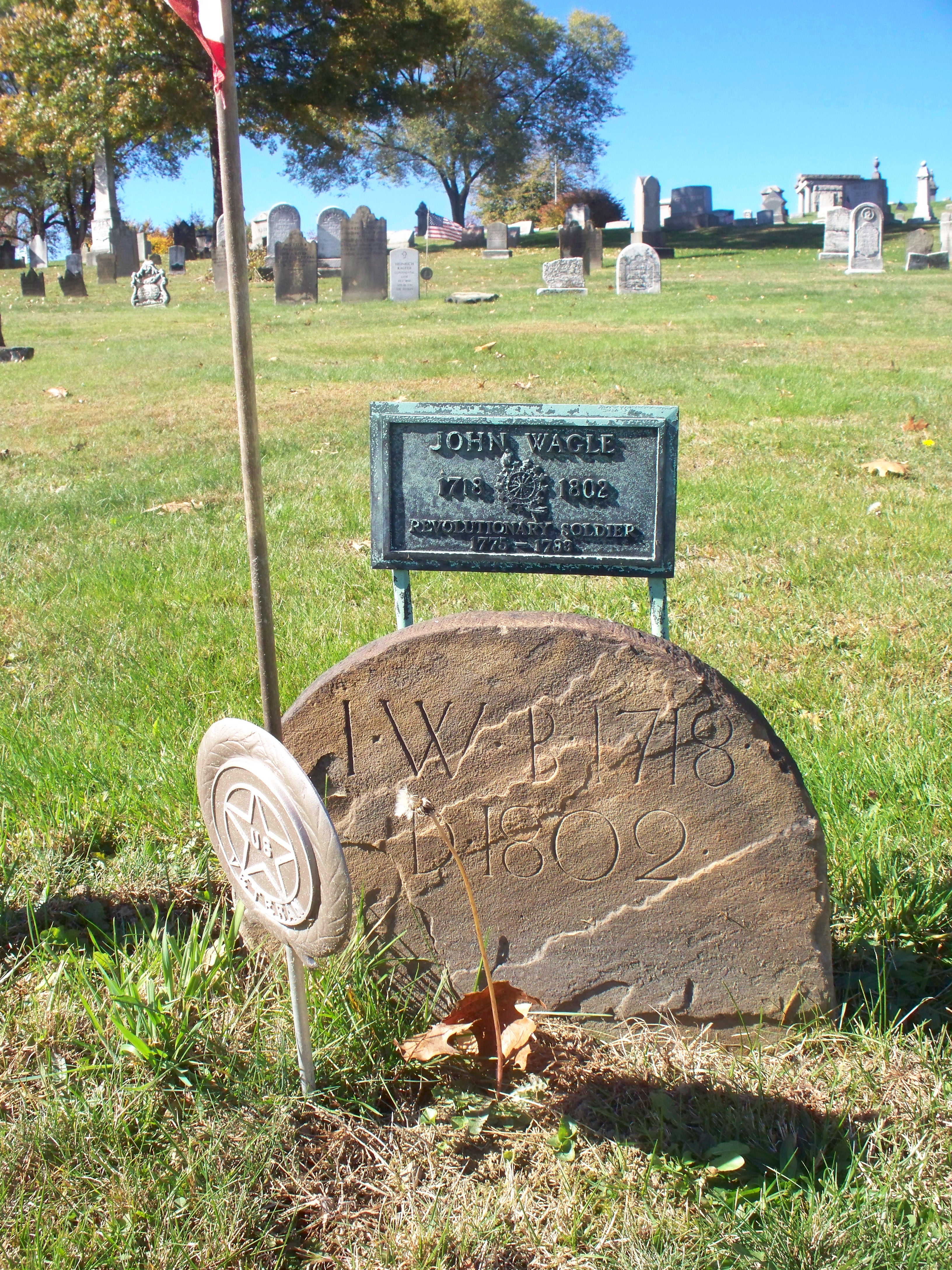
J. W.
B. 1718
D. 1802

The plaque gives the name of this Revolutionary War veteran as John Wagle; he is buried near Christina Wegl, and Wagle and Wegl are almost certainly different ways of spelling the same name.

IN
MEMORY
OF
PHILIP SMITH
HE WAS BORN 1743
AND DIED 1824
AGED 76

HERE LIES
LUDWIG KAEMMERER
DIED JANUARY
21ST 1808 AGED
90 YEARS

Old Pa Pitt is assuming that the line over the M indicates a doubled letter.

HERE LIES
MAGDALENA
KAEMMERIN DIED
JUNE 12th IN THE
YEAR 1794 AGED 26

If this was installed when Magdalena died, then this is one of the earliest legible tombstones in the area.

IN
MEMORY
OF
LUDWIG
KEMERER Junr. HE
WAS BORN AD 1749
DEPARDET THIS
LIFE 1817 AGE —

This seems to be the work of the same stonecutter—perhaps a family member—who did the two German stones above. Note the different spelling of “Kemerer” in English.

HERE LIES
J. CONRAD SCHIDLER
HE & ELISABETH HIS
WIFE BORE 10
CHILDREN HIS PARENTS
ANDREAS & MARGARET
HE DIED APRIL 20th
1796 AGED 58 YEARS
Text John Chap. II V. 25

PAUL EBERHART

ELISABETH
LINSENBIGLER

Father Pitt is being a little facetious in bestowing the title “master” on this particular craftsman. He is not exceptionally good. We name him, as usual, from a readily identified feature of his style: he always carves the date in italic letters. And it is interesting to see his work in two different cemeteries, fairly far apart. Above, John Frew’s tombstone in the St. Clair Cemetery, Mount Lebanon. The unusual inset name is unique in what Father Pitt has seen of this craftsman’s work, and he suspects it represents, not an aesthetic decision, but an embarrassing correction of the deceased’s name. William Frew‘s, below, is more typical.

Now here are several tombstones in Hiland Cemetery, north of West View. Note that the name “Richey” or “Ritchey” is spelled two different ways, suggesting that John Frew’s tombstone is not the only one in his career where our artist misspelled a name.

IN MEMORY OF
ROBERT LONG
Who departed this life
August 1st 1832 aged 60
years.
Go home dear friends
And cease from tears.
Here I must lie
Till Christ appears.


W. Savage, Sculptor, Williamsport.

We have seen another pair of tombstones in a similar style in the Bethany Cemetery near Bridgeville: the tombstones of Billingsley Morgan and his (illegible) wife, which were signed by H. Savage. Was H. Savage a brother or other relative of W. Savage? And if “Williamsport” means the only Williamsport Father Pitt knows of in Pennsylvania, then this stone was hauled across the mountains, which must have been quite expensive. Perhaps there was no one in the immediate area who could carve a stone of this quality in 1832—for it certainly is a splendid piece of folk art, well worth the trouble of hauling in from Williamsport.

—An update: Father Pitt has to confess his ignorance sometimes. Williamsport, he has discovered, was the name of the town that is now called Monongahela. The name is remembered in the Williamsport Road, which leaves Elizabeth and heads straight for Monongahela before changing its name to Rostosky Ridge Road, which is probably not the early settlers’ name for the trail, about two-thirds of the way along.

An elevated slab for a Revolutionary War veteran and his wife. The two inscriptions were certainly done by the same craftsman, but from subtle differences in the thicknesses and forms of the letters it looks as though they may have been done at different times, suggesting that Jennet’s was added to Thomas’ already existing stone.

IN
Memory of
THOMAS Mc NARY Esqr.
Who departed this life on the
9th of July A.D. 1820 in the 76th
year of his age.

IN
Memory of
JENNET Mc NARY
Consort of
THOMAS Mc NARY
Who departed this life on the
15th of April A.D. 1828 in the 84th
year of her age.

Oak Spring Cemetery in Canonsburg has a number of slab stones elevated into table-like structures—an arrangement common in some old cemeteries. Obviously the props under these stones are newer than the stones, but they may have replaced older ones that were original. Old Pa Pitt simply doesn’t know whether these slab stones were always elevated or whether graveyard caretakers elevated them later, when they began to vanish under the ground.

SACRED
to the
MEMORY OF
SAMUEL WHITE
Who departed this life
May 12th 1837, In the
82nd year of his
age.

Samuel White, Sr. was a veteran of the Revolutionary War. He married a considerably younger woman named Mary:

SACRED
to the
MEMORY
of
MARY WHITE
wife of
SAMUEL WHITE
DIED
JUNE 12th, 1841 in the
76th year of her age.

In the short time between the death of Samuel in 1837 and the death of Mary in 1841, a new fashion in tombstones had swept over Western Pennsylvania. Samuel’s is a simple slab stone of the sort that had been made here since the late 1700s, but Mary’s is in what Father Pitt calls the “poster style,” with each line in a different style of lettering, like an advertising poster of the same era.

This is a fine piece of work in the engraved-title-page style of the 1850s, but cut in the native stone (sandstone, Father Pitt believes, but he is happy to be corrected by someone better informed on the subject of rocks) that by this time had almost been abandoned in favor of limestone and marble. If it remains intact, the native stone preserves an inscription indefinitely, so that we can appreciate every flourish wrought by this talented artist.

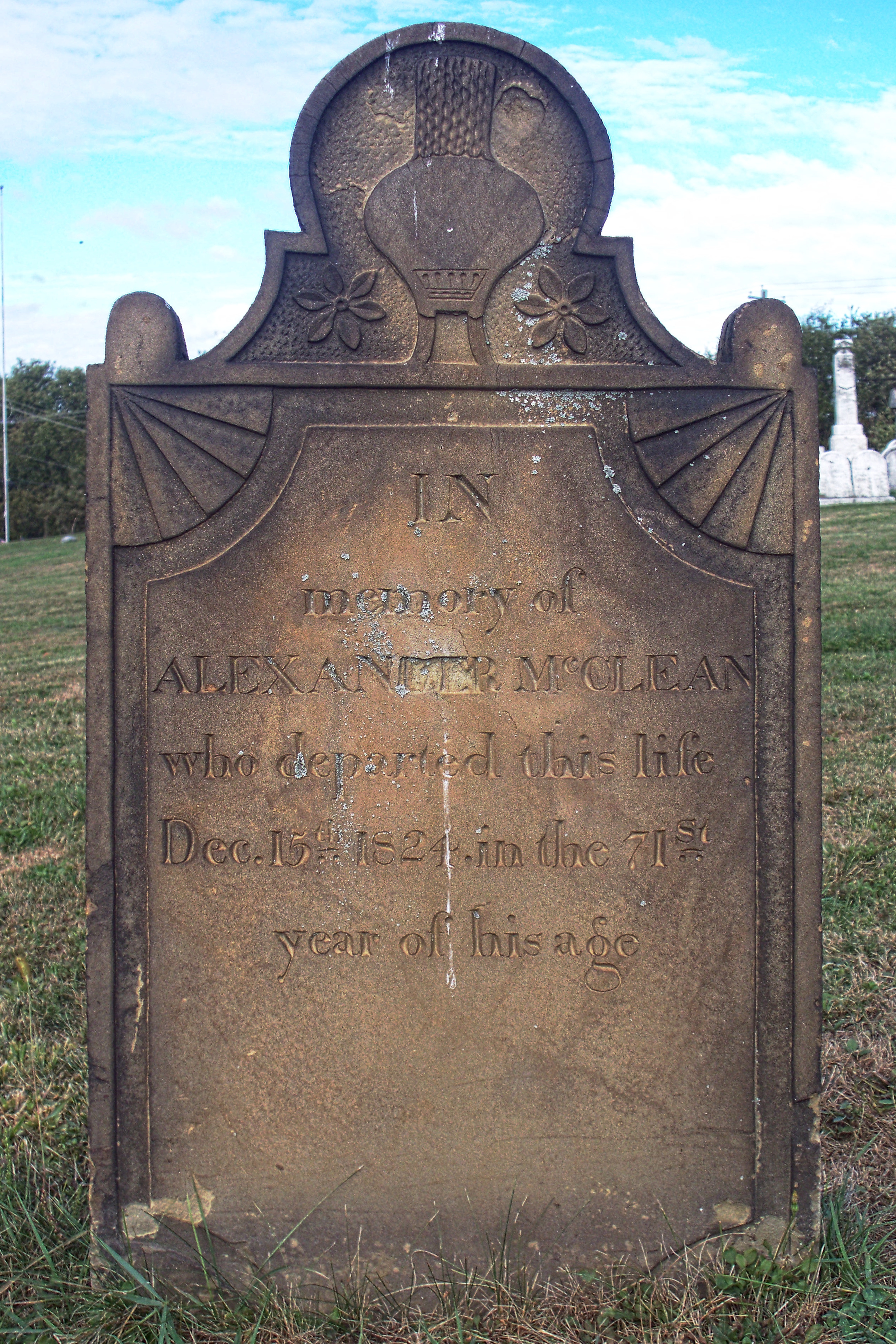
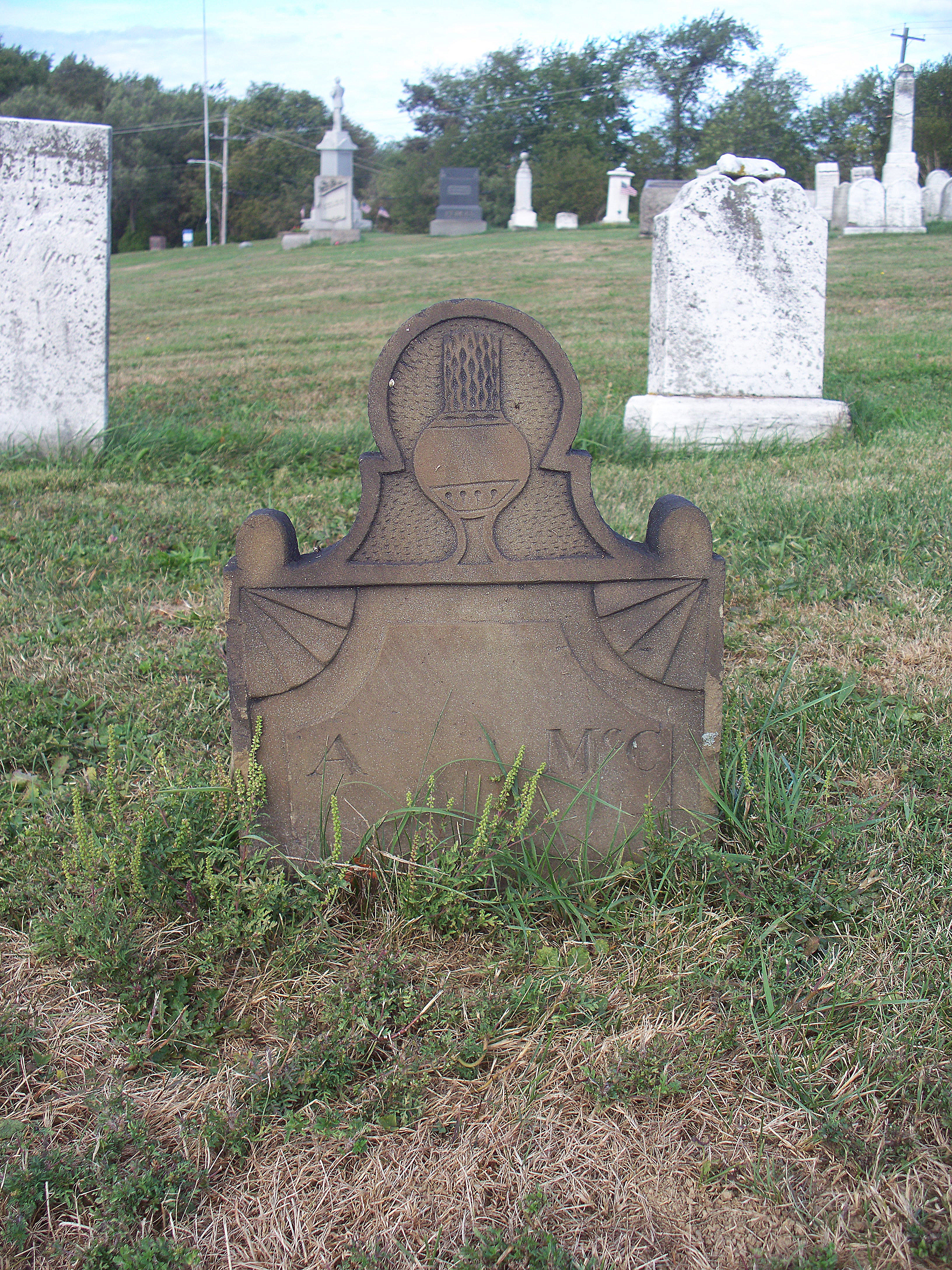
This particular craftsman, active in Robinson Run Cemetery in the 1830s, sticks to one particular symbol, which Father Pitt interprets as a stylized thistle—emblematic of sorrow, but also emblematic of Scotland, perhaps the homeland of most of his patrons. Fan ornaments decorate the corners of all his stones.

Alexander and Isabella McClean’s headstones are good and well-preserved examples of his work. He also gave them footstones, which seem to have migrated a little from their original positions, but are still fairly close to the headstones they go with. The carving on the footstones looks a little hastier, although some of that may just be the smaller size.

The same artist made this stone for Elisabeth Moss. “The grave of,” incidentally, is a very unusual way to introduce a tombstone inscription around here, but it was obviously a family preference: Elisabeth Moss is buried in the same plot as the McBurneys, who, though their stones were cut by a different craftsman, both have inscriptions that begin with “The grave of…”

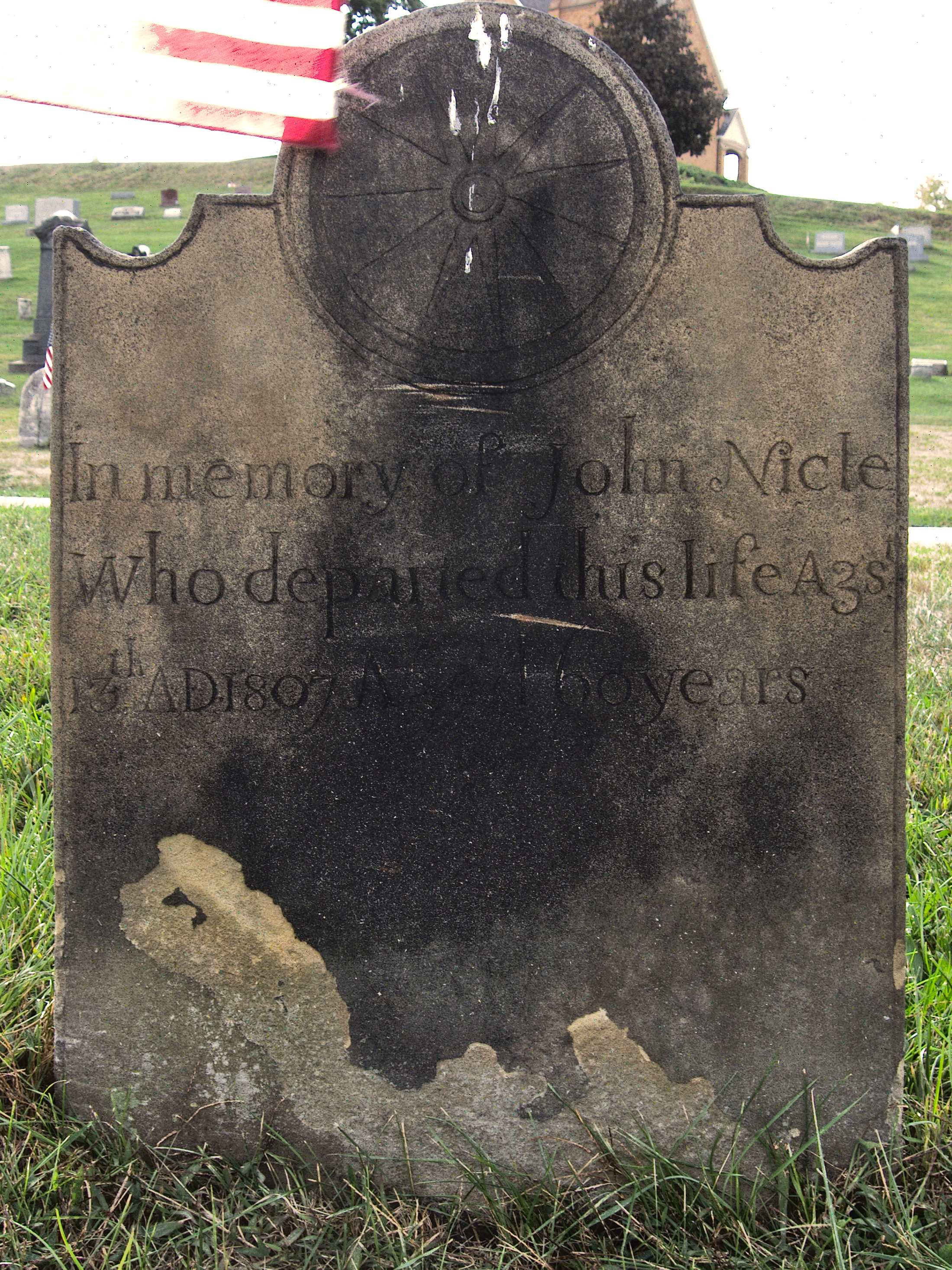
We have already met the Master of the Curly G in Robinson Run Cemetery. Union Cemetery, the burying ground of the adjacent Union Church, is only a few miles away, and we find the same readily identifiable craftsman active here, too. Above, the grave of a Revolutionary War veteran who died in 1807 (spelled “John Nicle” here and “John Nickle” on a modern bronze plaque next to the stone).

This stone is no longer completely legible, but its few distinct features mark it as obviously the work of the same artist. It is interesting to note that (if Father Pitt reads the remains of the inscription correctly) it begins with “Here lies the body of,” like a New England tombstone, rather than the far more usual “In memory of.” Father Pitt’s best effort at a transcription follows; unfortunately, the two data we should most like to have—the surname and the date of death—seem to be irretrievably obscured.

Here lies the body of Matth.
—— who departed this
life ———— in the 27th
year of his age.

Only a small part of the inscription on Mary Morgan’s tombstone is visible above ground, but again it is enough for us to recognize the craftsman instantly.

Instantly recognizable as the work of the Master of the Curly G, these two stones have inscriptions beginning simply “the grave of”—a curious family tradition also observed by Elisabeth Moss, who was buried in the same plot and is probably related. Note the awkward and rather embarrassing correction of the name “McBur[n]ey” above.