Pittsburgh Cemeteries

The Art and Architecture of Death

IN MEMORY
OF
MOSES COULTER
who departed this life
Dec 6th 1828 Aged 55 years

Bleſsed are the dead who die in the
Lord they rest from their labours; and
thir [sic] works do follow them

Broken in two but otherwise well preserved, this is a very good example of a ledger-type horizontal marker. The epitaph is an abridged version of Revelation 14:13. Note the long S in “Blessed”: although the long S was for all practical purposes extinct in print by the 1820s, it was still taught in handwriting copybooks that the first S in a double-S pair should be a long S.

This is the churchyard of the Mount Pisgah Presbyterian Church in Green Tree. The little cemetery itself straddles the line between Green Tree and the Westwood neighborhood of Pittsburgh, and it is a curious fact that the section of the cemetery in Green Tree is neatly maintained, but the section in Pittsburgh is overgrown and forgotten—although some attempt had been made to clear some of the larger bushes from it when Father Pitt visited. Doubtless the true explanation of the phenomenon is that the overgrown section is not visible from the church, and thus can be allowed to go to ruin without making a spectacle of itself every Sunday.

Tombstones litter the forest in the overgrown section. Much of the ground cover is Vinca minor, which is often called Cemetery Vine because it was such a popular planting in old cemeteries.

In this section were some old family plots fenced with iron rails; we can still identify the Graham family plot, below:

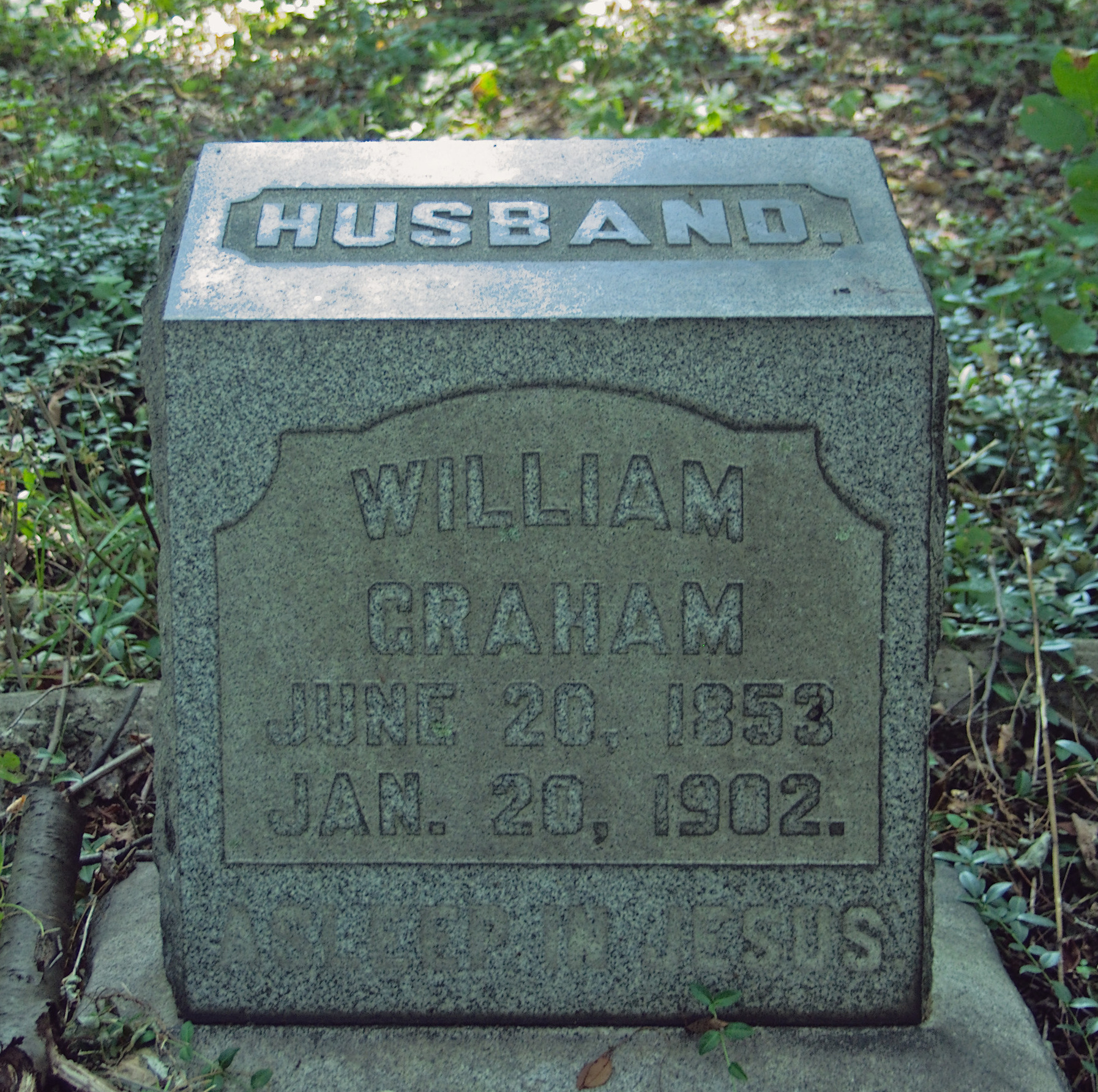
Note, again, the luxuriant growth of Vinca minor.

There are tombstones here that go back to the 1840s at least, but most of the older ones are illegible, if they can be found at all. Here, however, is a legible tombstone from 1842 (forgive the strong backlighting):
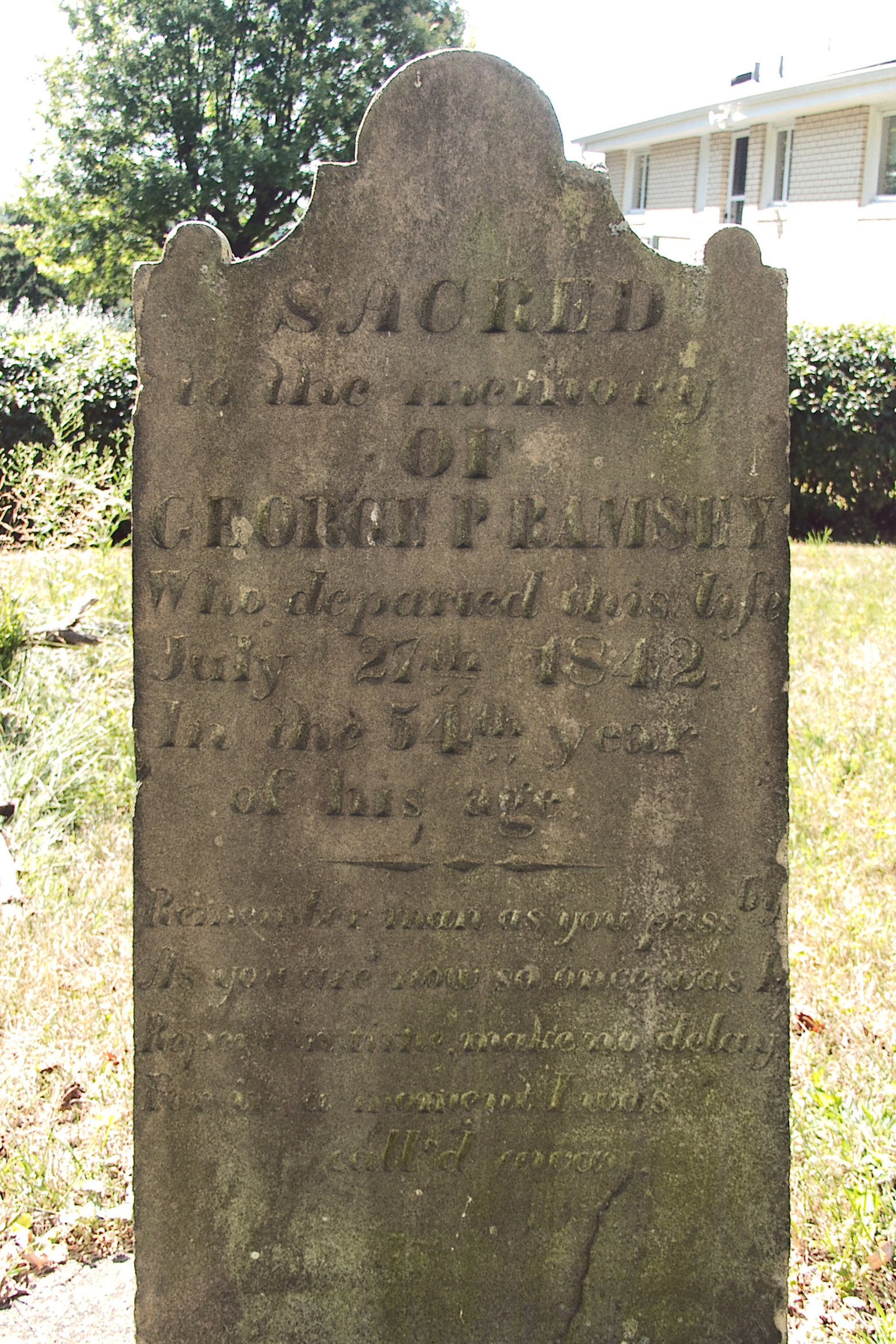
SACRED
to the memory
OF
GEORGE P. RAMSEY
Who departed this life
July 27th 1842.
In the 54th year of his age.

Remember man as you pass by
As you are now so once was I;
Repent in time, make no delay,
For in a moment I was call’d away.

The epitaph begins as one well-known funerary poem and ends as another; the last line has five feet instead of four. But it is still a powerful sentiment.

In spite of the general neglect, someone cares enough to see that all the identifiable veterans have flags for their graves, so that little flashes of red, white, and blue light up the floor of the woods. Here is the grave of Corporal David Aston, a Civil War soldier whose birth and death dates are not mentioned:

REBECCA RITCHEY
departed this life,
December 27, 1838.
Aged 42 years 11 months
& 4 days.

Here is a work by a stonecutter whom we shall call the Master of the Italic Months, from one of the most distinctive features of his style. He also writes the name of the deceased in all capitals (not small capitals), and he places a comma after the words “departed this life.” He adds an ornamental dash below the inscription. His lettering is not nearly as neat as that of the Master of the Erratic Centering, who also cut many stones in the Hiland Cemetery; but, on the other hand, his centering is a bit better.

In
memory
of
NANCY OWENS
who departed this life
july 31st 1824,
aegd 19 years

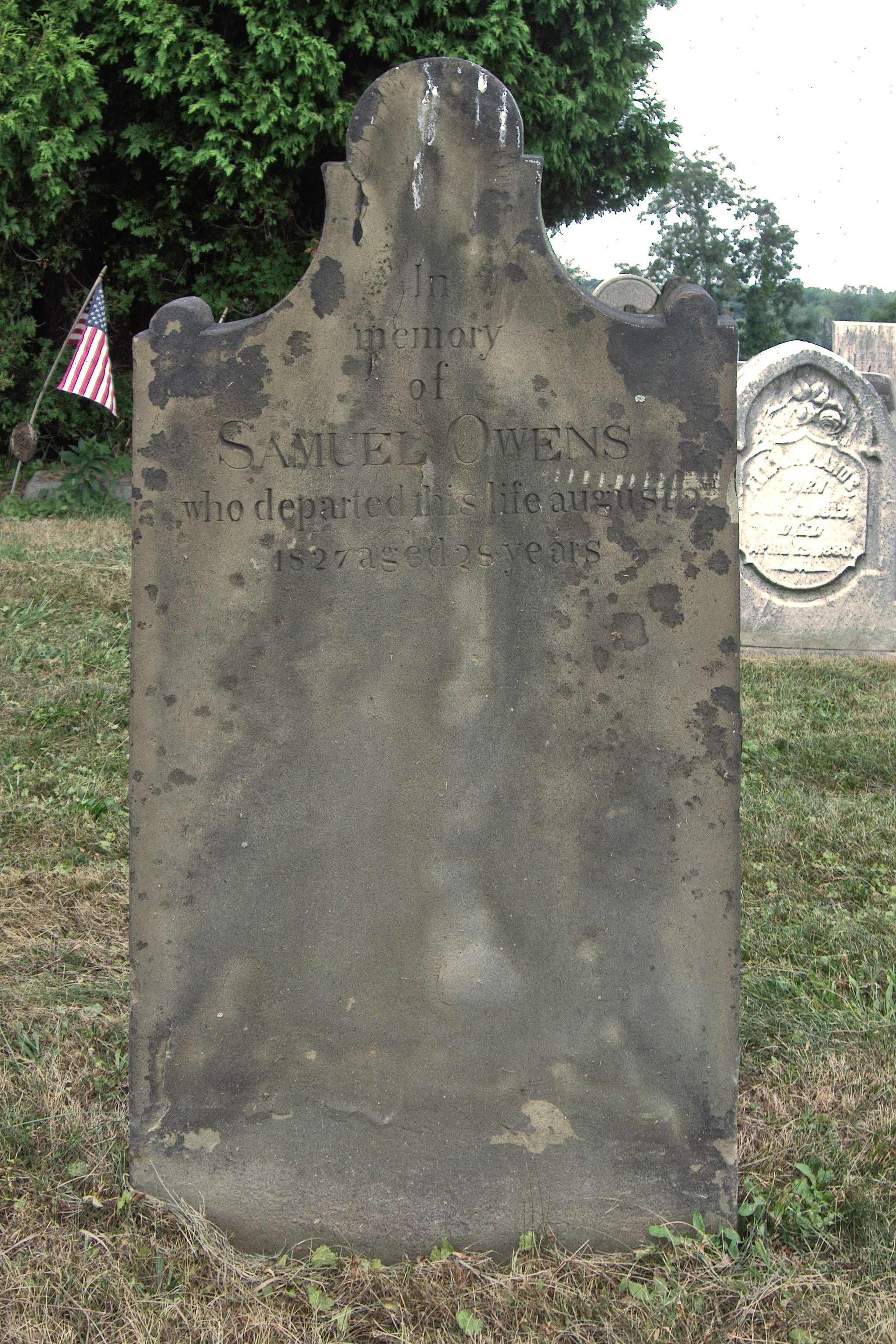
Two more works of the stonecutter we identify as the Master of the Erratic Centering, whose erratic centering and aversion to capitalization are both on display here. Both Nancy and Samuel died as young adults. Were they a young married couple, or were they brother and sister?

In
memory
of
SAMUEL OWENS
who departed this life august 2nd
1827 aged 28 years

An 1829 tombstone typical of the Hiland Cemetery. We can identify this particular stonecutter by two very distinctive traits: his erratic centering and his avoidance of capital letters and punctuation. We shall call him the Master of the Erratic Centering.

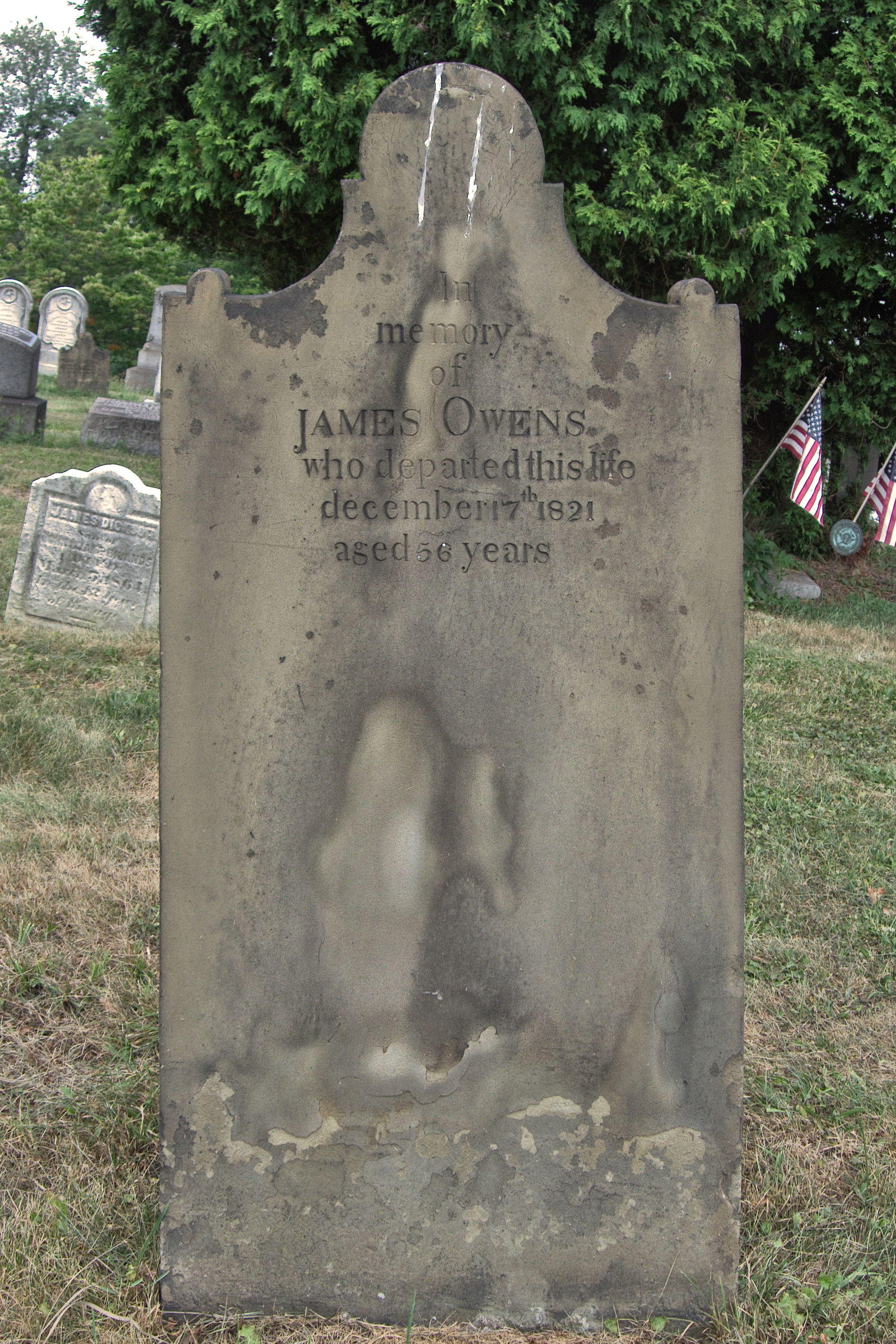
An 1821 tombstone that appears to be another work of the Master of the Erratic Centering, whom we identify by his erratic centering and his aversion to capitalization—note, for example, the spelling “december.”

In
memory
of
JAMES OWENS
who departed this life
december 17th 1821
aged 56 years

Nothing is particularly outstanding about these tombstones, except that they are nearly two hundred years old and still quite legible.

IN
Memory of
ELIZABETH HERRIOTT
Consort of
GEORGE HERRIOTT
Who departed this life
August the 29th A.D. 1819
aged 46 years.

IN
Memory of
GEORGE HERRIOTT
Who departed this life
December the 2d A.D. 1826
aged 61 years.

A tombstone for a young mother and her child. Elizabeth died at two months in 1839. Two months later her mother died as well. Did she die of the same disease? Cholera was very popular in Pittsburgh in the 1830s, but there seems to have been a lull in the epidemics in 1839. Perhaps Nancy died of grief, as mothers often did in those days. (Today we would look for another diagnosis, but modern medical science agrees that psychological factors play a large role in the body’s ability to overcome serious ailments.) Grief also reached epidemic proportions in the nineteenth century, when childhood mortality was, by our standards, appalling.

A simple rectangular stone is unusual in this era. This stone commemorates two Andrew Russels (note the spelling of the name). The first died in 1808 at six years old. (If a tombstone says “in the x_th year of his age,” it usually means the deceased was _x years old, though technically an x-year-old is in the x+1 year of his age.) The second died in 1814 at 82 years old, so he was probably a great-grandfather of the first.

Father Pitt believes that this stone was put up in 1808, and the inscription for Andrew Russel, Sr., added in 1814. His evidence is, first, the word “Also,” and second, a demonstrable difference in the styles of lettering between the two inscriptions. The second is well matched to the first, but probably by a different hand, one that made thinner letters—or possibly by the same stonecutter after six more years of practice.

IN MEMORY OF
ANDREW M. RUSSEL
who died
Feb,y 27th 1808;
in the 6th year of his age.

ALSO
ANDREW RUSSEL, Senr
died
June 20th 1814;
in the 82nd year of
his age.

Three different burials in the same family plot show us three different styles of early-settler tombstones.

Jacob Bell lived the longest of the three: he was buried in 1842. Shortly after that, local stonecutters would begin to be replaced by more centralized businesses, so this is one of the last of what Father Pitt would call the early-settler tombstones. It does not seem as elegantly cut or proportioned as the earlier tombstones, which makes us wonder whether the stonecutter’s craft was already fading. The inscription reads:

SACRED to the MEMORY OF JACOB BELL, Who departed this life, Nov. 18th 1842 in the 75th year of his age.

Elizabeth Bell, Jacob’s “consort” (the stonecutters’ preferred term for “wife”), died in 1829, and her tombstone is typical of the time. It is not as elaborately cut as some other 1820s tombstones, but compare it to Jacob’s and see how much better formed the individual letters are, and how much more carefully laid out the lines are in the inscription.

IN Memory of ELIZABETH BELL, Consort of JACOB BELL Who departed this life January 13th A.D. 1829 in the 58th year of her age.

Finally, Charity Bell, who was probably a daughter of Jacob and Elizabeth, died in 1832, and was given a tombstone of the Gothic shape popular in the 1830s. The lettering is done very well (non-standard spelling of the month notwithstanding), and the stonecutter has added the tree ornament—probably intended as a weeping willow—that we commonly see on early-settler tombstones.

IN MEMORY OF CHARITY BELL Who departed this life Aprile the 6th A.D. 1832 in the 35 year of her age