Pittsburgh Cemeteries

The Art and Architecture of Death

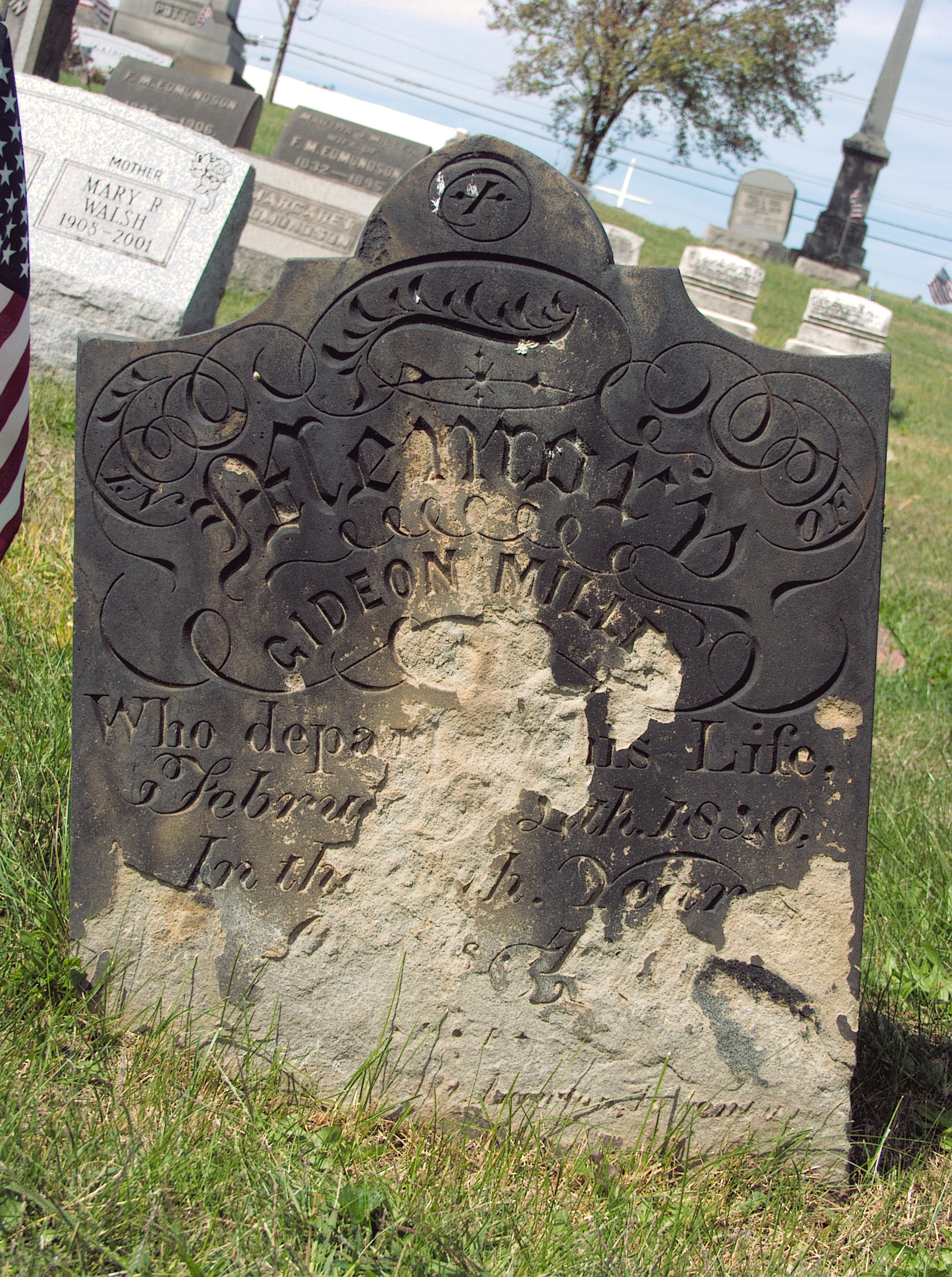
This is one of the earlier burials that were moved from nearby churchyards to Prospect Cemetery in Brackenridge, and it is probably the most artistic early-settler tombstone Father Pitt has yet found in this area. The style is a close and extraordinarily skillful imitation of nineteenth-century decorative penmanship styles, so we shall call this craftsman the Master of the Brackenridge Flourishes. And although Father Pitt admits to using the title “Master” a bit facetiously for some of the other local craftsmen, it is entirely deserved here.

In Memory of
GIDEON MILLER
Who departed this life,
February –th, 1820
in the –th Year
[Of his Age]

[Epitaph]

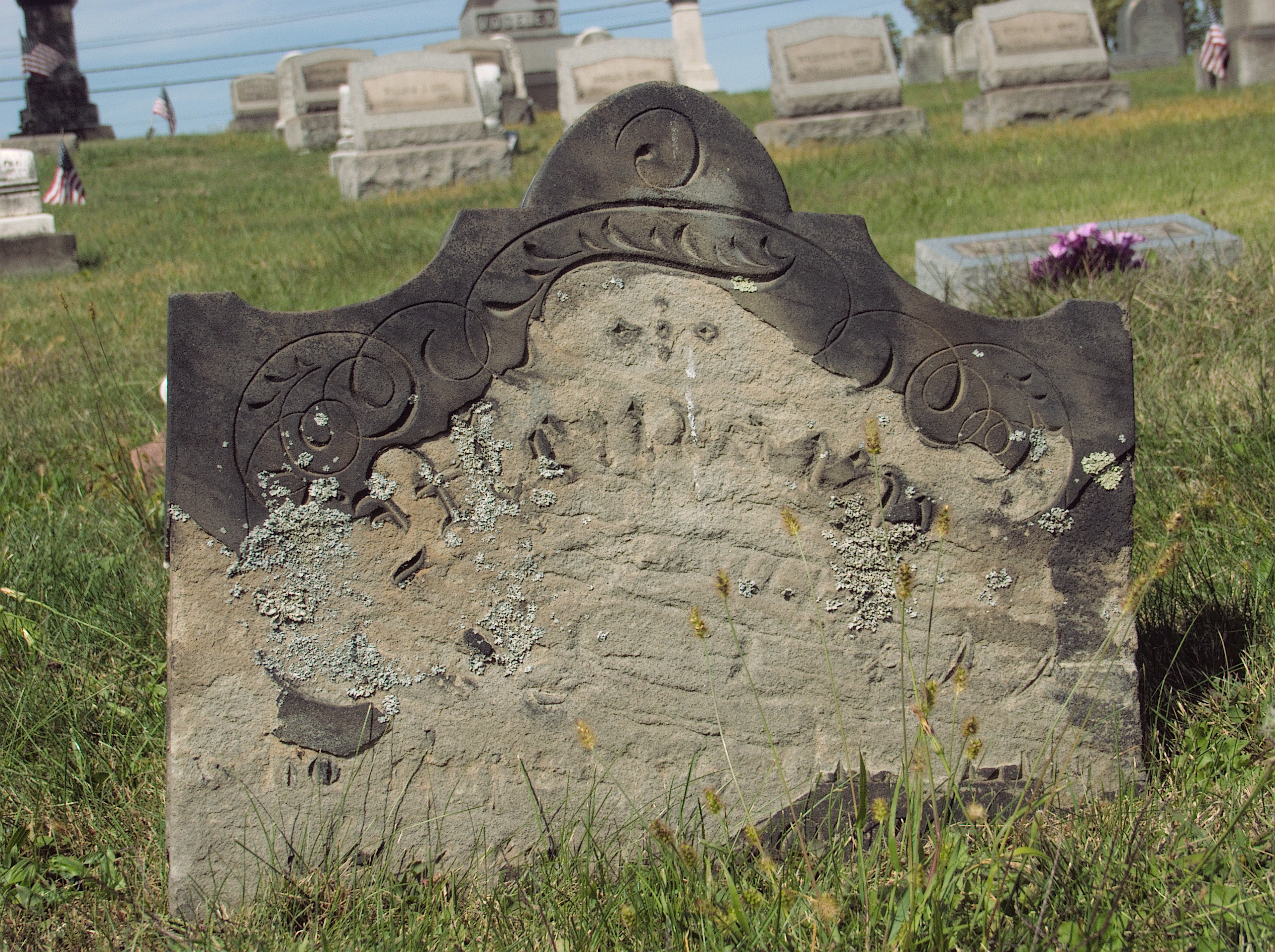
The stone may be later than its 1820 date, but it is almost certainly not later than the 1840s. A matching stone beside it, obviously by the same artist, is too badly damaged to read.

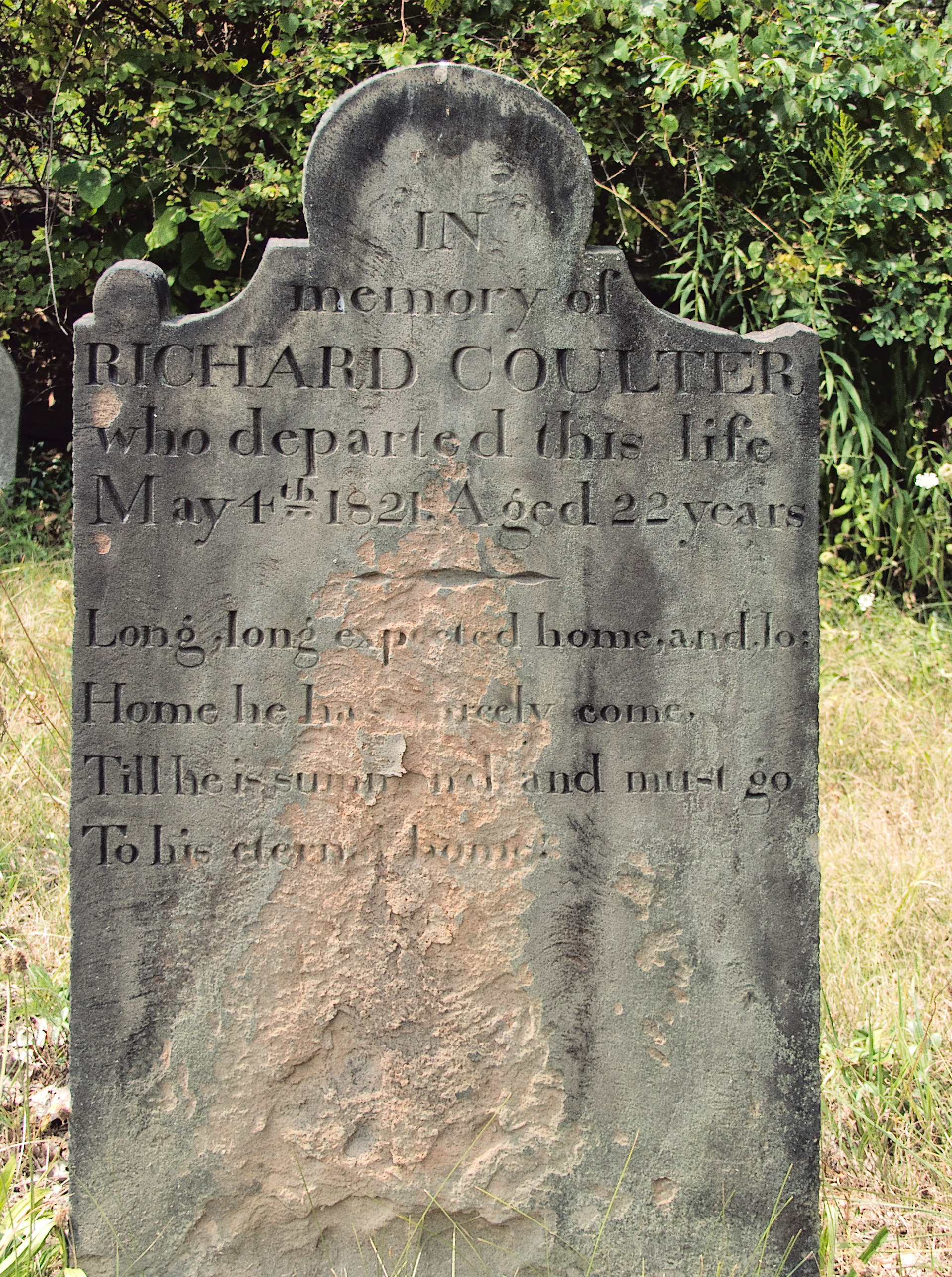
IN
memory of
RICHARD COULTER
who departed this life
May 4th 1821, Aged 22 years
——— Long, long expected home, and lo:
Home he has scarcely come,
Till he is summon’d and must go
To his eternal home.

This is a fairly well-preserved tombstone from nearly two centuries ago, and that is of course interesting enough. The most interesting thing, however, is the poem, which is from a collection of poems by the very obscure James Meikle, this one being headed “On a gentleman who died after his return to his family from foreign parts, after an absence of twelve years.” The poem itself is dated 1768, but it was kept in manuscript until after the poet’s death in 1799. The only edition of the posthumous poems of Meikle Father Pitt has been able to find is one published in Pittsburgh in 1819, two years before the death of Richard Coulter; so that we know with near certainty that whoever specified the epitaph on this stone had read it in this particular book.

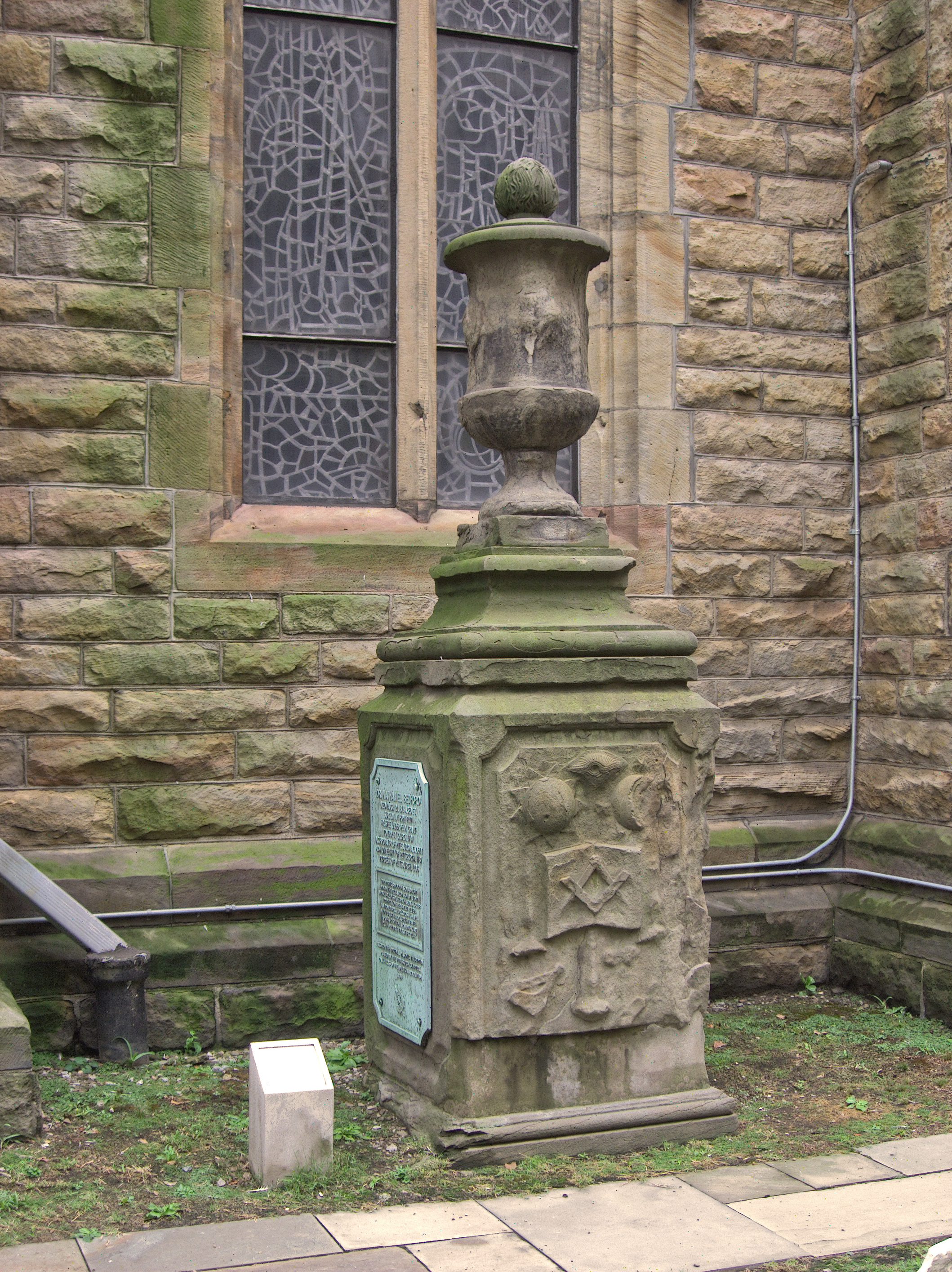
Dr. Nathaniel Bedford was the first physician in Pittsburgh. He came with the British to Fort Pitt and stayed. Here are two paragraphs from the Standard History of Pittsburg, Pennsylvania (1898):

Shortly after 1770 Dr. Nathaniel Bedford, surgeon in the British Army, resigned his commission and took up his permanent residence in the town, being attracted by the wonderful beauty of the place before the iron hand of Industry had stripped the verdure from the hills, seamed and scarred the lovely bosom of the earth, defiled the sparkling waters and spread a sooty pall across the sky.

Dr. Bedford was a man of polished manners, thoroughly educated in his profession, as his commission in the British Army attested, and of scholarly habits. His success was rapid and complete and he accumulated a modest fortune in the form of several tracts of land on the south side of the Monongahela, now within the city limits. Shortly after the beginning of the present [nineteenth] century he retired from practice. In the city directory of 1815 his name appears as “Nathaniel Bedford, gentleman, Birmingham.” He never married [this is incorrect; see below], and after his death the Freemasons, of which fraternity he was a prominent member, erected a monument to his memory in the form of an iron urn, which still stands, or did until recently, on the hillside immediately under the track of the South Twelfth Street Inclined Railway.

The assertion that Dr. Bedford never married is incorrect, He married very well indeed: his wife was Jane Ormsby, heiress of the Ormsby family, and through her inherited the land that became the town of Birmingham—named for Birmingham in England, near which Dr. Bedford was born. In other words, Dr. Bedford owned the South Side, or at least the part of it out to 17th Street, where an awkward kink in the street grid and the sudden broadening of Carson Street mark the beginning of the former separate borough of East Birmingham. Dr. Bedford and his wife had no children, however, and it was his Masonic lodge that erected this memorial when Dr. Bedford died in 1818. He was probably buried under it, in a spot that would have been verdant and semi-rural in 1818, but rapidly developed into one of the most crowded neighborhoods in the city of Pittsburgh. The monument stood neglected under the Knoxville (or South Twelfth Street) Incline until 1901, when the Pennsylvania Railroad needed the land. Then the dilapidated monument was moved here to Trinity Churchyard, probably with the remains of Dr. Bedford (sources seem to differ on whether his remains were discovered).

These Masonic symbols in relief have eroded considerably, but are still recognizable.

This little stone lay hidden under the ground until 2008, when a landscaper almost literally stumbled on it. It marks the grave of a small child who died in 1794, and that is all we know about her. But the stone and its inscription are very fine for the era, so we suspect her parents had some money.

In Memory of
BILLINGSLEY MORGAN
Who departed this life
[Marc]h the 7th 1836
[in the —]th year of his age

Here is a pair of tombstones by the same extraordinary folk artist—and, because he actually signed one of them, we know his name: H. Savage. Both are badly damaged, but they form a pair side by side, so old Pa Pitt guesses that the illegible stone marks the resting place of Mrs. Billingsley Morgan. Unlike most Western Pennsylvania tombstones of the 1830s, these are handsomely carved in relief, much like the famous New England tombstones of the colonial era, but without the flying skulls.

Even this unusually artistic and ambitious stonecutter did not sketch out his lettering before beginning the inscription, so that he ran out of space for the name “MORGAN” on Billingsley Morgan’s tombstone.

Here is a stone inscribed by someone who obviously did not make a living creating tombstones. Yet the work is done well enough that the stone is perfectly legible nearly two centuries later, preserving the embarrassing spelling mistake for all time.

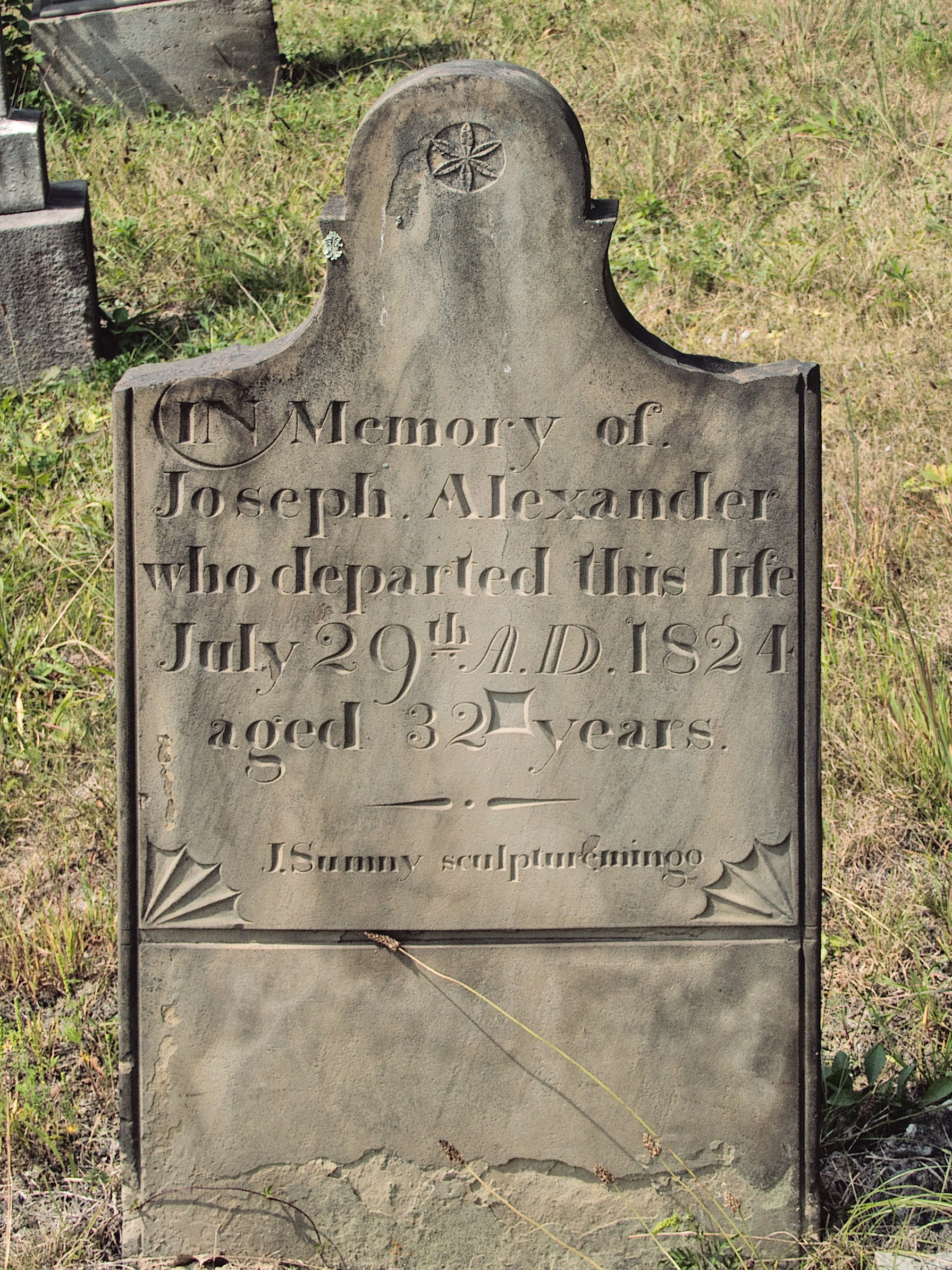
Very few of the stonecutters who worked around here before 1840 (or after, for that matter) signed their work. But occasionally one who was particularly proud of one of his productions would put his mark on it, although—oddly—none of them seem to have made a habit of it. J. Sumny, for example, signed this stone:

The signature “J.Sumny sculpture,mingo” is prominent. “Mingo” was a common term for local American Indian tribes; it is probably the name of a settlement—perhaps Mingo Creek, south of Finleyville, where there is still a church whose congregation was heavily involved in the Whiskey Rebellion.

This one of only two stones visibly signed by J. Sumny, but we can identify others by him in the same graveyard.

Elisabeth Law’s is also certainly one of his;

In addition to the fan ornaments in the corners, note the characteristic ornamental dash after the main inscription and the distinctive ordinal (“26th”) with the superscript “th” underlined, and a double comma under the underline. (Distinctive, but not unique: at least one less artistic stonecutter in the same cemetery also used the underline and double comma for abbreviations.)

Though it lacks the ornaments, Elisabeth Jeffery’s stone is also by J. Sumny:

Again we see the characteristic ordinal and ornamental dash, as well as the backslant in the line that identifies the relations of the deceased.

Moses Coulter McDowell’s tombstone shows all the same quirks, though the shape of the stone itself is fashionably Gothic, like most of the rest of J. Sumny’s stones (the Joseph Alexander stone above is damaged, but probably had the same Gothic spikes). Moses was another child taken away by the same scarlet-fever epidemic that killed Elizabeth Jeffery; it must have been a profitably busy time for stonecutters.

Again we see that distinctive way of forming ordinals (and the abbreviation “Janr.”)

Hardly a family in the Bethany Presbyterian Church was spared by this scarlet-fever epidemic. The winter of 1831 was a somber time in the little settlement. Catharine Herriott also died, and was given a very fine stone by J. Sumny:

It is a rare thing to be able to identify one of these local craftsmen by name, but J. Sumny’’s signature on one stone has allowed us to attribute a number of others to the same artist.

Added: J. Sumny continued to practice in this area for some years, and Father Pitt has found another signature of his, this time on a very plain stone. Father Pitt is inclined now to believe that he signed all his works, but almost always near the bottom of the stone, so that most of the signatures are under the ground by now. Indeed, the first time Father Pitt photographed the James Hastings tombstone from 1840, the signature was not visible:

But having fortunately returned just after the cemetery received one of its infrequent mowings, he found the signature that had been obscured by vegetation. We see here that, by 1840, he was spelling his name “Sumney”:

Recognizing that the style of J. Sumny (or Sumney) had changed somewhat over the years, Father Pitt is now inclined to say that probably half the early settlers’ tombstones in this graveyard were inscribed by him.

in memory of
George Dickson
Who died Dec. the 8th A.D.1817
in the 83d, year of his age.
Also of
Rachel Dickson his wife
Who died May A.D. the 20th
1798 in the 47th year of her age.

These are probably the parents of the Agness Dickson who died in 1799 and is buried next to them. Their stone was cut by the same craftsman who cut Agness’ stone, whom we call the Master of the Curly G. Here, however, he has done much more elaborate work, which may be explained by his having had eighteen years of experience since Agness’ stone. The decorations are something new, and the individual letters seem more neatly made.

This tombstone gives us very good evidence of how our early stonecutters did their work. We can still see the lines scratched into the stone with a straightedge to align the letters. But it is equally plain that the stonecutter did not first trace the letters with chalk or any other impermanent material: he made his lines, and then he just started writing. If it were not so, he would not have been taken by surprise when he came to the end of a line and had no room for the E in “wife.” He would not have left out the day of the month in Rachel’s inscription, then realized his mistake, shrugged, and stuck it in after “A.D.” And this seems to be the almost universal practice of the stonecutters of two centuries ago: they never drew the inscription first before cutting it, but launched straight into cutting the letters, dealing with errors in any clumsy way that occurred to them.

Now, it is quite possible that Agness’ stone was cut at the same time as this one, rather than when she died in 1799. In favor of that proposition we have these arguments:

  1. Both stones were cut by the same craftsman (but, on the other hand, local craftsmen often worked for decades in the same cemetery).
  2. Rachel, who died in 1798, apparently did not have a stone until her husband George died, so it is reasonable to suppose that Agness might not have had one either.

There are enough differences between the work on this stone and the work on Agness’, however, including the decorations and (in Father Pitt’s eyes) much neater individual letters, to suggest that the stonecutter might have been considerably older and more experienced when he cut this stone. Old Pa Pitt regards the matter as worthy of further investigation.

in memory of
Agnesſ Dickson
Who died feb. the 11th A.D.
1799 in the 21ſt year of her
age

If this stone was cut when Agness Dickson died in 1799, then it is one of the oldest legible grave markers in the Pittsburgh area. Father Pitt is not sure that it was not put up later, however; it could have been cut at the same time as her parents’ stone in 1817.

Robinson Run Cemetery is a fairly large cemetery near McDonald. It includes a fourteen-acre burying ground that obviously goes back to the 1700s, and many interesting tombstones may be seen there.

The work of this stonecutter is distinctly recognizable, and he has left a few other stones in the same graveyard. His most distinctive quirk is his habit of making a lower-case G like a curly number 3. Following our usual custom, therefore, we shall call him the Master of the Curly G.

On this stone he has made use of the long S twice, and in both cases he gets it wrong. He uses it for the second member of the double S in “Agness,” when it should be the first; and he uses it in the ordinal “21st,” but makes it shorter than the T following (it should be longer, since the long S should have the same dimensions as a lower-case F).

Note the spelling “Agness,” by the way, which seems to have been the usual spelling of that name among the early settlers of western Pennsylvania.

From the dates Father Pit guesses that these are two brothers, both of whom died in their twenties six years apart. Clearly the same stonecutter did the exceptionally neat lettering on both stones: all-capitals tombstones are unusual in the 1830s, and note the graceful curve of the bottom stroke in the letter E, the reduced size of the line “WHO DEPARTED THIS LIFE,” and the straight underline under the “TH” in ordinal numbers. We shall call this artist the Master of the Bethany Capitals.