
Presumably “Theo” is an abbreviation for Theodore, though it could also be Theobald or Theophilus. This is a standard rusticated Doric mausoleum with a good Sacred Heart window.

Pittsburgh Cemeteries
The Art and Architecture of Death
The Art and Architecture of Death
Presumably “Theo” is an abbreviation for Theodore, though it could also be Theobald or Theophilus. This is a standard rusticated Doric mausoleum with a good Sacred Heart window.

in memory of
Agnesſ Dickson
Who died feb. the 11th A.D.
1799 in the 21ſt year of her
age
If this stone was cut when Agness Dickson died in 1799, then it is one of the oldest legible grave markers in the Pittsburgh area. Father Pitt is not sure that it was not put up later, however; it could have been cut at the same time as her parents’ stone in 1817.
Robinson Run Cemetery is a fairly large cemetery near McDonald. It includes a fourteen-acre burying ground that obviously goes back to the 1700s, and many interesting tombstones may be seen there.
The work of this stonecutter is distinctly recognizable, and he has left a few other stones in the same graveyard. His most distinctive quirk is his habit of making a lower-case G like a curly number 3. Following our usual custom, therefore, we shall call him the Master of the Curly G.
On this stone he has made use of the long S twice, and in both cases he gets it wrong. He uses it for the second member of the double S in “Agness,” when it should be the first; and he uses it in the ordinal “21st,” but makes it shorter than the T following (it should be longer, since the long S should have the same dimensions as a lower-case F).
Note the spelling “Agness,” by the way, which seems to have been the usual spelling of that name among the early settlers of western Pennsylvania.

St. Mary’s Cemetery, on a steep hill overlooking McKees Rocks, is one of the most ethnically diverse smaller cemeteries we have. It seems to have been shared by several Catholic parishes in McKees Rocks back in the days when Catholics segregated themselves by ethnic heritage. Some parts of the cemetery developed as little ethnic neighborhoods, and you can often tell the ethnicity of the neighborhood by the shapes of the monuments.
Curiously, the Italians and the East Europeans tend to have the same taste in monuments: cross-topped tombstones with gracefully curved shoulders and, frequently, a photograph of the deceased. Some of these pictures have succumbed to the ravages of the elements or vandalism, but a surprising number remain fresh-looking today. Here is a young Italian woman who died at the age of about 22 almost a century ago, and we can still see her face as clearly as if she sat for her portrait yesterday.

Father Pitt was not able to read the whole inscription, which has weathered badly. He was able to make out the name “Marta Formoso” (he is almost certain that the Christian name is not “Maria”) and the dates somethingth of April 1895 and somethingth of March 1917. The epitaph is mostly illegible, except for the words on the right-hand side; something about a flower and being sorrowful and memory. In a different light the rest of the inscription might come to life.


From the dates Father Pit guesses that these are two brothers, both of whom died in their twenties six years apart. Clearly the same stonecutter did the exceptionally neat lettering on both stones: all-capitals tombstones are unusual in the 1830s, and note the graceful curve of the bottom stroke in the letter E, the reduced size of the line “WHO DEPARTED THIS LIFE,” and the straight underline under the “TH” in ordinal numbers. We shall call this artist the Master of the Bethany Capitals.


A certain strain of romanticism is common in monuments of the 1800s, but few go to such extremes of romanticism as this. The profusion of vine-covered vines overwhelms the composition so much that at first it is hard to make any visual sense of the thing. How many different kinds of vines can you identify? Father Pitt finds at least passionflowers, morning glories, and ivy, and the top may be roses, although the erosion makes it hard to tell. If the enormous urn-flower at the foot end came from a vine, it was a vine that wants to eat you.
If there was ever an inscription, it is illegible now; but since the monument occupies a space in the Lewis family plot, we may presume that it belongs to some Lewis or other.


IN MEMORY
OF
MOSES COULTER
who departed this life
Dec 6th 1828 Aged 55 years
Bleſsed are the dead who die in the
Lord they rest from their labours; and
thir [sic] works do follow them
Broken in two but otherwise well preserved, this is a very good example of a ledger-type horizontal marker. The epitaph is an abridged version of Revelation 14:13. Note the long S in “Blessed”: although the long S was for all practical purposes extinct in print by the 1820s, it was still taught in handwriting copybooks that the first S in a double-S pair should be a long S.


This is the churchyard of the Mount Pisgah Presbyterian Church in Green Tree. The little cemetery itself straddles the line between Green Tree and the Westwood neighborhood of Pittsburgh, and it is a curious fact that the section of the cemetery in Green Tree is neatly maintained, but the section in Pittsburgh is overgrown and forgotten—although some attempt had been made to clear some of the larger bushes from it when Father Pitt visited. Doubtless the true explanation of the phenomenon is that the overgrown section is not visible from the church, and thus can be allowed to go to ruin without making a spectacle of itself every Sunday.

Tombstones litter the forest in the overgrown section. Much of the ground cover is Vinca minor, which is often called Cemetery Vine because it was such a popular planting in old cemeteries.
In this section were some old family plots fenced with iron rails; we can still identify the Graham family plot, below:

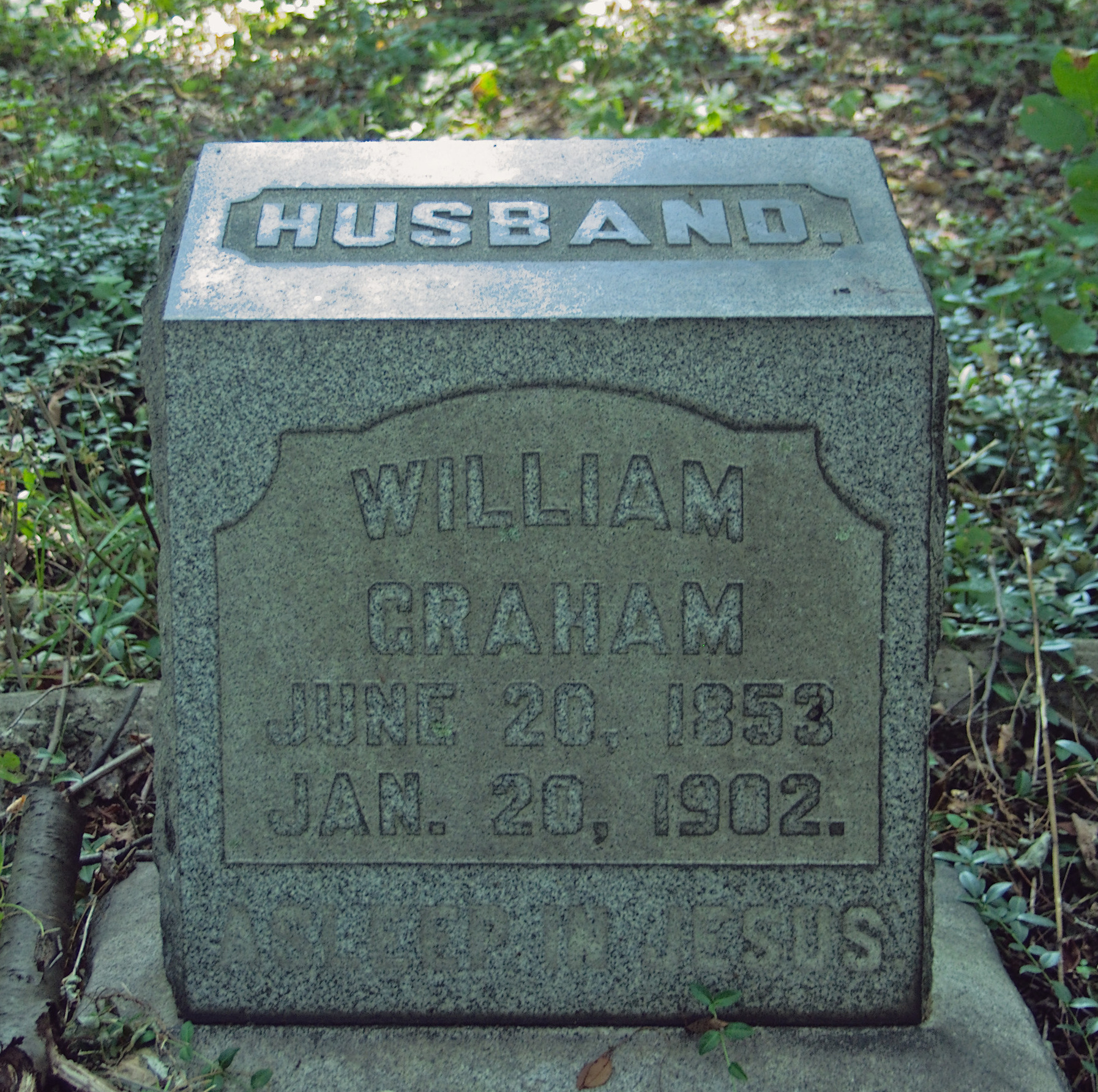

Note, again, the luxuriant growth of Vinca minor.
There are tombstones here that go back to the 1840s at least, but most of the older ones are illegible, if they can be found at all. Here, however, is a legible tombstone from 1842 (forgive the strong backlighting):
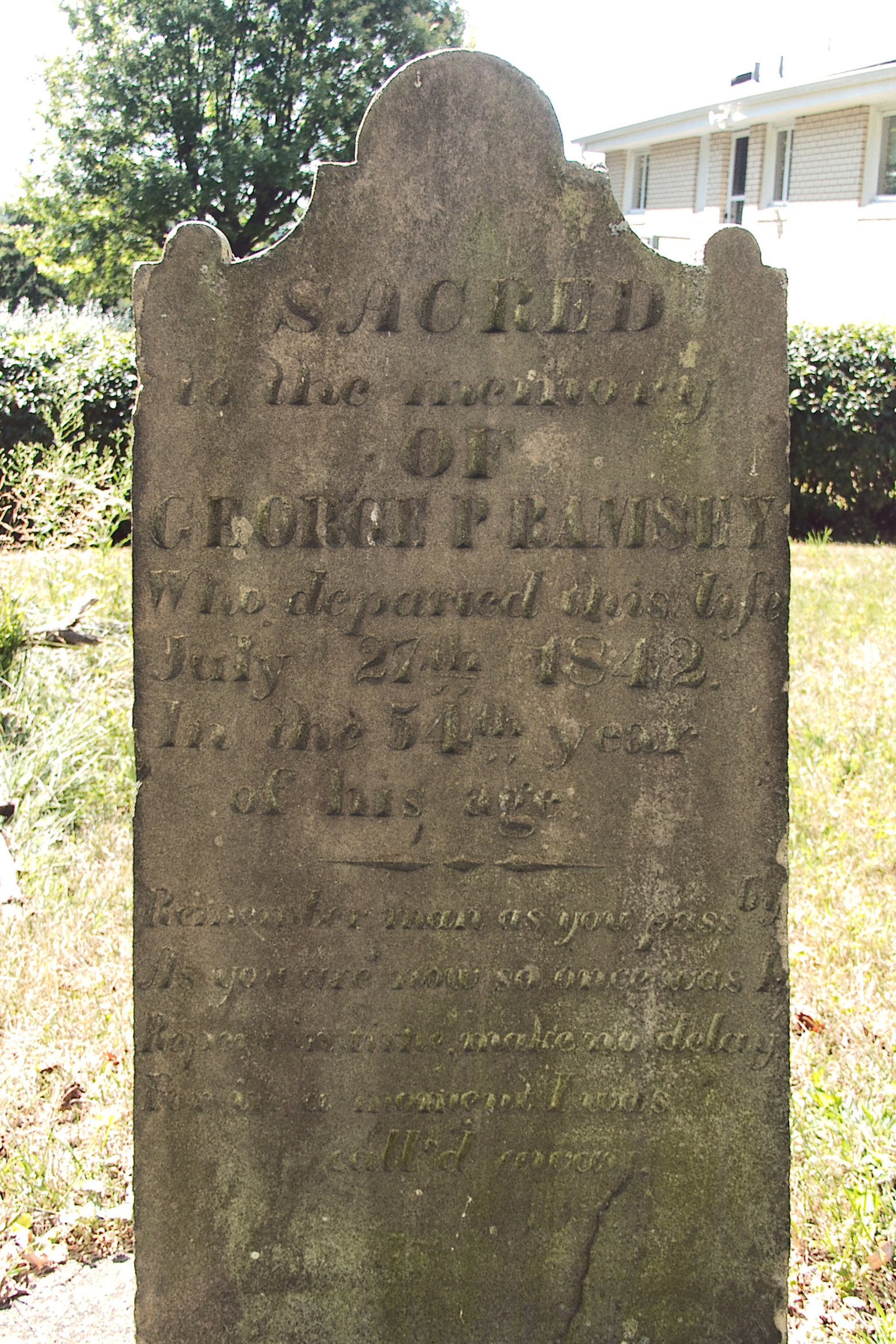
SACRED
to the memory
OF
GEORGE P. RAMSEY
Who departed this life
July 27th 1842.
In the 54th year of his age.
—
Remember man as you pass by
As you are now so once was I;
Repent in time, make no delay,
For in a moment I was call’d away.
The epitaph begins as one well-known funerary poem and ends as another; the last line has five feet instead of four. But it is still a powerful sentiment.
In spite of the general neglect, someone cares enough to see that all the identifiable veterans have flags for their graves, so that little flashes of red, white, and blue light up the floor of the woods. Here is the grave of Corporal David Aston, a Civil War soldier whose birth and death dates are not mentioned:


A priceless piece of folk art, this memorial to two children who died in the late 1800s was carefully carved by a barely literate family member or friend who makes the letter N backwards. The carver could not carve delicately enough to spell out the names, so we get only initials, which doubtless were enough for the family as long as memory endured.
Old Pa Pitt calls this “priceless” not necessarily because of the skill involved—it is not an especially skillful work—but because it documents how ordinary people of the late 1800s imagined a tombstone should look. It is clearly an imitation of the tombstones of fifty years or more before, complete with a little tree laboriously scratched into the stone for each of the two deceased.
Father Pitt is having a little trouble working out the dates. The obvious way of reading the stone is to divide it in left and right halves:
C. H.
BORN AUGUST
26 • DIED
OCT • 6
1881
W. H.
BORN
FEB • 19
DIED•FEB
1
1891
You can see the difficulty: this reading has W. H. dying before he was born. Perhaps the stonecutter has recorded only the birthdays and omitted the years of birth, in which case we do not know for certain even that these were children.
The picture was taken when the stone was strongly backlit. Father Pitt has boosted the local contrast and used various other manipulations to make the inscription more legible.
You might have trouble finding this stone if you went looking for it. It is well into the overgrown woods section of the Mount Pisgah Cemetery, and Father Pitt actually used his foot to hold back a hickory seedling in order to get an unobstructed picture.

This towering monument is in a style all its own. What shall we call it? Pittsburgh German Rococo? The inscription, cut by a local stonecutter (a tradition that survived among the Germans here decades longer than it did among English-speakers) quotes from Job: in the words of the King James Version, “Seeing his days are determined, the number of his months are with thee, thou hast appointed his bounds that he cannot pass.” The German translation of the first line would be more closely rendered as “Short are the days of man,” which is a more striking sentiment that seems tailor-made for an epitaph.

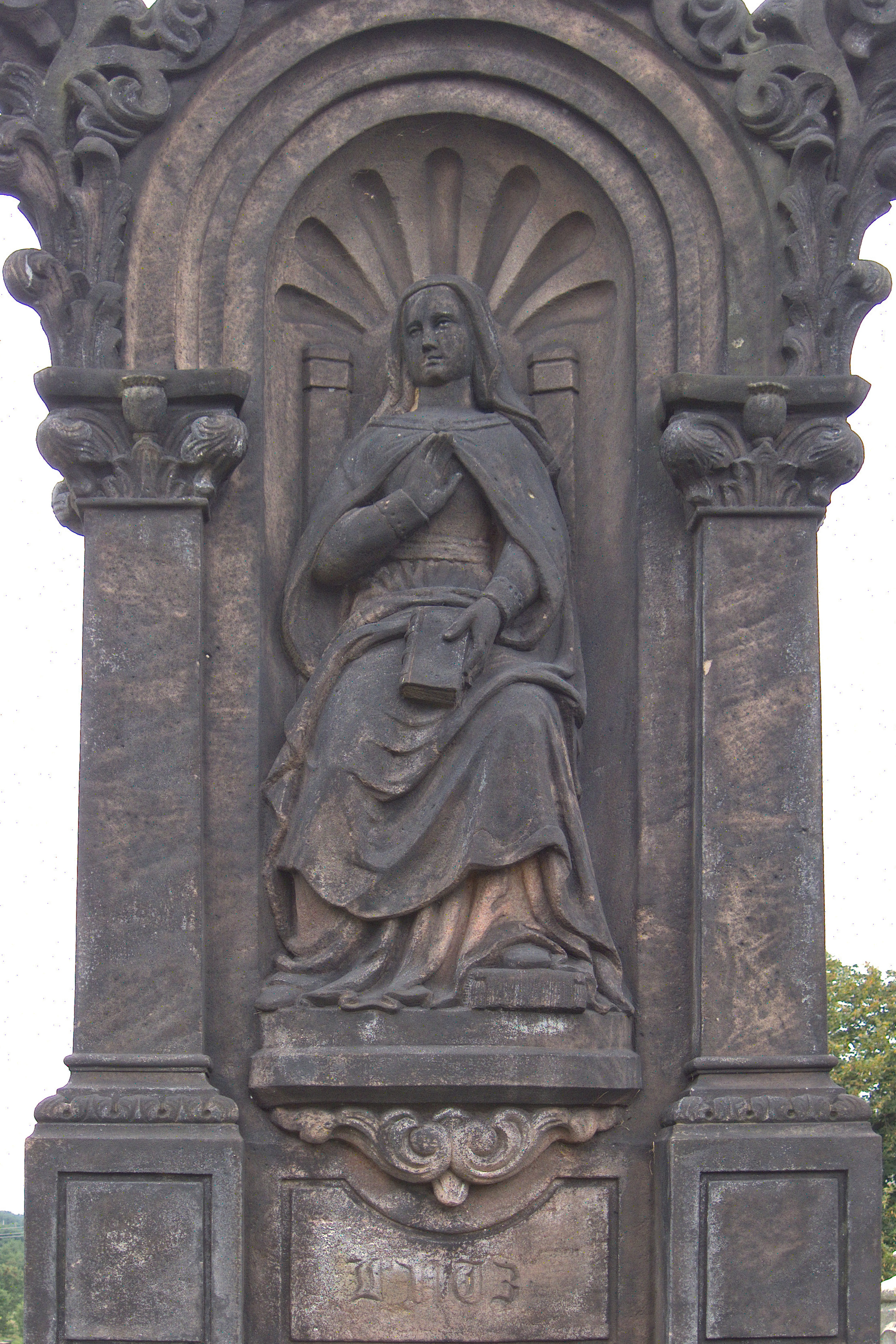
The relief is a bit elementary, like something that would have been turned out by the second-best student in a community-college sculpture class. The overall composition, however, is unforgettable. The blackness of industry has only added to the impression that this monument is something colossal and important.

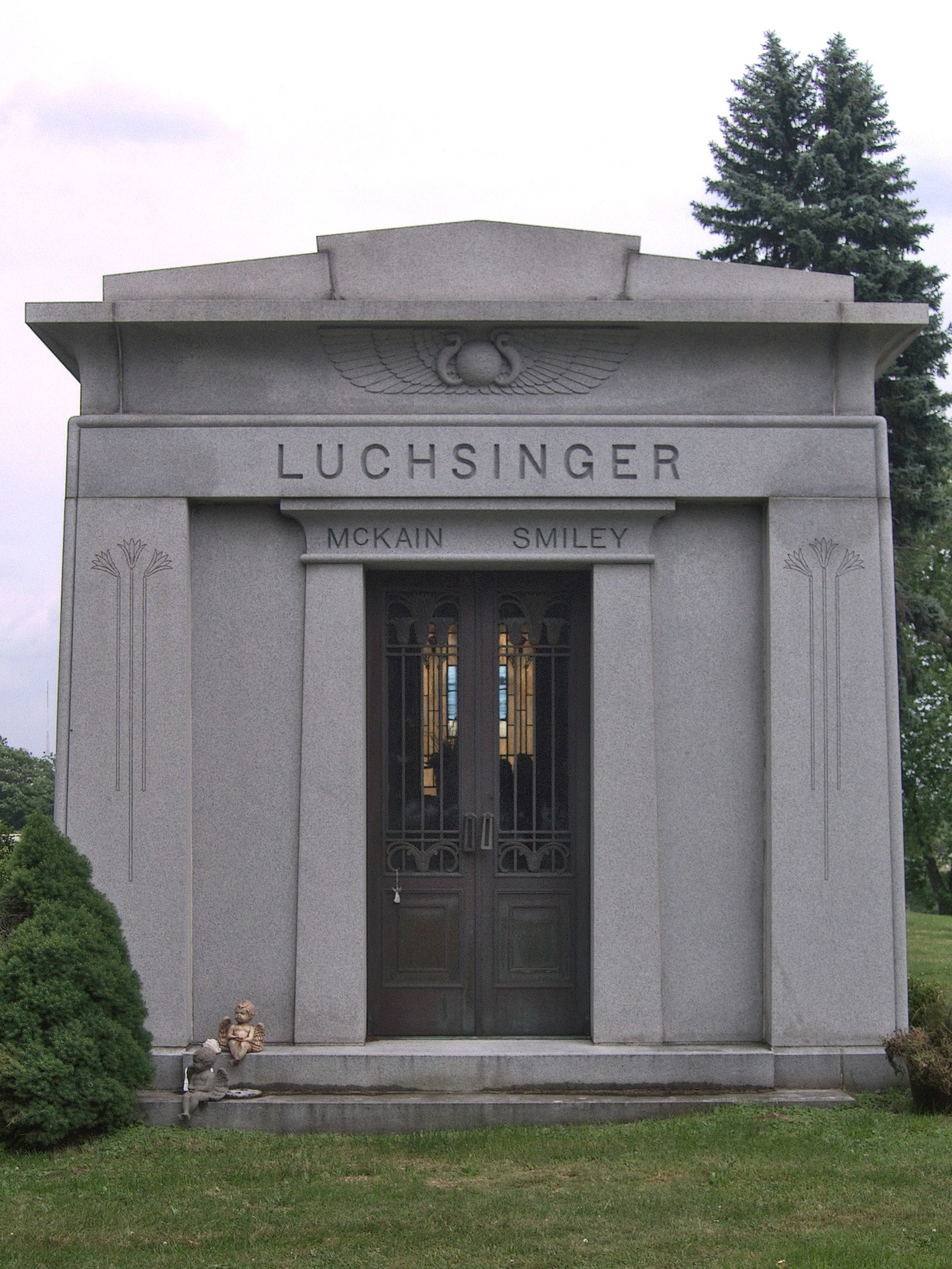
A smallish but still thoroughly Egyptian mausoleum; Father Pitt guesses it is fairly late in the era of the second Egyptian Revival. Inside is a simple but effective stained-glass view of a pyramid.


