Pittsburgh Cemeteries

The Art and Architecture of Death

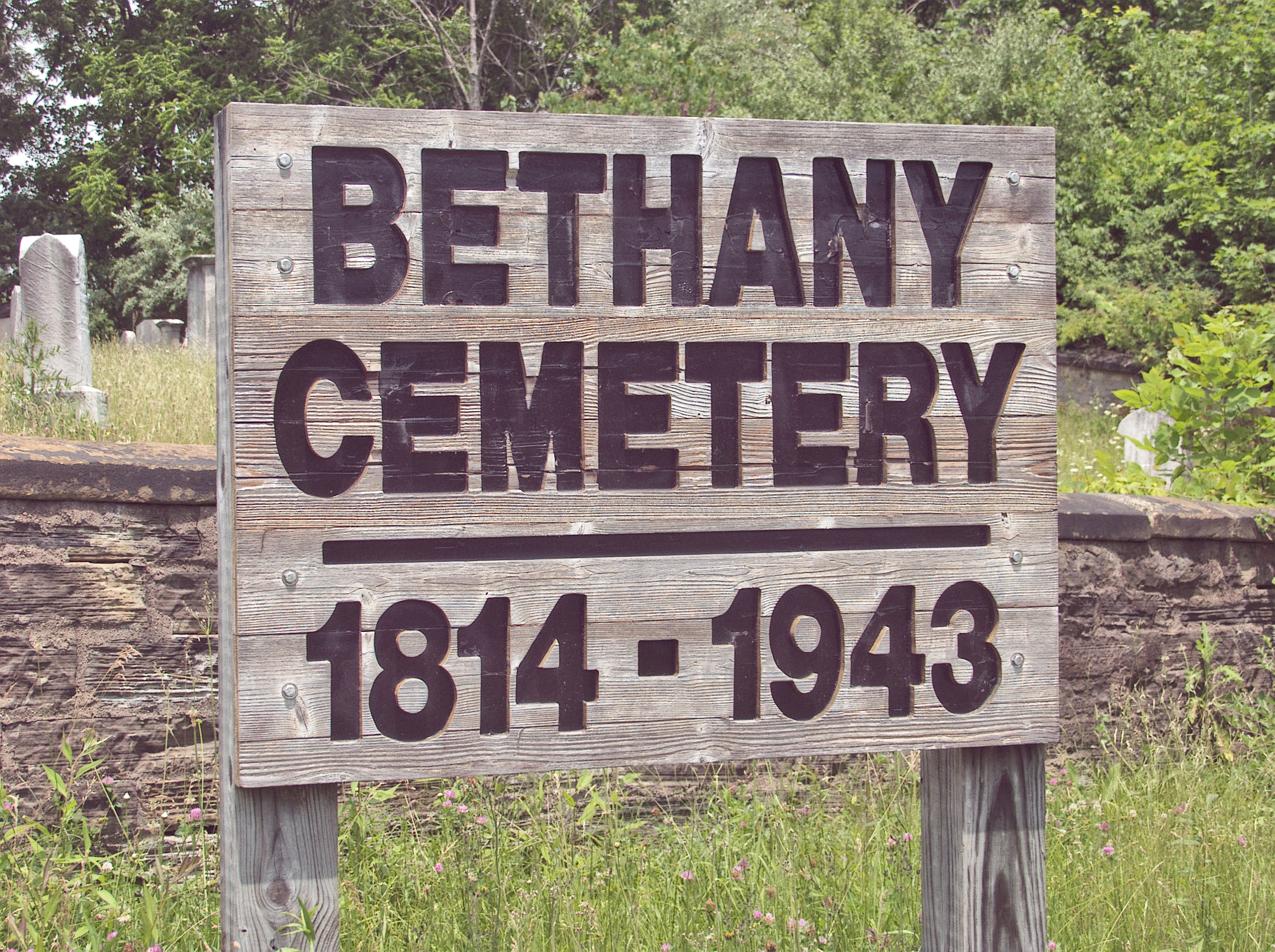
The Bethany Cemetery was originally the churchyard of Bethany Presbyterian Church, now located on Washington Avenue in Bridgeville. It was founded in 1814 and continued to receive burials until 1943. Many of the early tombstones from 1830 and before are still quite legible.

Visiting this cemetery is a bit of an adventure. It sits above the Presto-Sygan Road, and just to the south of the cemetery there is a little space in the weeds where one can pull off and park—if no one else is parked there. One must then walk back along the road, squashed against the stone wall, until one reaches the steps up into the cemetery.

This skillfully cut stone from 1824 is, so far, the only tombstone of its era Father Pitt has seen that is signed by the stonecutter: “J. Sumny sculpturemingo.”

We suspect that “Mingo” (a name often used for local Indians) is the name of a settlement, now vanished; and that “sculpture” is the stonecutter’s incorrect expansion of the often-seen abbreviation “sculp.” after an artist’s name, which stands for the Latin “sculpsit.” We also suspect that this is not the only tombstone by J. Sumny in the cemetery; several others look like his work.

Note the curious curved square cut to the right of the number 32. Father Pitt’s guess is that this is a correction: the stonecutter may have incorrectly cut “aged 32d years.”

“Pastor Russell,” as his followers called him, founded the Watch Tower Bible and Tract Society and the International Bible Students Association, the organization that—after various schisms and defections—came to be known as Jehovah’s Witnesses. He was born in Allegheny (now the North Side), and when he died he was buried in what is now (after a number of changes of ownership) the Rosemont, Mt. Hope, & Evergreen United Cemeteries in Ross Township.

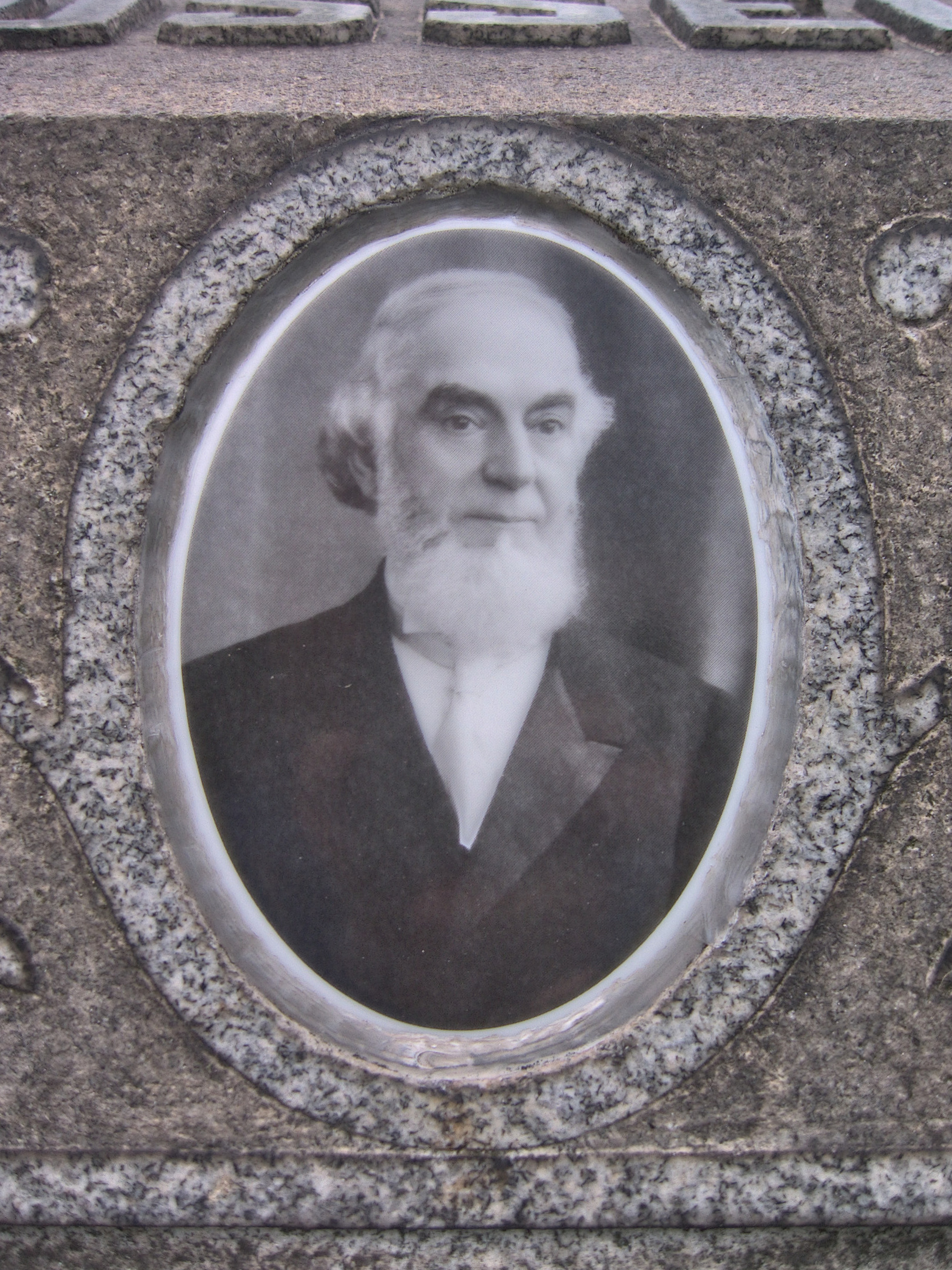
His fairly modest grave monument includes a photograph of Pastor Russell, lovingly preserved (and perhaps replaced more than once over the years).

Note the inscription identifying Pastor Russell as the Laodicean Messenger, or “the angel of the church of the Laodiceans,” as the King James Bible translates it (Revelation 3:14). Russell’s followers believed that he himself was that messenger.

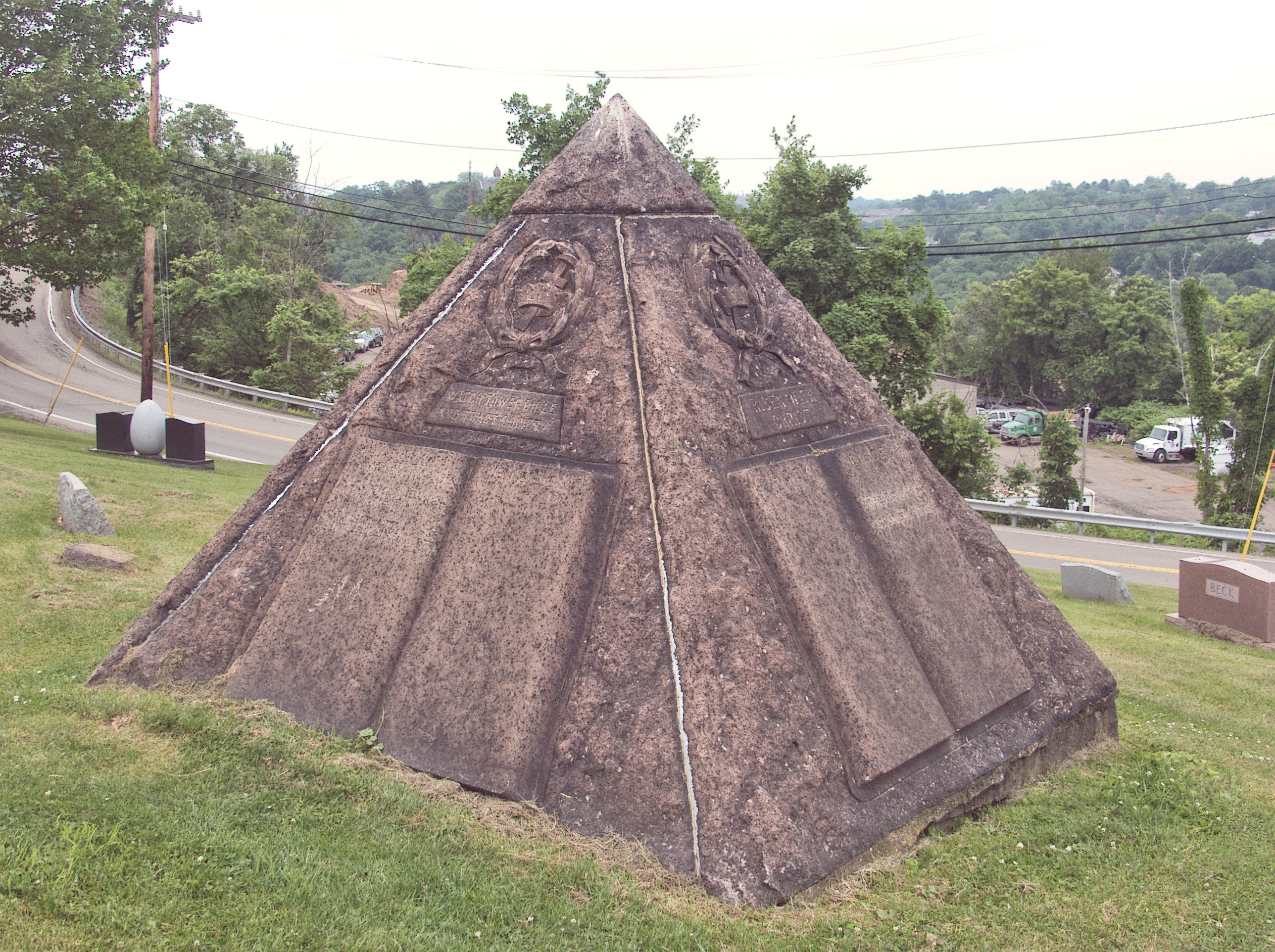
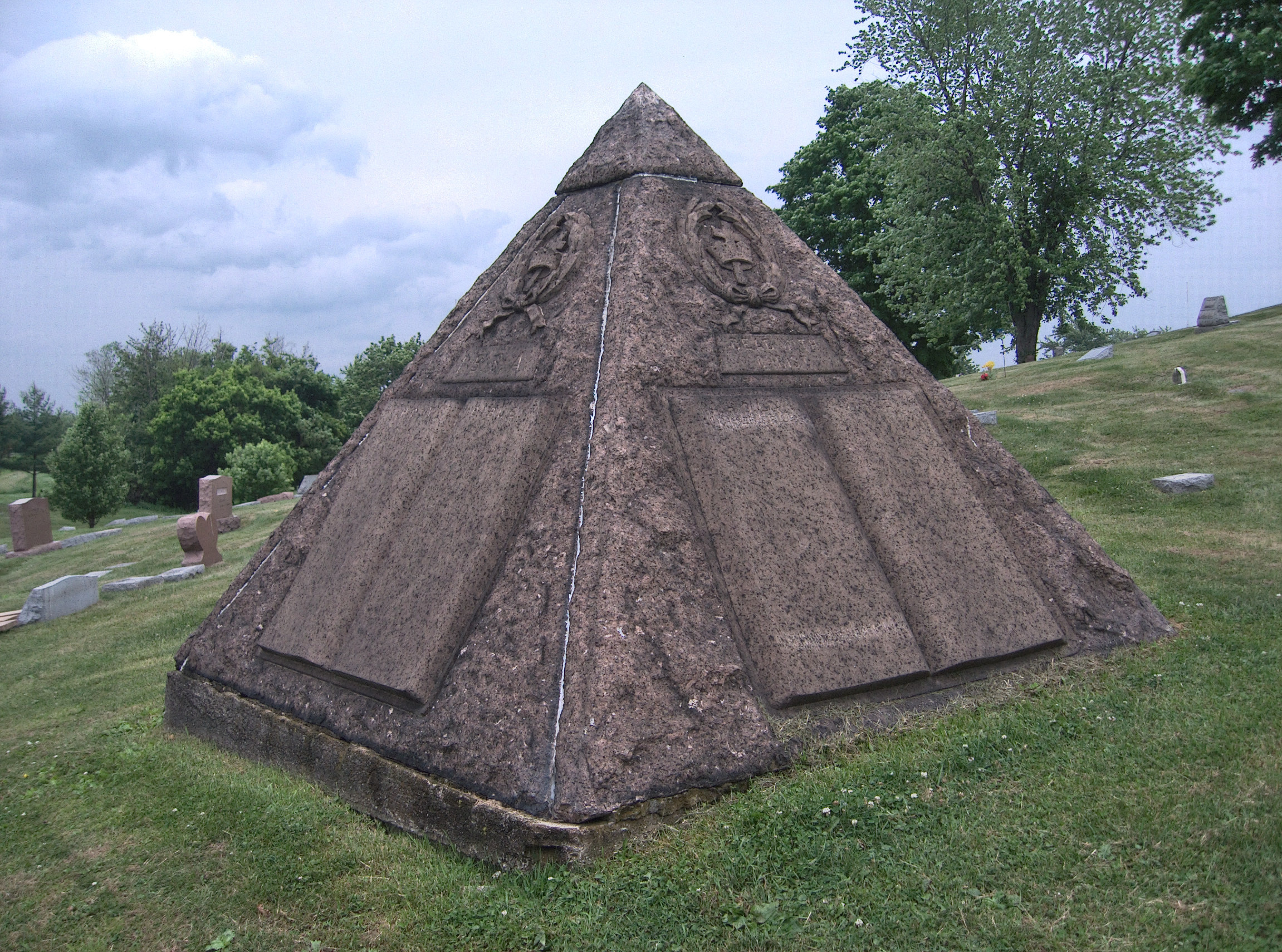
Russell died in 1916. In 1921, some of his followers erected a showier monument in the form of a pyramid. One of Russell’s odd beliefs was that the Great Pyramid in Egypt was designed by God himself as a prophecy in stone. Like most such prophecies, it was meant to be uninterpretable until the correct clever interpreter came along—in this case, Pastor Russell.

This is actually one of the few cemetery pyramids in the Pittsburgh area whose proportions are Egyptian rather than classical Roman. It is meant to have the same proportions as the Great Pyramid, and in particular the capstone is carefully proportioned to match the Great Pyramid’s capstone, which in Pastor Russell’s interpretation represents the Christ.

The pyramid was meant as a marker not only for Russell, but for a number of other members of the Watch Tower Bible and Tract Society, who owned this plot in the cemetery. A few names are inscribed in the open Bibles on the four sides of the pyramid, but most of the blank space was never used. It seems that the separate ownership of this plot has been preserved through the various changes of ownership the rest of the cemetery has gone through.

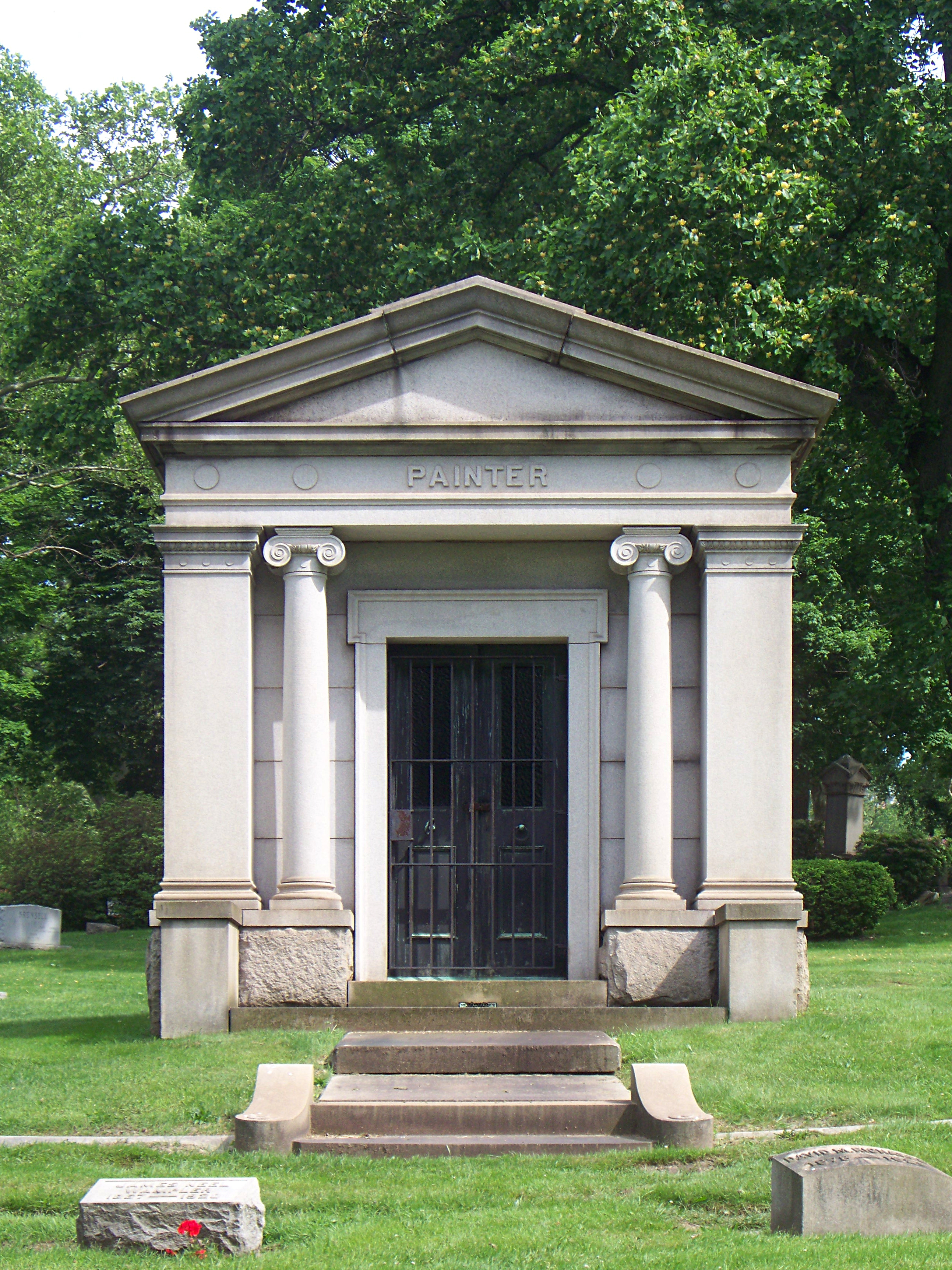
This imposing Ionic mausoleum stands in its own circular plot with a commanding view of the valley below. It is a common sort of classical mausoleum, and yet it seems different enough from the classical constructions in the Pittsburgh cemeteries to remind us that we are in McKeesport, which is a different world. The first Painter took up residence here in 1902, so the mausoleum dates from that year or before.

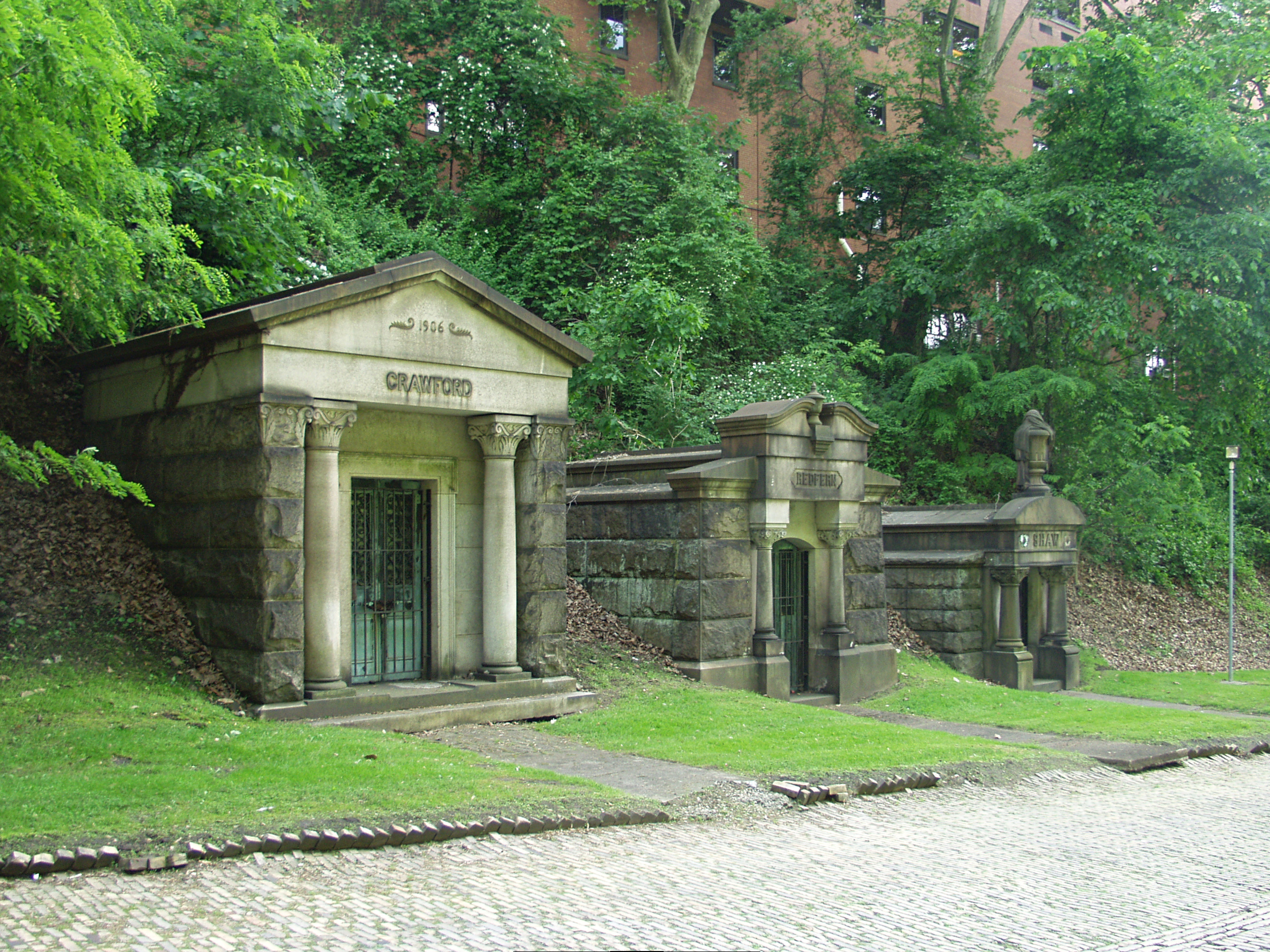
Another mausoleum in this cemetery whose style is hard to pin down. The shape is classical, but the capitals on the columns are more like a medieval interpretation of Corinthian capitals than they are like classical Corinthian capitals. Below we see this mausoleum as it stands in a row with the Redfern and Shaw mausoleums, just inside the Fifth Avenue gate.

This is a particularly splendid Ionic mausoleum. Its richness of texture makes most other classical mausoleums seem half-finished by comparison. It appears to be an exact duplicate of the Fownes mausoleum in the Homewood Cemetery, but with the addition of an extra set of steps in the front to take into account the hillside site.

The bronze doors are cast in an interesting pattern.

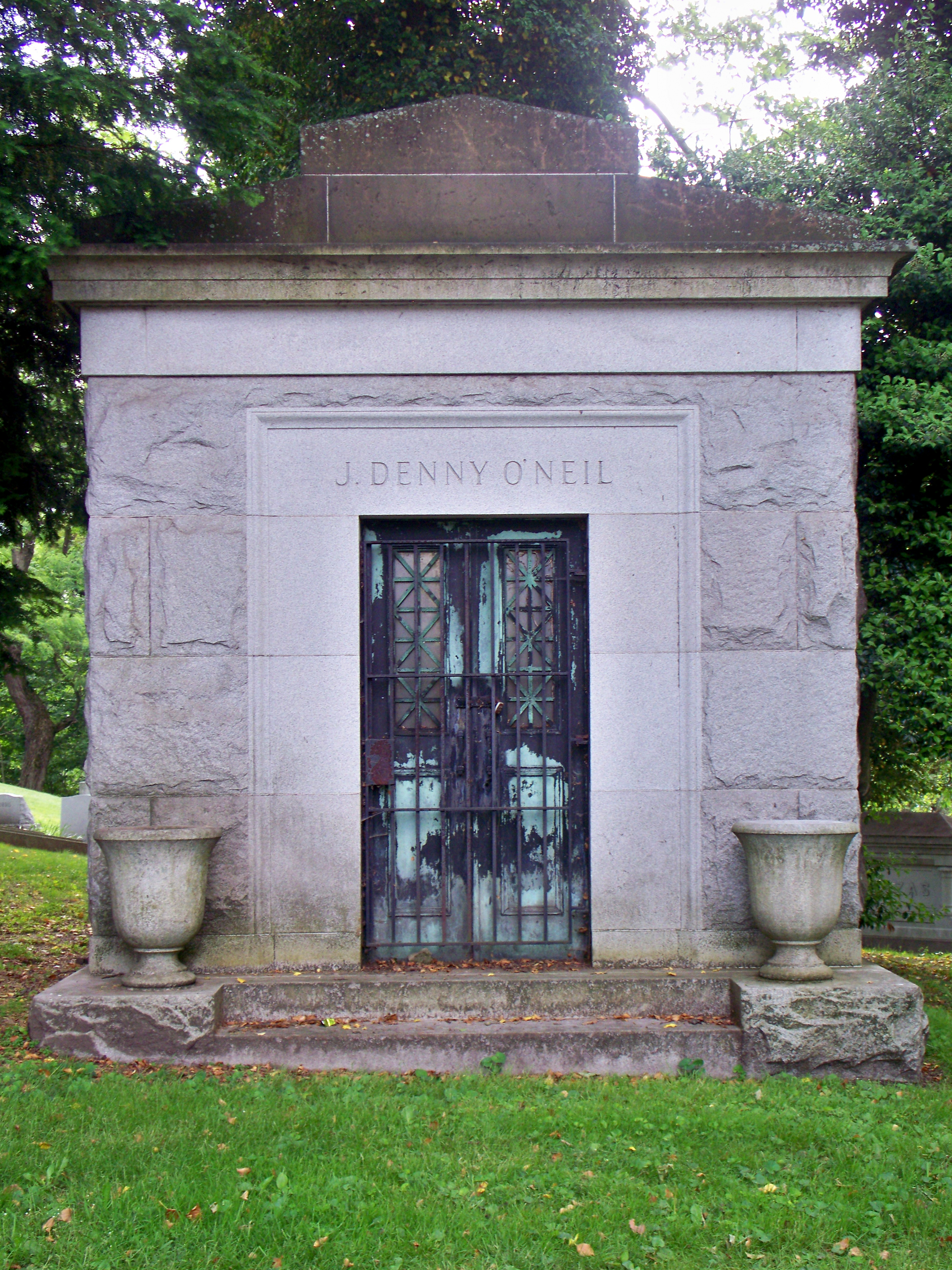
An unusual mausoleum in this unusual cemetery—unusual because its restrained modern-classical style would look at home in other Pittsburgh-area cemeteries, whereas most of the mausoleums here are noticeably different from any standard Pittsburgh style. Cemetery records list a James D. O’Neil (who must be the “J. Denny” of the inscription) as the first interment here; he died in 1915, so that is probably about the date of this mausoleum.

Without the date 1926 on the front, we might be forgiven for supposing this rustic stone vault to be a relic of the Neolithic era. The date, however, is a bit of a mystery: cemetery records list burials here as early as 1889 (and as recent as 1990). Perhaps 1926 is the date of a major reconstruction of the front, and the stonework to either side is earlier.

This mausoleum once had urns flanking the entrance (probably dating from the 1926 construction, if we accept that some of the stonework is earlier), but only the bases remain. The base on the right-hand side is nearly obliterated by the advancing years. Like many mausoleums in this cemetery, it is half underground; and the slope of the drive in front gives us a good indication of the kind of landscape the architects had to deal with.

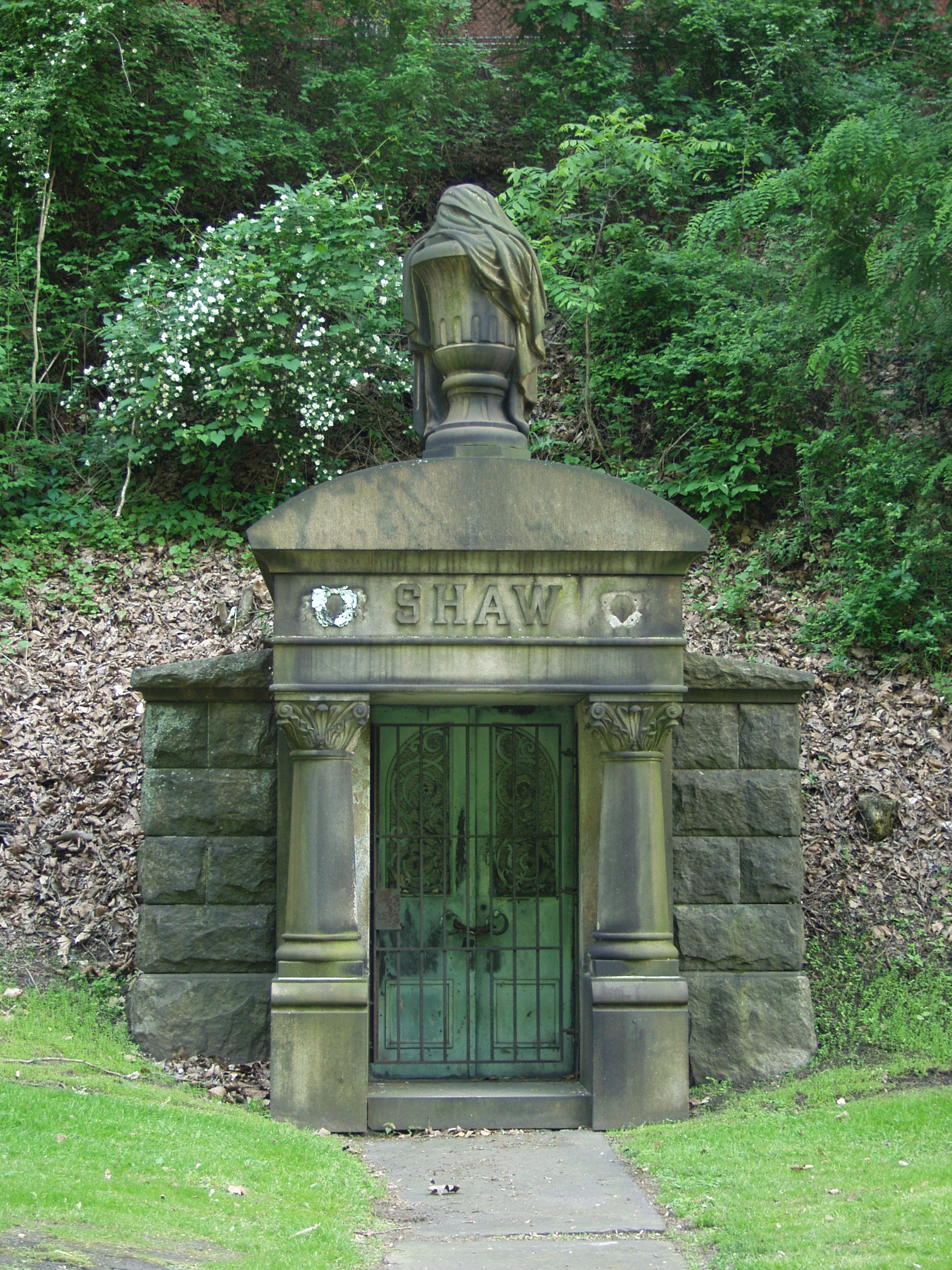
Yet another mausoleum in this cemetery whose style is hard to define; we shall call it Romanesque, because of the rusticated stone, the medieval columns, and the divided arch in the bronze doors. The huge urn on top is almost cartoonish. Two bronze ornaments flanking the inscription have been stolen, probably to be melted down for their trivial worth in metal.

The earliest interment listed here was in 1896, and the most recent in 2001.

Another unusual design from this cemetery. We shall call the style Romanesque because of the prominent round arch and the rusticated stone, but once again the architect has refused to meet our expectations of the Romanesque in the details. You will find nothing quite like it in the Pittsburgh city cemeteries. According to cemetery records, this mausoleum received its first burial in 1883—a few years before the Allegheny County Courthouse opened the floodgates of the Romanesque revival in the Pittsburgh area.