Pittsburgh Cemeteries

The Art and Architecture of Death

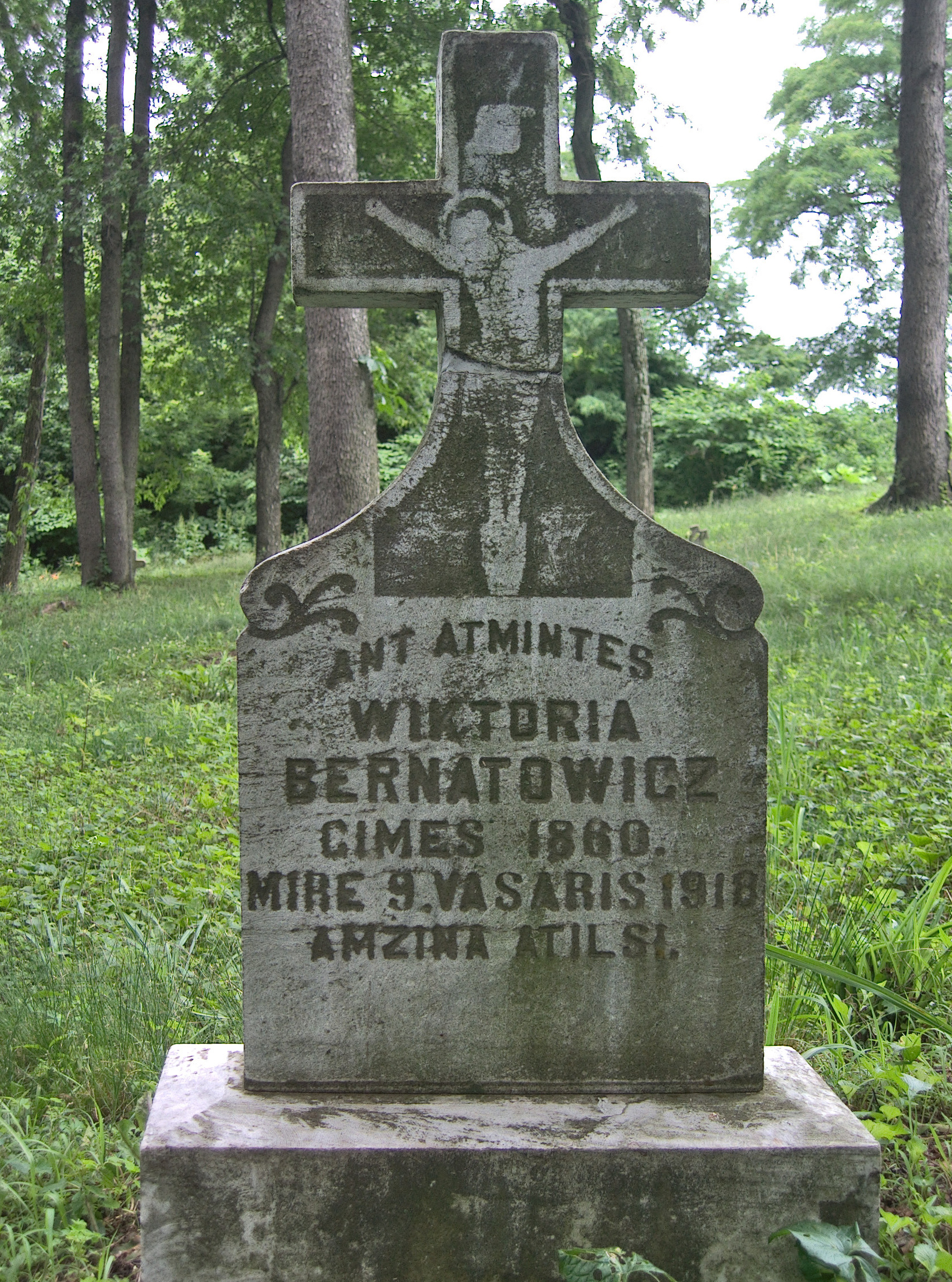
A Lithuanian tombstone in a good state of preservation. European immigrants tended to bring with them their memories of what a gravestone should look like, so we find very different styles in different ethnic groups. This is a common East European style. The East European tombstones here were often decorated in very shallow relief, much of which has vanished in a century or so of erosion; but this crucifix is still visible in outline, though the details are lost.

With the help of Google Translate, here is the inscription:

IN MEMORY OF
WIKTORIA BERNATOWICZ
BORN 1860
DIED FEBRUARY 9, 1918
ETERNAL REST

A simple rectangular stone is unusual in this era. This stone commemorates two Andrew Russels (note the spelling of the name). The first died in 1808 at six years old. (If a tombstone says “in the x_th year of his age,” it usually means the deceased was _x years old, though technically an x-year-old is in the x+1 year of his age.) The second died in 1814 at 82 years old, so he was probably a great-grandfather of the first.

Father Pitt believes that this stone was put up in 1808, and the inscription for Andrew Russel, Sr., added in 1814. His evidence is, first, the word “Also,” and second, a demonstrable difference in the styles of lettering between the two inscriptions. The second is well matched to the first, but probably by a different hand, one that made thinner letters—or possibly by the same stonecutter after six more years of practice.

IN MEMORY OF
ANDREW M. RUSSEL
who died
Feb,y 27th 1808;
in the 6th year of his age.

ALSO
ANDREW RUSSEL, Senr
died
June 20th 1814;
in the 82nd year of
his age.

Well, here is an interesting little mystery. There is some story behind this triple monument, but old Pa Pitt has not been able to unravel it. His usually fruitful speculative imagination has failed him. If anyone knows the real story of the monument, a comment below would be very welcome.

This triple monument commemorates three people named Barrett. Hannah Barrett died in 1864 at the age of 25; William Barrett died in 1868 at the age of 24; and Dennis Barrett hasn’t died yet. Well, clearly he has, since we have not heard of any 150-year-old Barretts roaming the earth; but his death date has never been filled in.

Now, who were these people? It is not impossible that William and Hannah were husband and wife, though she was five years older than he was, and he would have been only twenty when she died. The position of the stones seems to make that unlikely, however. Hannah takes precedence—again, not impossible, but every nineteenth-century instinct would have made a husband and wife’s monuments equal, or the husband’s the central and higher one. And who was Dennis? A son? A father?

It seems more likely that they were brother and sister, Hannah taking precedence because she was the elder. And then who is Dennis? Was he another brother who was still alive when the monument was bought? One can imagine the conversation with the monument salesman: “You have that other son, too, right? What’s his name—Dennis? He’s coming up on twenty now, and the way your family’s going you’ll need a stone for him in four or five years. It happens we’re having a three-for-the-price-of-two special this week only, so…”

If Dennis was a brother who lived a long life afterwards, it would explain why his stone was never filled in. He might well have married, fathered children, and been buried in his own family plot fifty or sixty years later, possibly in another part of the country.

One final question: When was the stone bought? Father Pitt’s eye for cemetery styles suggests that it’s more likely to have been in 1868, when William died, than in 1864, when Hannah died. Did Hannah go without a marker for her grave for four years? Or did the family purchase a monument for all three when Hannah died, on the principle that everybody’s got to go sometime?

Three different burials in the same family plot show us three different styles of early-settler tombstones.

Jacob Bell lived the longest of the three: he was buried in 1842. Shortly after that, local stonecutters would begin to be replaced by more centralized businesses, so this is one of the last of what Father Pitt would call the early-settler tombstones. It does not seem as elegantly cut or proportioned as the earlier tombstones, which makes us wonder whether the stonecutter’s craft was already fading. The inscription reads:

SACRED to the MEMORY OF JACOB BELL, Who departed this life, Nov. 18th 1842 in the 75th year of his age.

Elizabeth Bell, Jacob’s “consort” (the stonecutters’ preferred term for “wife”), died in 1829, and her tombstone is typical of the time. It is not as elaborately cut as some other 1820s tombstones, but compare it to Jacob’s and see how much better formed the individual letters are, and how much more carefully laid out the lines are in the inscription.

IN Memory of ELIZABETH BELL, Consort of JACOB BELL Who departed this life January 13th A.D. 1829 in the 58th year of her age.

Finally, Charity Bell, who was probably a daughter of Jacob and Elizabeth, died in 1832, and was given a tombstone of the Gothic shape popular in the 1830s. The lettering is done very well (non-standard spelling of the month notwithstanding), and the stonecutter has added the tree ornament—probably intended as a weeping willow—that we commonly see on early-settler tombstones.

IN MEMORY OF CHARITY BELL Who departed this life Aprile the 6th A.D. 1832 in the 35 year of her age

This triple tombstone, the only one of its kind from its era that Father Pitt has ever seen, remembers three Allison children who all died in January of 1836. The cause of death is not stated, but it must have been some childhood disease that carried them off one after another. Scarlet fever is a likely candidate.

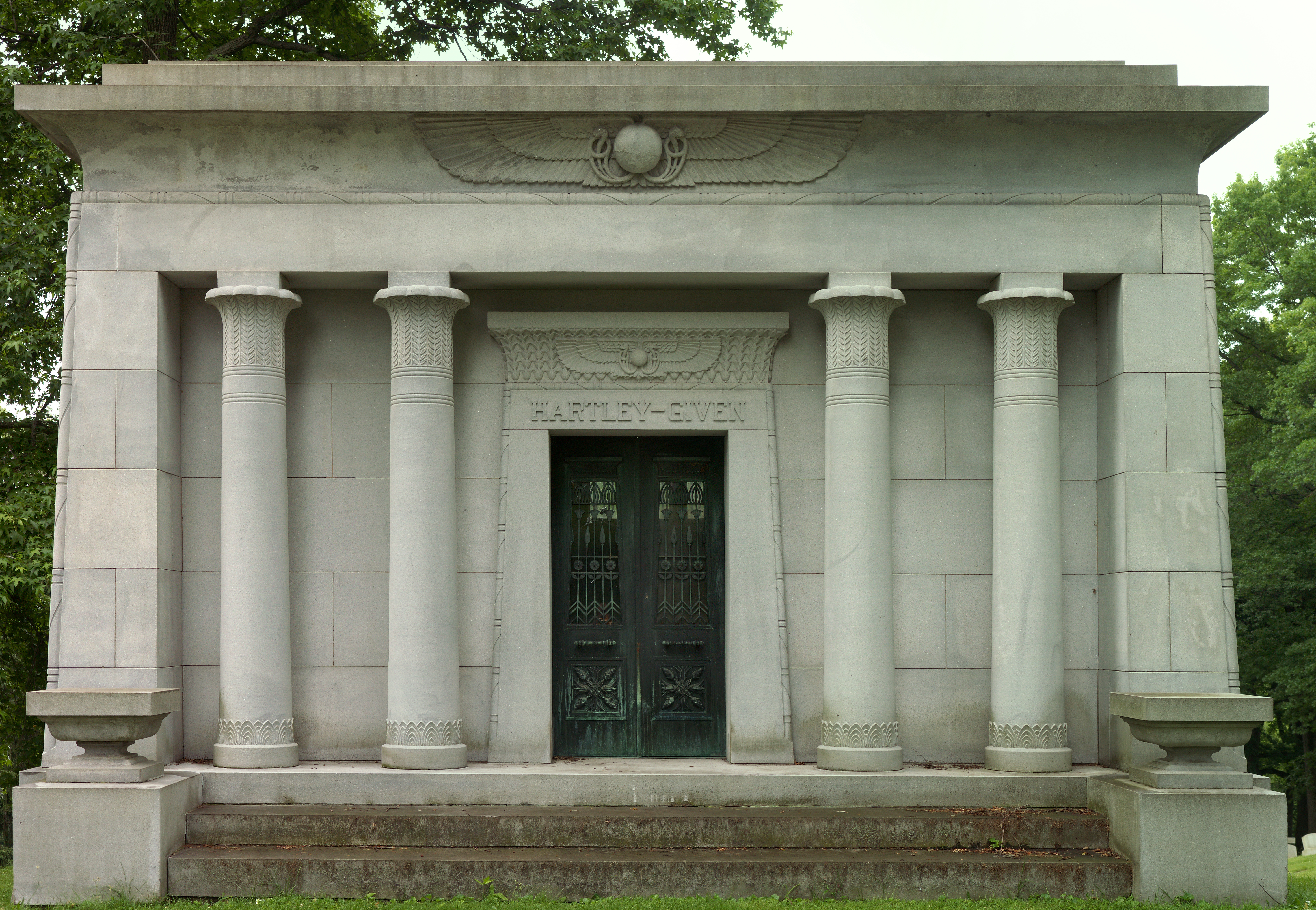
A typical Egyptian temple, except perhaps that it is rather grander than usual. It was built in 1913, and we can see the elements that almost invariably mark the Egyptianness of the style: the sloping sides and the lotus columns. Over the entrance we almost always find a winged sun disk or scarab entwined by serpents.

The picture above is huge if you click on it: there’s plenty of detail to appreciate, but be aware that clicking on it will cost you about twelve and a half megabytes.

A Doric mausoleum with a wreath in the pediment. The rusticated stone gives the structure, which bears the date 1906, a richness of texture that contrasts well with its simplified Doric entablature.

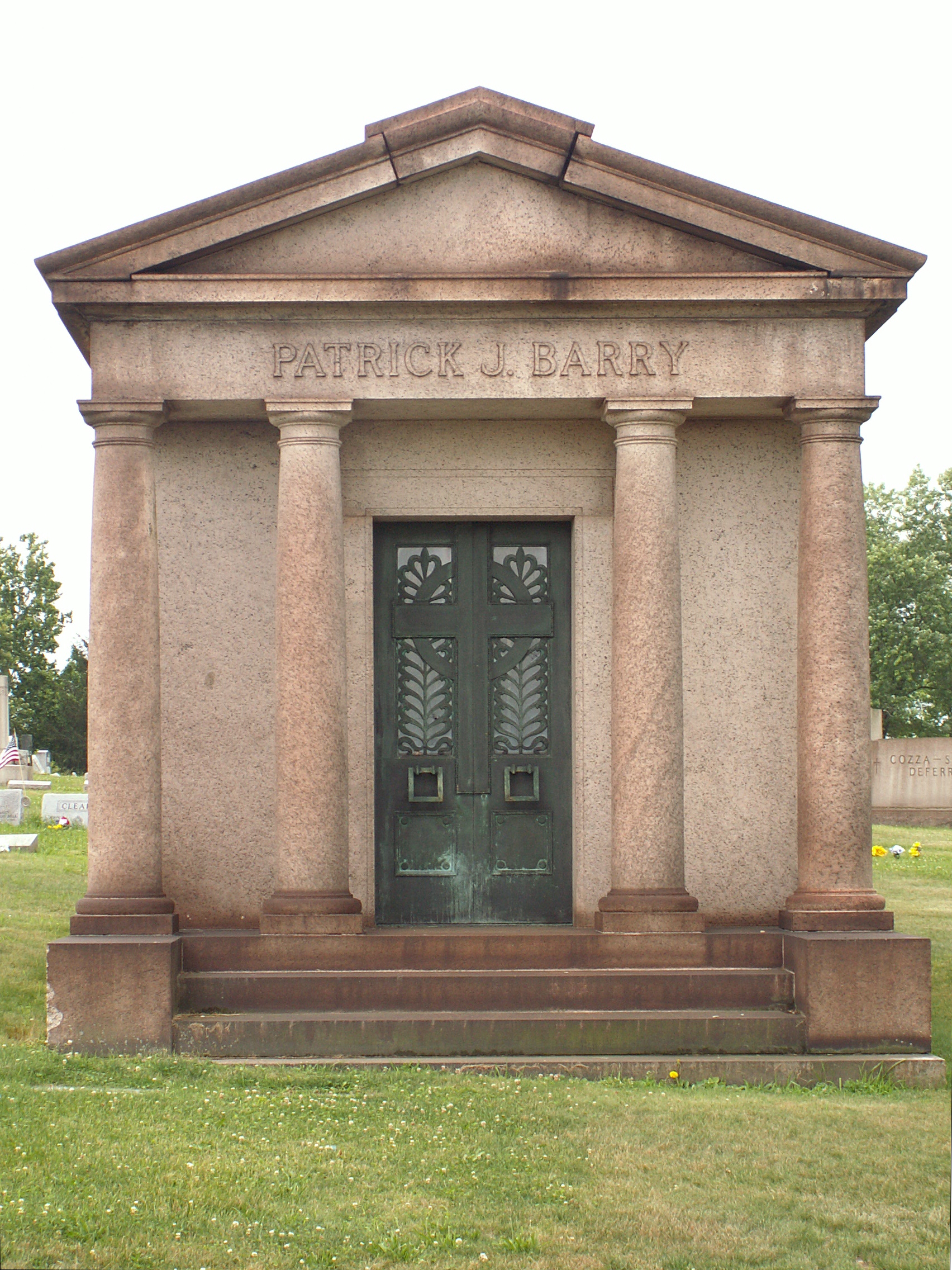
A somewhat unusual shape for a classical mausoleum. The bronze door is striking, with an Art Nouveau arrangement of cross and palms.

A simple and austere Doric mausoleum whose austerity is mitigated by a fine cross-and-palms bronze door and the fairly unusual warm honey color of the stone

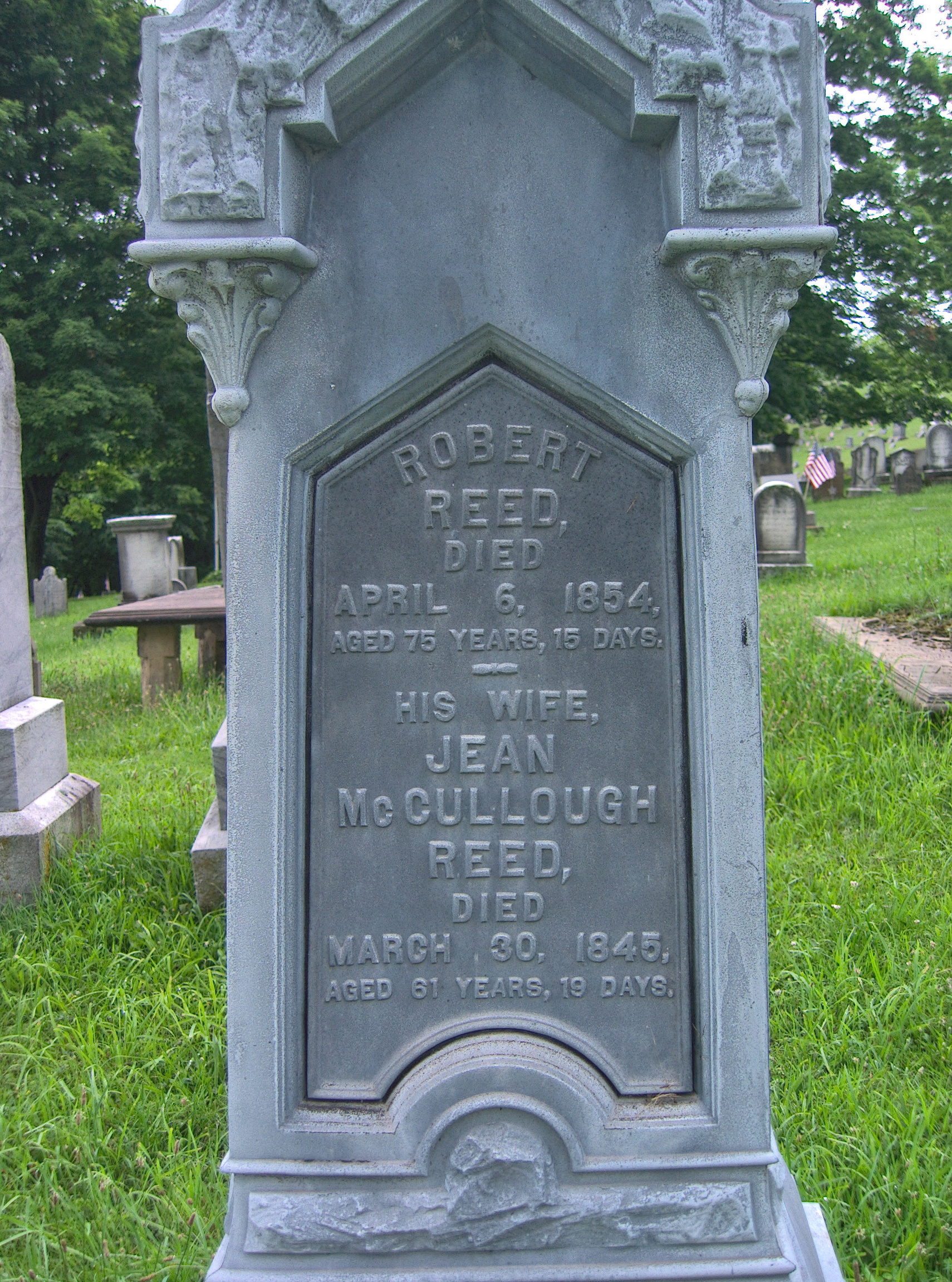
A typical zinc pillar with every panel filled to capacity with inscriptions. Father Pitt guesses that it was bought in about 1899 (the date of the death of Harvey Neill Reed), but the family took the opportunity to remember many other Reeds perhaps otherwise unrepresented by monuments, going all the way back to 1839. A Reed family was among the first settlers of the Canonsburg area, and some of those early settlers have tombstones very near this plot; these Reeds are probably related.