Pittsburgh Cemeteries

The Art and Architecture of Death

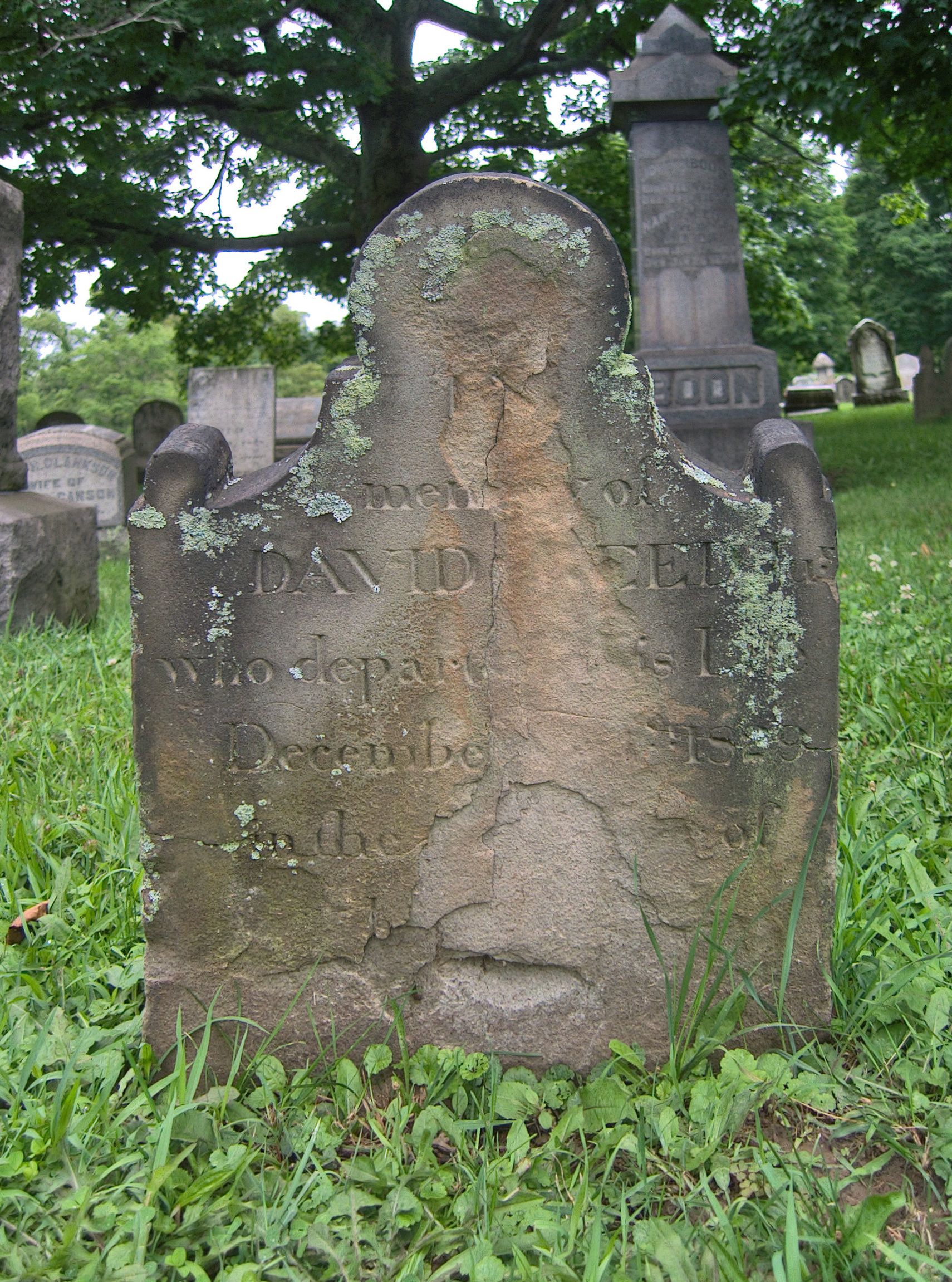
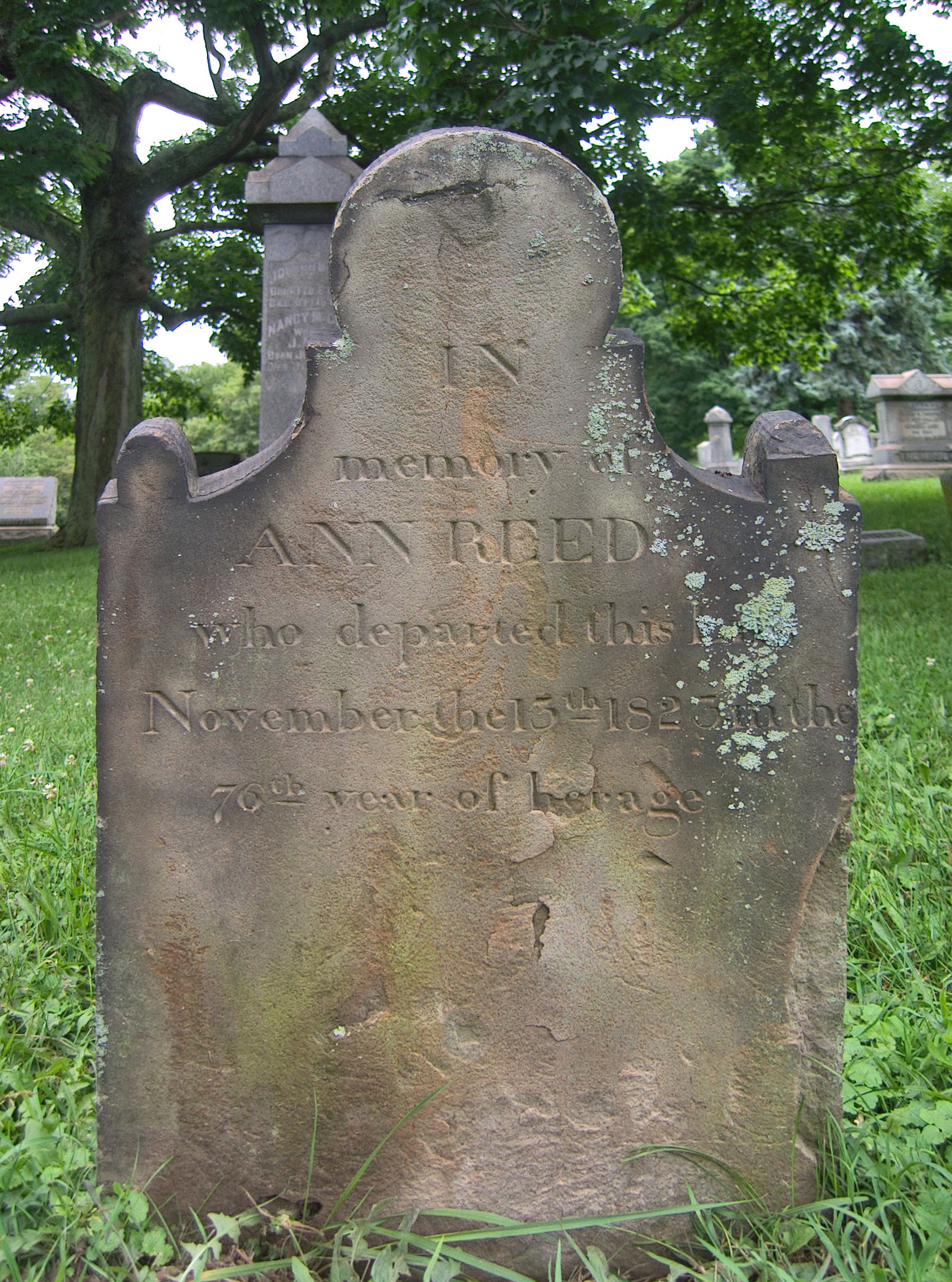
David Reed was one of the early settlers in the Canonsburg area, according to the cemetery’s Web site; we know that he was here by at least 1779. He hosted George Washington at his house, which was awfully considerate of him, considering that Washington had come to take his house away. George was a big-time real-estate speculator, and he had claimed huge tracts of land in what was, to him, Augusta County, Virginia. (The area south of the Ohio River was still fitfully disputed between Virginia and Pennsylvania until after 1800.) The Reeds and many other settlers had moved here on the strength of other claims to the same land, and politely told Washington they would await the decision of the court. Courts ultimately ruled in favor of Washington, but the settlers moved only a short distance, close enough to walk to their little log church and be buried in its churchyard.

Ann’s tombstone is well preserved; David’s is damaged, but enough of the inscription remains to tell us that he died in December of 1829, fifty years after his first appearance in the records as an elder of the church.
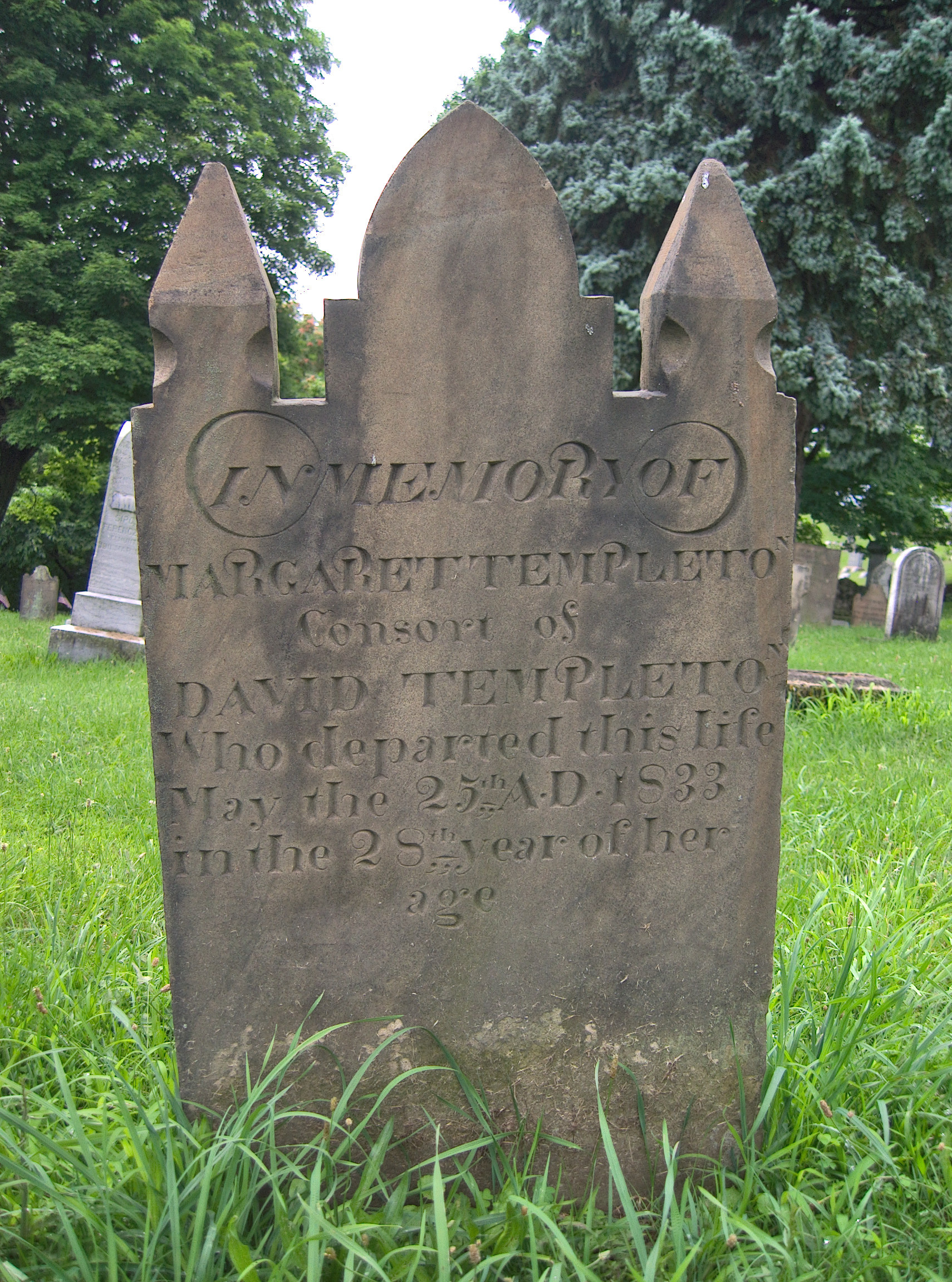
Somehow the stonecutter managed to run out of room twice while cutting the name “Templeton” into this stone for a young wife who died at the age of twenty-eight. (“Consort” simply means “wife”; it was strongly believed among rural folk in the early nineteenth century that “consort” was a much more elegant word.) This Gothic style of tombstone became popular at about this time; there are several examples in the cemetery.

Only about half this tombstone is visible above ground—enough to tell us the name and death date (1832), and to show us that the stone itself was a very attractive piece of folk art.

This is an exceptionally elaborate tombstone for 1830. As a piece of folk art, it is priceless. The stonecutter did outrun himself a bit in John’s inscription, forcing him to squeeze the date “1810” into a very small space; but on the whole, even with the damage we see here, this is one of the most attractive stones of that era Father Pitt has ever seen.

If this tombstone was erected in 1805, then it may be the oldest legible stone in this cemetery, and one of the oldest in this area. (Older stones were often of shale or other impermanent materials.) The cemetery’s Web site tells us that the oldest readable stone is the James Ross stone from 1807, but Father Pitt does not know whether that is because this stone is known to be younger than its inscribed date, or because this stone was simply missed in someone’s survey of the oldest stones in the cemetery. Oak Spring Cemetery is one of the largest early-settler burying grounds in the area, and it does not seem to have been thoroughly surveyed.

A tombstone from 1817 remembering a father and daughter. Since they have different surnames, it seems likely that the daughter married; but perhaps her husband had no money for a tombstone, and it was not until her father died (he outlived her by eight years) that she had any memorial.

Old Pa Pitt was not able to read the last part of the inscription, but here is what he could read:

In memory of John Reed Esq. who Departed this life April 14th 1817 in the 73d year of his Age——and Cathrine McLean his daug[hter] who died in the 25th year of her Age 1807 they liv’d in peace with the world in love with their [neighbors?] death…

Note the spelling of “Cathrine.” Reeds were among the very earliest settlers in the Canonsburg area; this is probably a branch of that family.

The stonecutter was the craftsman we identify as the Master of the Curly G, who had a wide-ranging practice: stones of his also show up in Robinson Run Cemetery and Union Cemetery (Robinson Township).

A good and mostly well-preserved early-settler tombstone. It would have been erected in 1825 when Matthew died, to judge by the fact that the inscription seems to have been made all at once. The spelling “Agness” is unusual, but many early settlers were illiterate, and the stonecutters were only barely literate. An update: Father Pitt has changed his mind here: the spelling Agness is not unusual, but rather the standard spelling of the name in western Pennsylvania in the late 1700s and early 1800s. He has found at least three other tombstones of the era with the same spelling.

If you enlarge the picture, you can still trace the faint lines the stonecutter scratched in the stone to guide his lettering.

SACRED to the memory of Agness Bowland Who departed this life 9th of Augt. 1797 in 46 year of her age

And in memory of Matthew Bowland Who departed this life Febry. 13th 1825 in the 82d year of his age.

A mausoleum for priests who have gone home. The style is interesting: the overall shape is very much Egyptian, but there are no pagan Egyptian details, and the rusticated stone and Celtic-style uncial inscription are quasi-medieval.

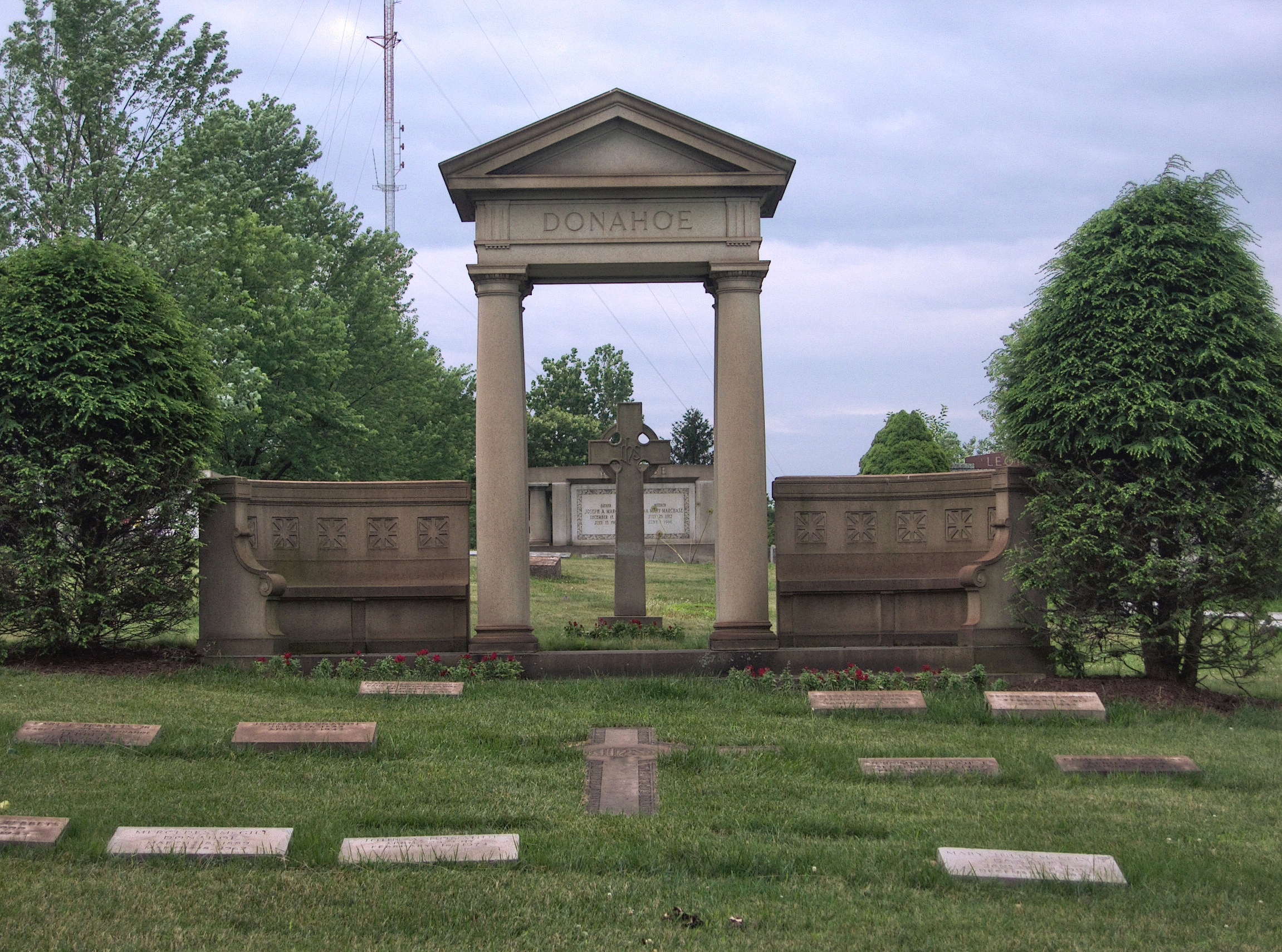
An unusual classical monument: a pediment with two columns flanked by curved benches. The effect is something like a gateway, with the repaired cross behind representing the destination.

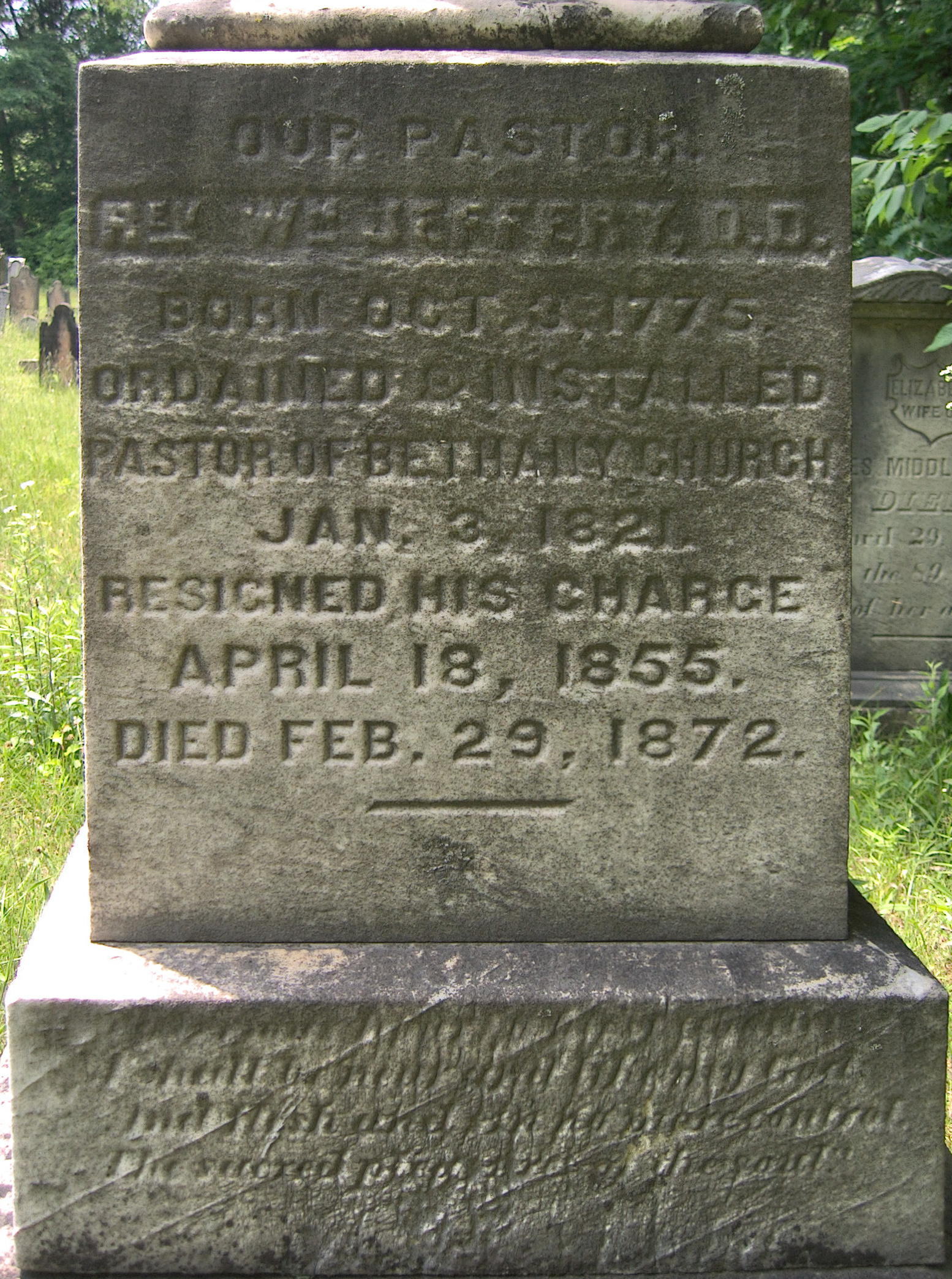
The Rev. William Jeffery, D.D., was pastor of Bethany Presbyterian Church for 34 years. He retired in 1855, as he was approaching the age of eighty; but he lived almost another seventeen years after that, dying at ninety-six in 1872. From the style, we guess that this obelisk was put up when he died.

Pastor Jeffery’s wife is also marked by this obelisk, and so is a daughter Elizabeth, who died at not quite five years old in 1831.

Elizabeth also has her own fine tombstone in the style of forty years earlier, which tells us that she died of that great scourge of nineteenth-century childhood, scarlet fever:

The only proper reaction to such a loss is the one Pastor Jeffery had cut into her tombstone: to quote from the book of Job.