Pittsburgh Cemeteries

The Art and Architecture of Death

This is one of the earlier burials that were moved from nearby churchyards to Prospect Cemetery in Brackenridge, and it is probably the most artistic early-settler tombstone Father Pitt has yet found in this area. The style is a close and extraordinarily skillful imitation of nineteenth-century decorative penmanship styles, so we shall call this craftsman the Master of the Brackenridge Flourishes. And although Father Pitt admits to using the title “Master” a bit facetiously for some of the other local craftsmen, it is entirely deserved here.
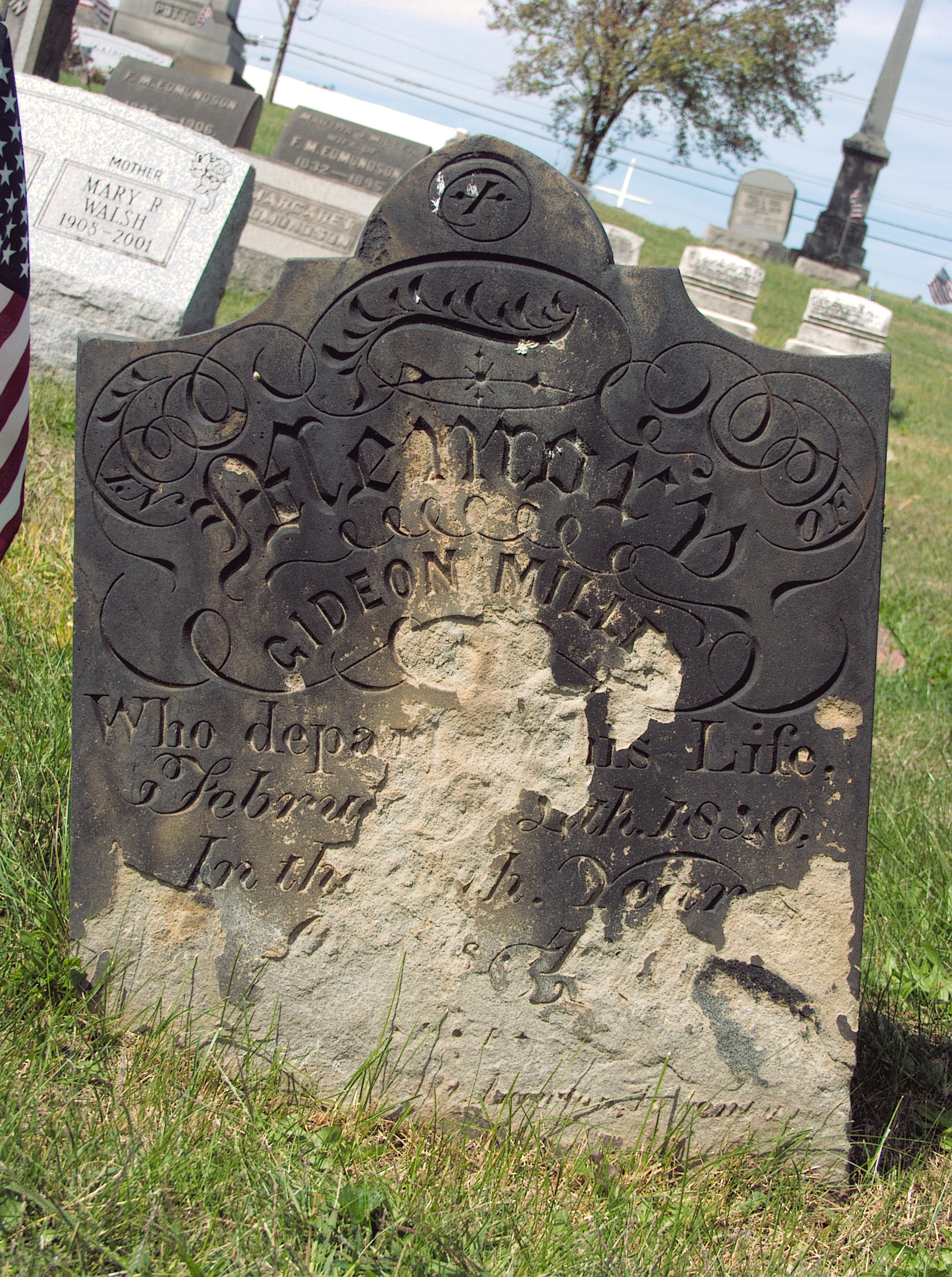
In Memory of
GIDEON MILLER
Who departed this life,
February –th, 1820
in the –th Year
[Of his Age]

[Epitaph]

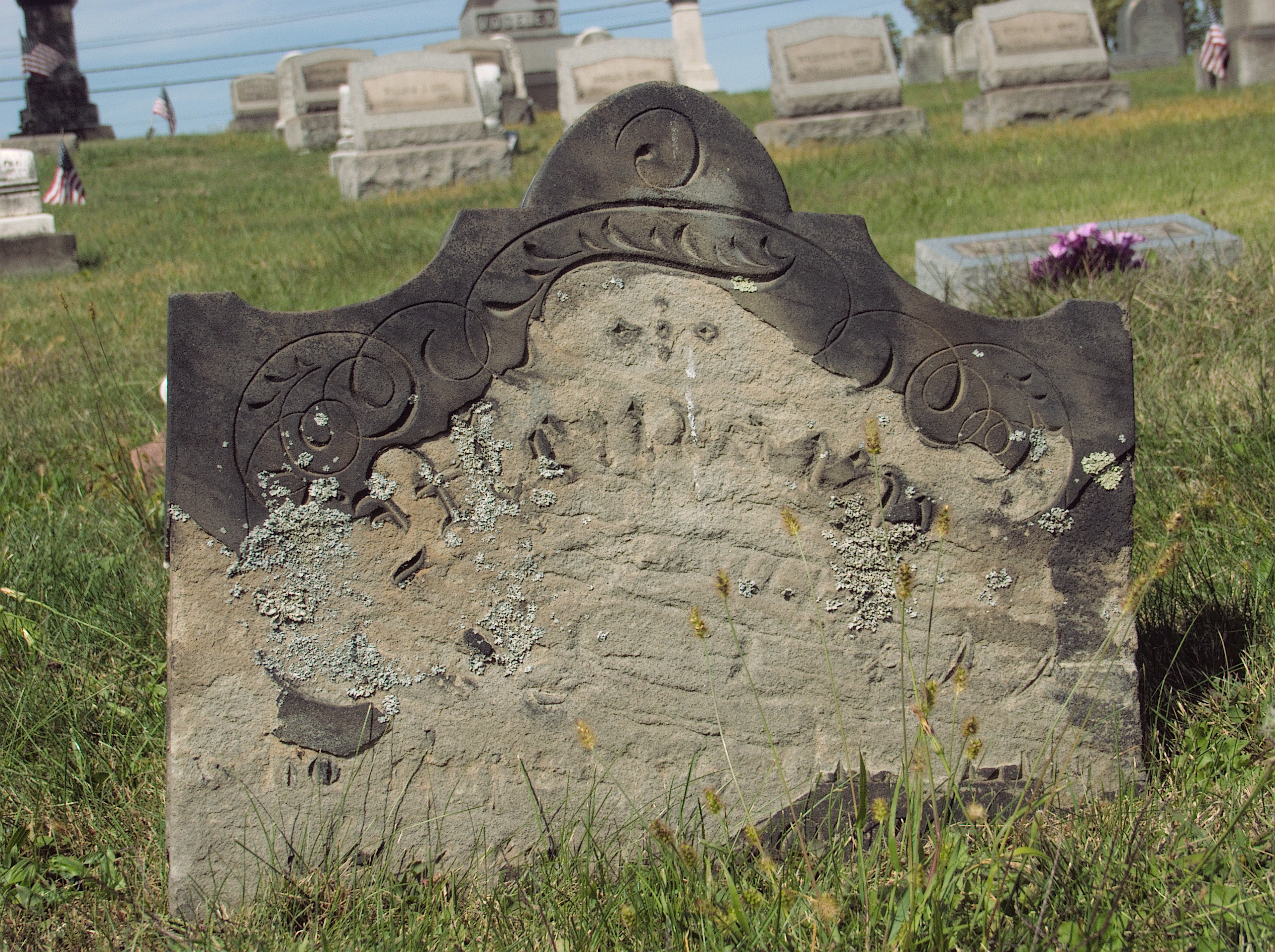
The stone may be later than its 1820 date, but it is almost certainly not later than the 1840s. A matching stone beside it, obviously by the same artist, is too badly damaged to read.
A small but rich-looking mausoleum in a kind of classicized Gothic style, topped by Hope clutching her anchor. The bronze doors are particularly worth looking at. The mausoleum and statue are nearly identical to the J. P. Ober mausoleum in Allegheny Cemetery, with only very slight alterations in the details.

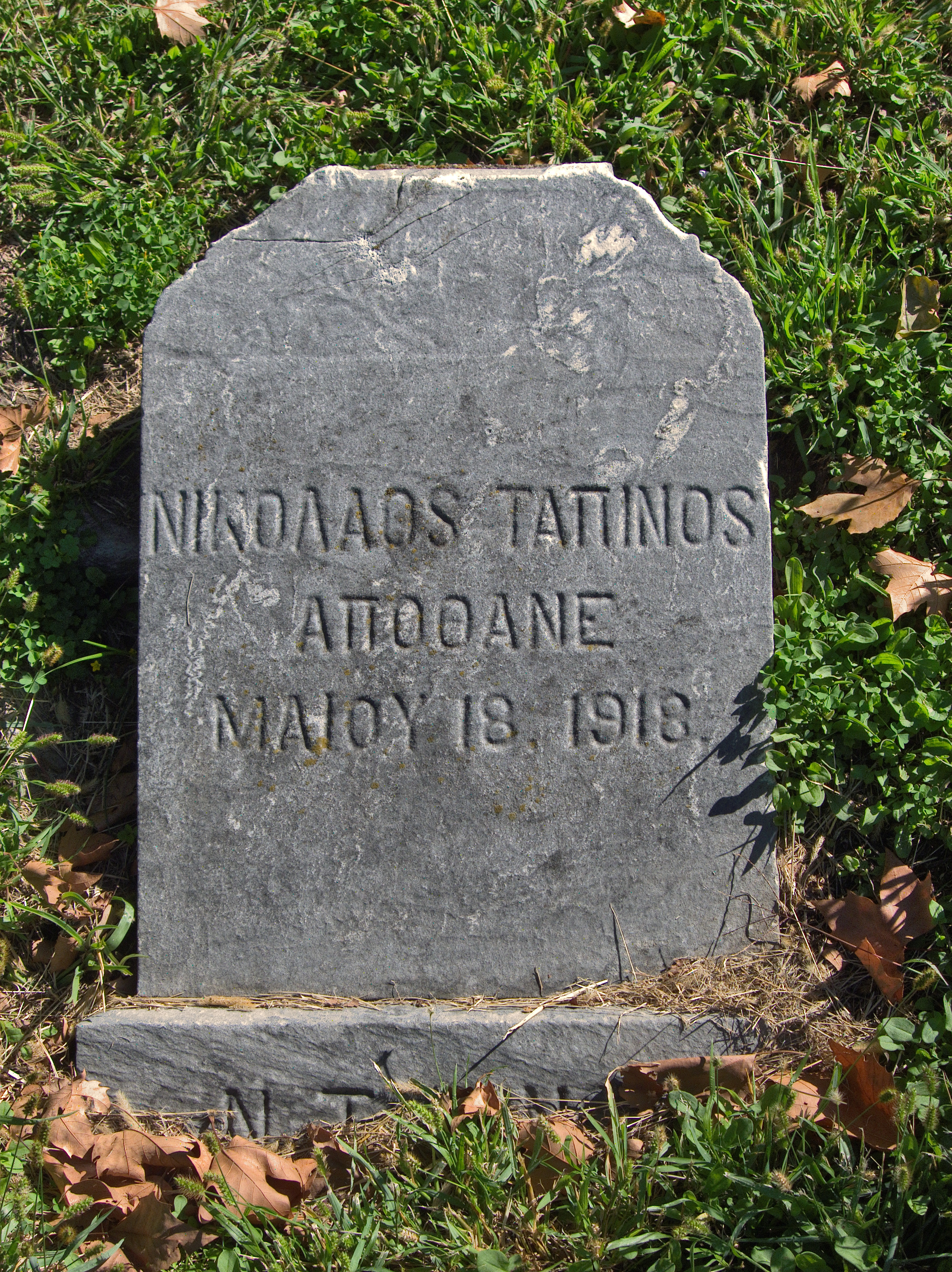
The Minersville Cemetery was the burying-ground of a German Lutheran congregation in the Hill District. But one corner of it is devoted to a wide variety of other ethnic groups. The Hill, which would become the legendary heart of African-American culture in Pittsburgh, was an extraordinary jumble of ethnicities a hundred years ago. The stone above is Slovak; the inscription is regrettably damaged, so that we cannot quite read the full name of the deceased.

Slovaks were often Lutheran, and might have attended the German Lutheran church; but here is a Greek tombstone for one Nikolaos Tapinos. There are other Greek monuments as well, suggesting that this corner of the cemetery was opened to the Lutherans’ Greek Orthodox neighbors.

Finally, here is an Arabic tombstone, the only one Father Pitt found in the cemetery. It probably belongs to a Lebanese or Syrian immigrant; there was a considerable Lebanese population in Pittsburgh a hundred years ago.

The Hill, which was very crowded and not very wealthy, seems to have been hit hard by the Spanish Flu pandemic. A quick look around the Minersville Cemetery shows a very large number of burials of young adults in 1918 and the next two years.

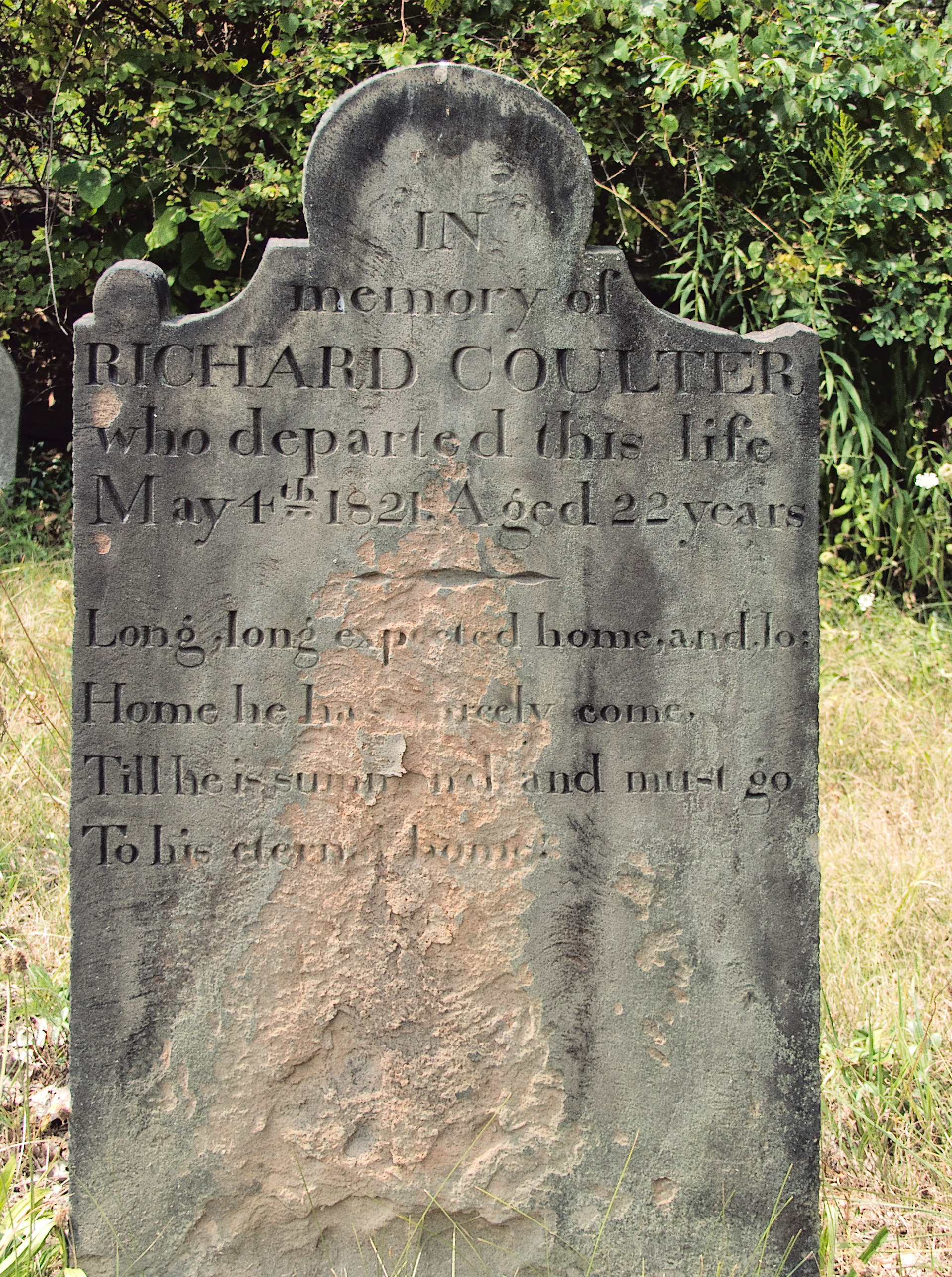
IN
memory of
RICHARD COULTER
who departed this life
May 4th 1821, Aged 22 years
——— Long, long expected home, and lo:
Home he has scarcely come,
Till he is summon’d and must go
To his eternal home.

This is a fairly well-preserved tombstone from nearly two centuries ago, and that is of course interesting enough. The most interesting thing, however, is the poem, which is from a collection of poems by the very obscure James Meikle, this one being headed “On a gentleman who died after his return to his family from foreign parts, after an absence of twelve years.” The poem itself is dated 1768, but it was kept in manuscript until after the poet’s death in 1799. The only edition of the posthumous poems of Meikle Father Pitt has been able to find is one published in Pittsburgh in 1819, two years before the death of Richard Coulter; so that we know with near certainty that whoever specified the epitaph on this stone had read it in this particular book.

Oak Spring Cemetery

In memory of
James R. Sinclair
who departed this life
Jan. the 21, AD 1843.
aged 5 months.

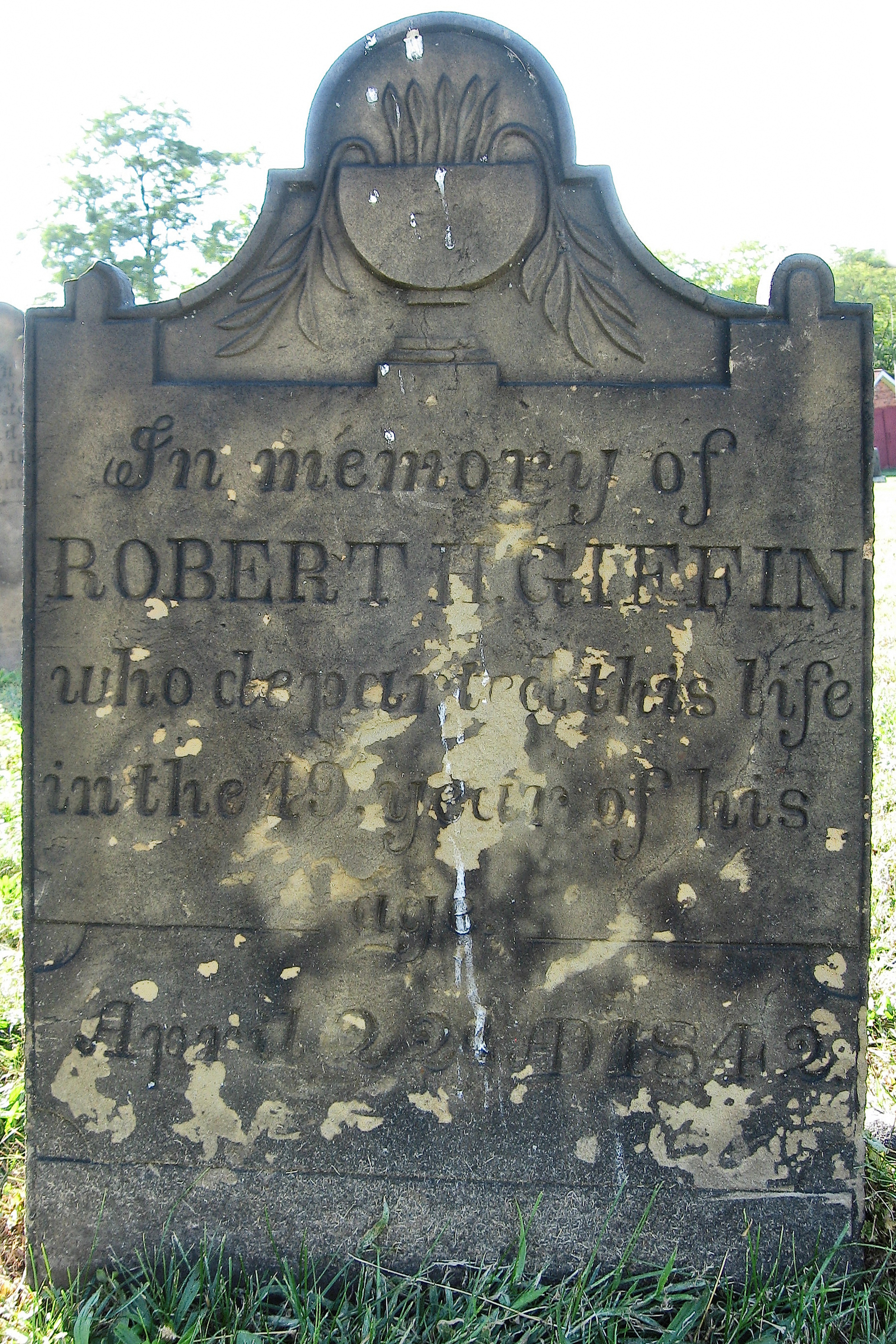
Two early-settler graveyards at opposite ends of Canonsburg have tombstones inscribed by some of the same local craftsmen. One of them, who worked in the 1830s and 1840s, is very easy to identify by three obvious quirks of his style:

  • He writes almost exclusively in italic letters.

  • He begins each inscription with a very distinctive capital I with curlicues.

  • He makes the abbreviation “AD” into a single character, with the right-hand stroke of the A serving as the left-hand stroke of the D.

In addition, if you paid him well enough, he was capable of some fine decorative folk-art reliefs.

The Giffin family, buried in Speer Spring Cemetery, employed him almost exclusively:

In memory of
ROBERT H. GIFFIN
who departed this life
in the 19 year of his
—age—
April 22 AD 1842

In memory of
ANDREW GIFFIN
who departed this life
in the 53d year of his
—age—
Aug. 12, AD 1841.

In
memory of
Samuel Webster Giffin
who departed this life
Sept. 18th, AD 1838, aged
9 months and 25 days

In
memory of
ELIZABETH McCOY
Consort of Andrew H. Giffin
who departed this life
May the 15th AD 1842, in
the 36th year of her age
— — —

Following his usual method of naming anonymous craftsmen after a distinguishing characteristic of their work, Father Pitt will call this artist the Master of the Curlicue I.

To round out the Giffin family plot, we include one broken tombstone done by a different craftsman:

IN
Memory of
ANDREW RAY
GIFFIN, who—
departed this life,
Febr. 11th, 1836
in the 13th year of
his age.

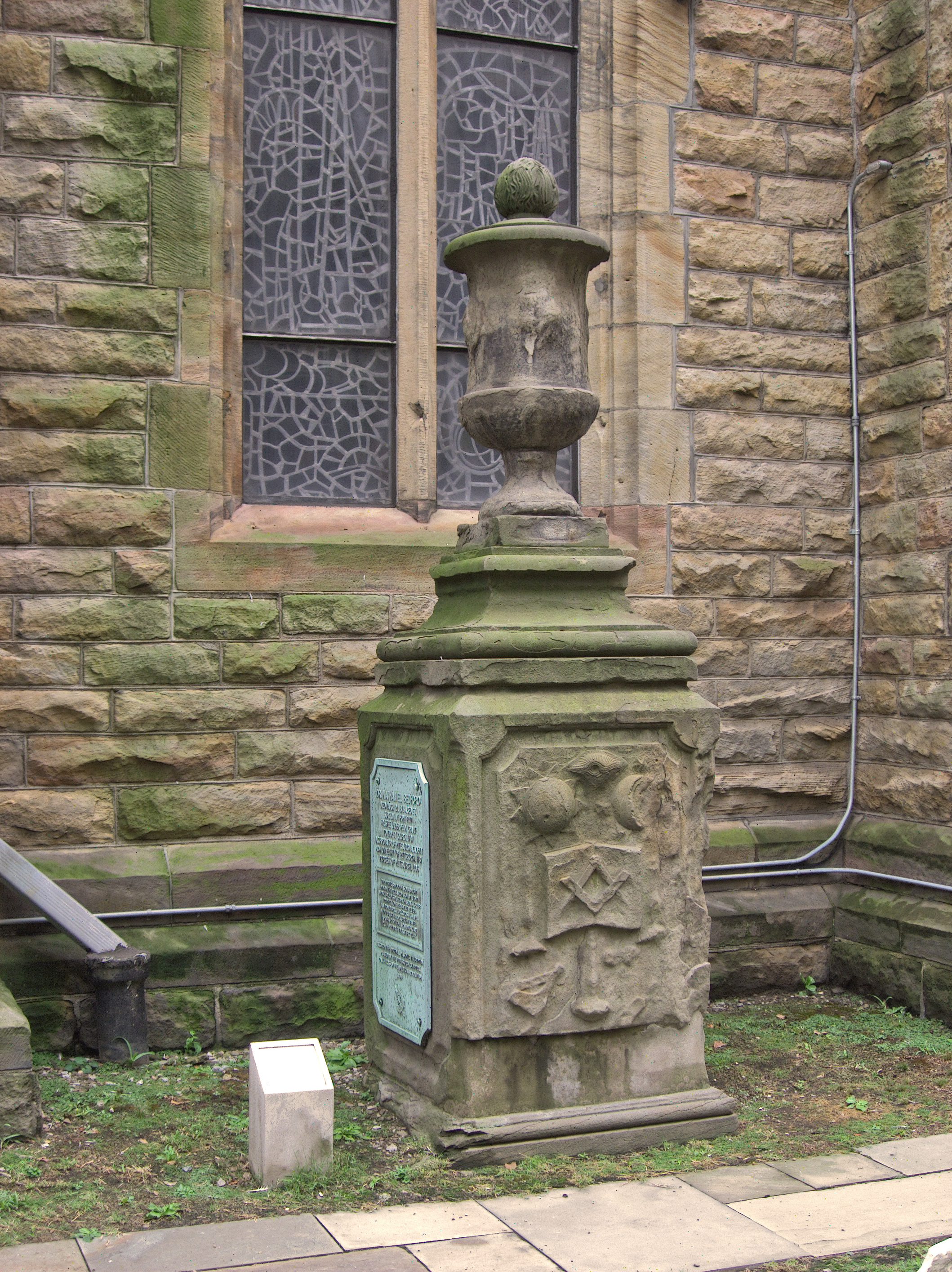
Dr. Nathaniel Bedford was the first physician in Pittsburgh. He came with the British to Fort Pitt and stayed. Here are two paragraphs from the Standard History of Pittsburg, Pennsylvania (1898):

Shortly after 1770 Dr. Nathaniel Bedford, surgeon in the British Army, resigned his commission and took up his permanent residence in the town, being attracted by the wonderful beauty of the place before the iron hand of Industry had stripped the verdure from the hills, seamed and scarred the lovely bosom of the earth, defiled the sparkling waters and spread a sooty pall across the sky.

Dr. Bedford was a man of polished manners, thoroughly educated in his profession, as his commission in the British Army attested, and of scholarly habits. His success was rapid and complete and he accumulated a modest fortune in the form of several tracts of land on the south side of the Monongahela, now within the city limits. Shortly after the beginning of the present [nineteenth] century he retired from practice. In the city directory of 1815 his name appears as “Nathaniel Bedford, gentleman, Birmingham.” He never married [this is incorrect; see below], and after his death the Freemasons, of which fraternity he was a prominent member, erected a monument to his memory in the form of an iron urn, which still stands, or did until recently, on the hillside immediately under the track of the South Twelfth Street Inclined Railway.

The assertion that Dr. Bedford never married is incorrect, He married very well indeed: his wife was Jane Ormsby, heiress of the Ormsby family, and through her inherited the land that became the town of Birmingham—named for Birmingham in England, near which Dr. Bedford was born. In other words, Dr. Bedford owned the South Side, or at least the part of it out to 17th Street, where an awkward kink in the street grid and the sudden broadening of Carson Street mark the beginning of the former separate borough of East Birmingham. Dr. Bedford and his wife had no children, however, and it was his Masonic lodge that erected this memorial when Dr. Bedford died in 1818. He was probably buried under it, in a spot that would have been verdant and semi-rural in 1818, but rapidly developed into one of the most crowded neighborhoods in the city of Pittsburgh. The monument stood neglected under the Knoxville (or South Twelfth Street) Incline until 1901, when the Pennsylvania Railroad needed the land. Then the dilapidated monument was moved here to Trinity Churchyard, probably with the remains of Dr. Bedford (sources seem to differ on whether his remains were discovered).

These Masonic symbols in relief have eroded considerably, but are still recognizable.

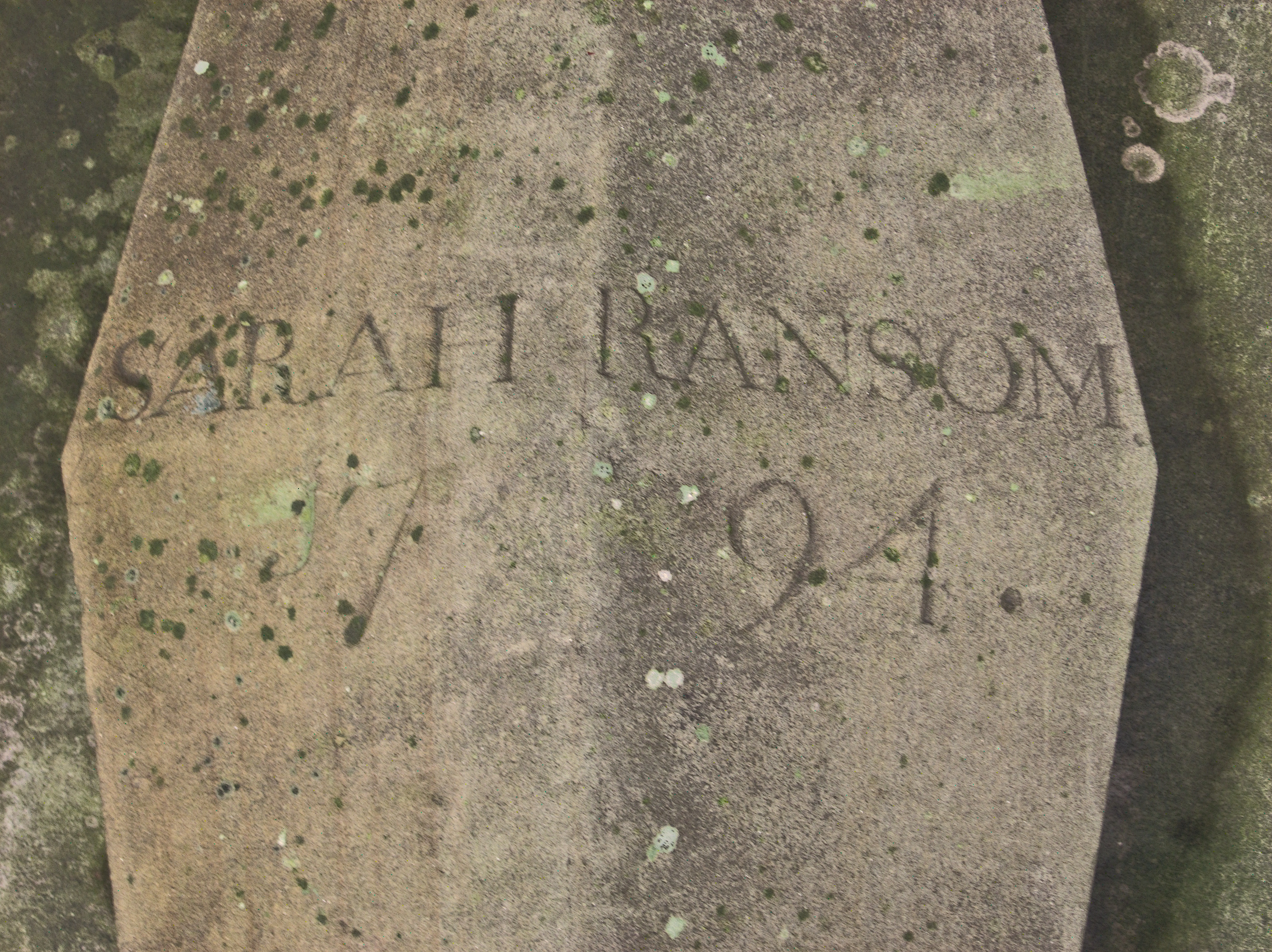
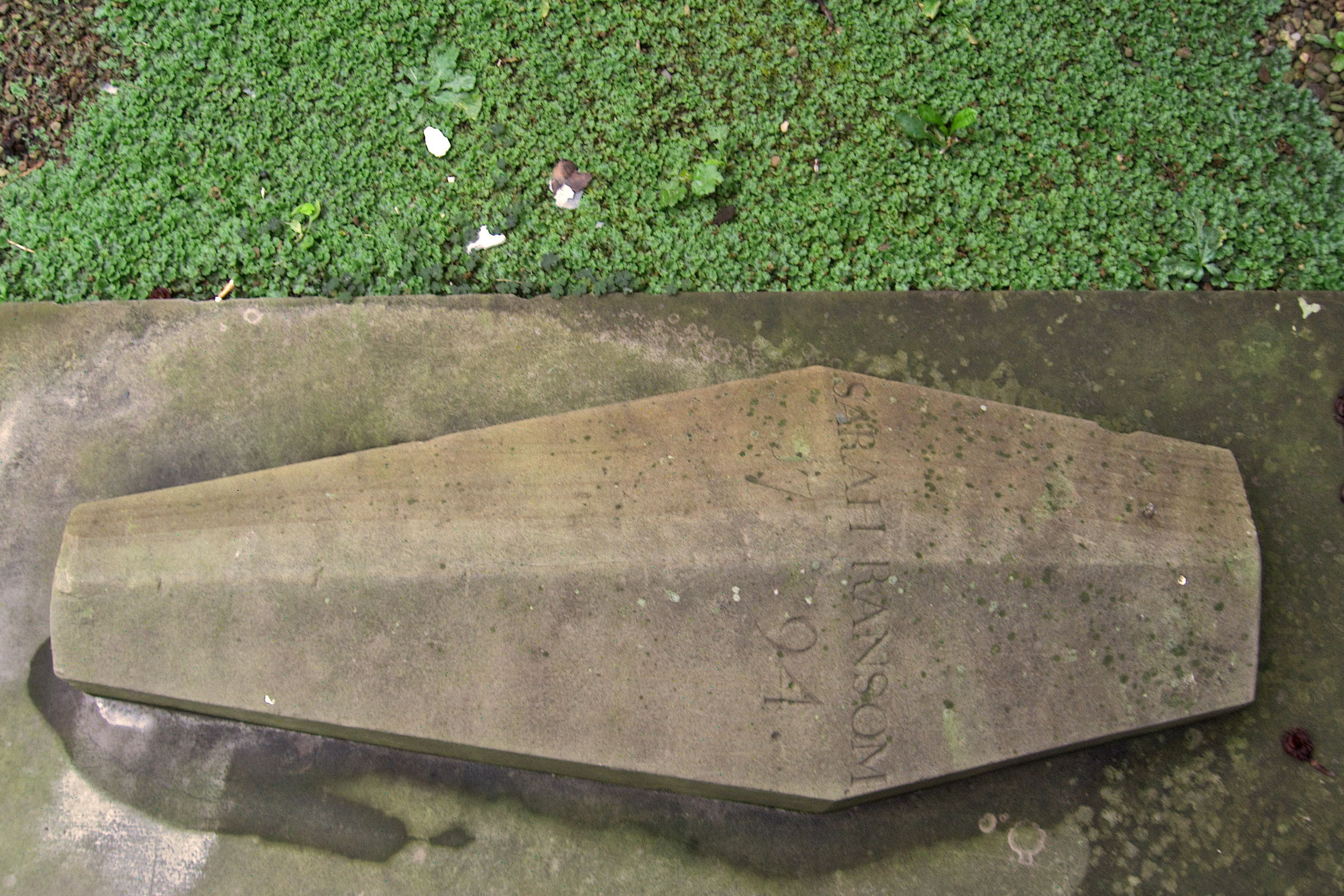
This little stone lay hidden under the ground until 2008, when a landscaper almost literally stumbled on it. It marks the grave of a small child who died in 1794, and that is all we know about her. But the stone and its inscription are very fine for the era, so we suspect her parents had some money.

GOODMAN Y. COULTER, Jr.
Died in N. Orleans
March 1, 1851
interred here
March 21, 1851
in his 21 year.

To the young
He being dead yet speaketh.

A good example of the style of the 1850s; it must have looked very modern beside the traditional tombstones of ten years earlier. “He being dead yet speaketh” is a quotation from Hebrews 11:4.

DIED
Sept. 18, 1856
In the 56th Yr.
of her age
MARTHA
Wife of
JOSEPH McMURRAY

The influence of printing on grave markers in the 1850s is especially obvious in this one, which, in its broad variety of lettering styles—a different one for each line—looks very much like a printed poster from the same era. Father Pitt cannot quite read the epitaph.

As Father Pitt has mentioned, Ridgelawn Cemetery has the best-preserved collection of stone-fenced family plots in the area. Here is a typical and crowded example.

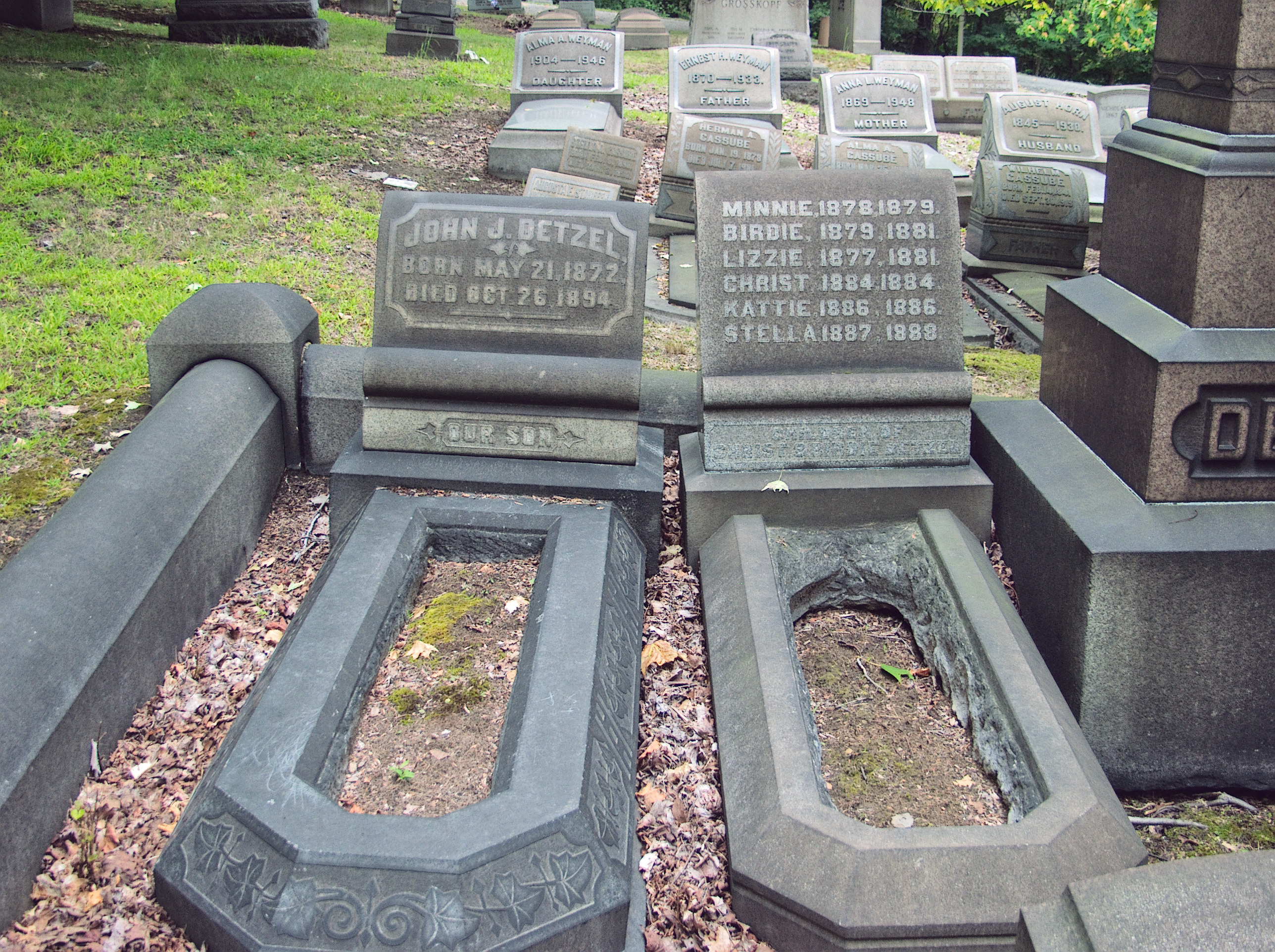
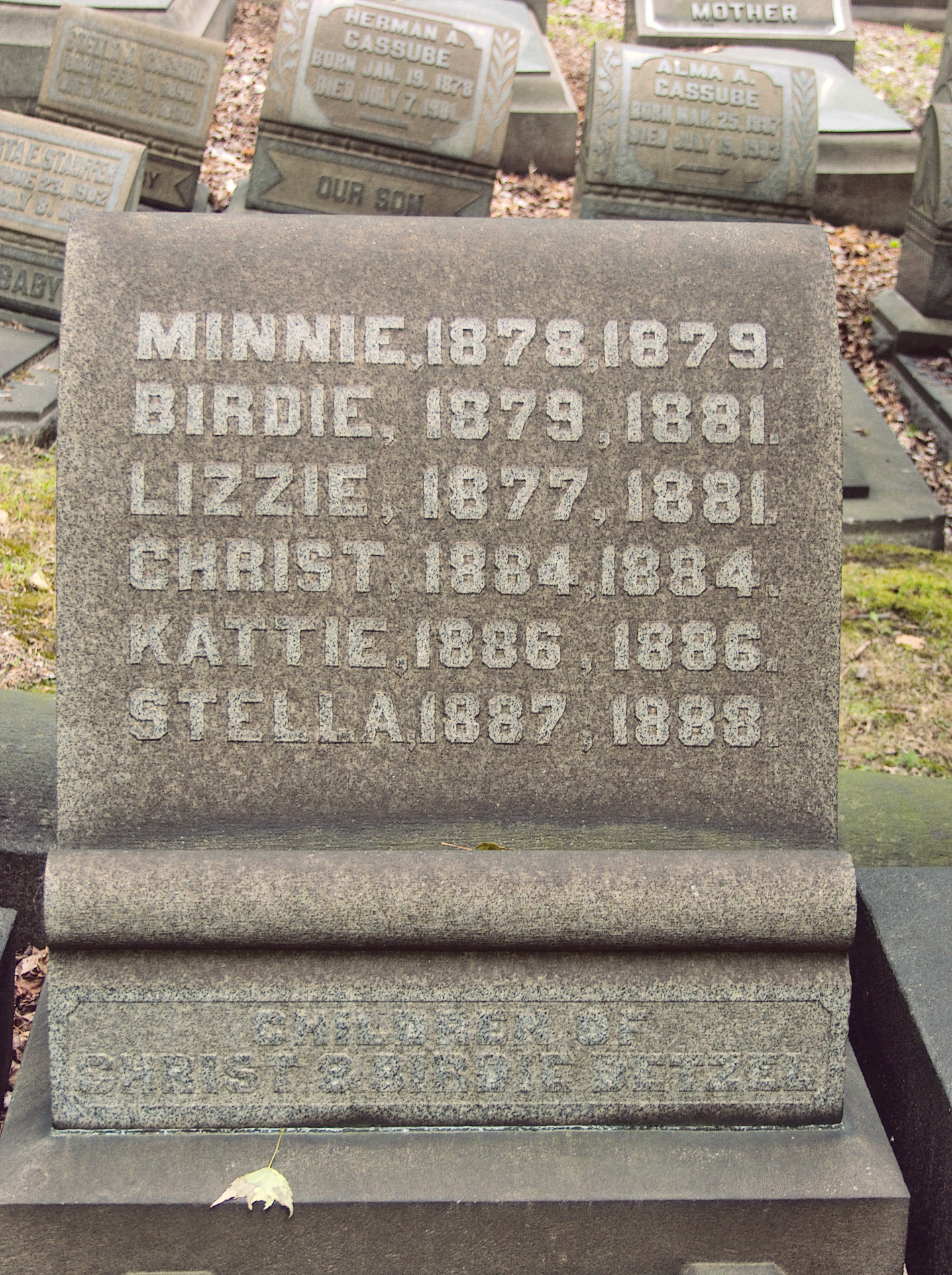
If you should happen to get caught in the middle of a conversation on the Internet in which some ignoramus argues that we do not need to vaccinate against childhood diseases because they were never all that bad, you have old Pa Pitt’s permission to share this picture (which you could do anyway, since it’s released under a CC0 public-domain dedication):