Pittsburgh Cemeteries

The Art and Architecture of Death

Art Deco was popular only for a few decades in the early and middle twentieth century, and it never became a very popular style for cemetery monuments. But among the wealthy residents of the Homewood Cemetery, a restrained and tasteful Art Deco was quite fashionable in the years from roughly 1930 to 1950. In many cases it takes the form of a streamlining and radical simplification of classical and Gothic styles. Some of these monuments look like pieces of sets from the world’s most somber RKO musical.

In Memory of
BILLINGSLEY MORGAN
Who departed this life
[Marc]h the 7th 1836
[in the —]th year of his age

Here is a pair of tombstones by the same extraordinary folk artist—and, because he actually signed one of them, we know his name: H. Savage. Both are badly damaged, but they form a pair side by side, so old Pa Pitt guesses that the illegible stone marks the resting place of Mrs. Billingsley Morgan. Unlike most Western Pennsylvania tombstones of the 1830s, these are handsomely carved in relief, much like the famous New England tombstones of the colonial era, but without the flying skulls.

Even this unusually artistic and ambitious stonecutter did not sketch out his lettering before beginning the inscription, so that he ran out of space for the name “MORGAN” on Billingsley Morgan’s tombstone.

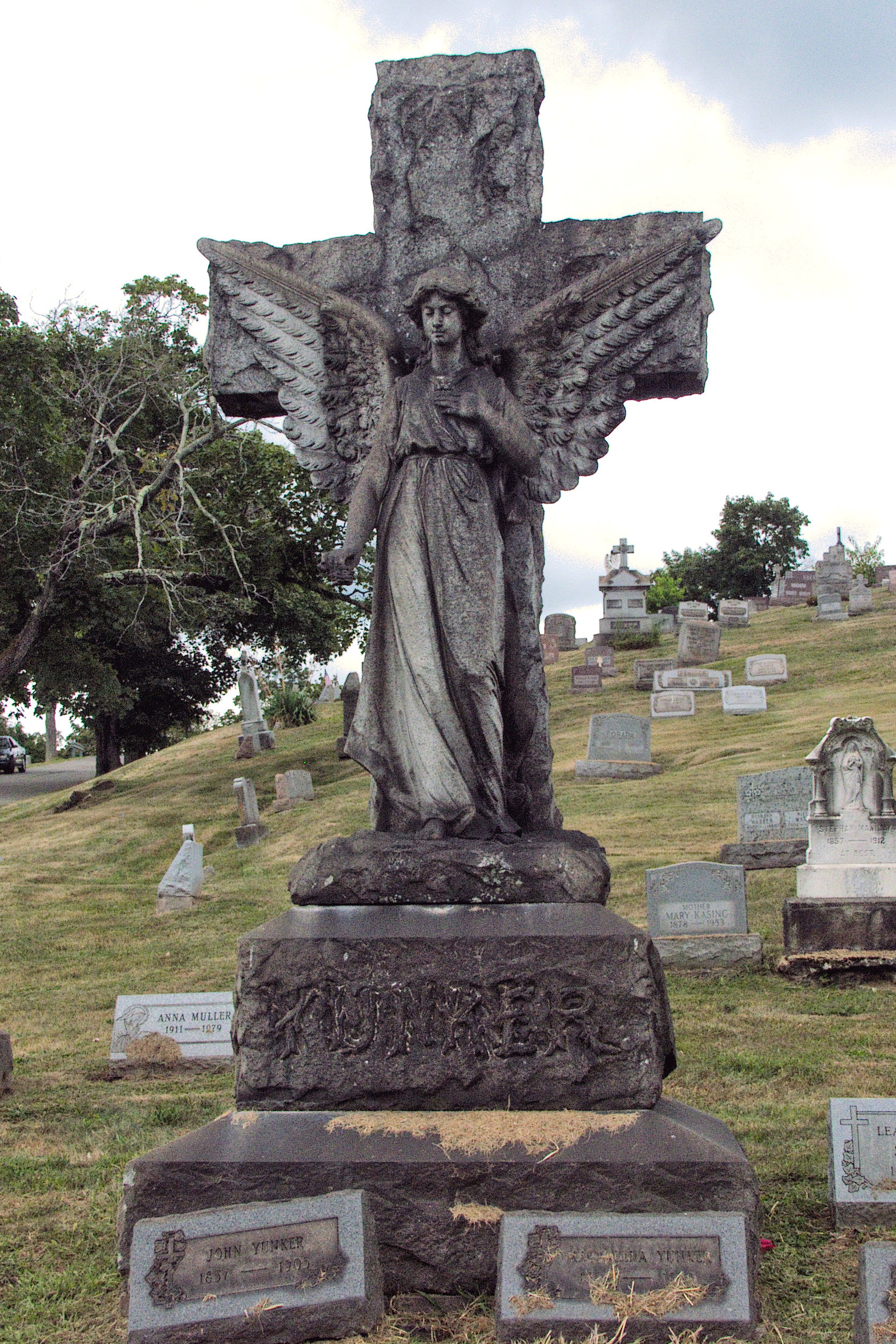
A rustic stone cross with a very good flower-dropping angel standing on a rock, and the family name spelled out in twigs on the base. It probably dates from about 1905, when John Yunker was buried here.

The 1840s were a time when the old art of tombstone-cutting was dying out, and new styles came into vogue—styles that, in many ways, imitated the styles of engravings of the era. Here is a good example: a large tombstone from 1848 that looks very much like an engraved title page of the same era. It no longer has the handmade look of even the best local craftsmen’s work, and it is executed in more expensive stone that turned out to be much less permanent. With some difficulty, we can make out most of the inscription except the epitaph:

JAMES McKOWN
DIED
Feb. 25, 1848
In the 60th year
of his age

The surname “McKown” is damaged, but there are several other McKowns buried in this graveyard, so there is little question about the reading.

Readers who have explored this site know already that Father Pitt collects zinc monuments. They were mass-produced and considerably cheaper than stone monuments of equivalent size, so that they were often condemned as tasteless and excluded from cemeteries for the better classes of dead people. But they live up to the zinc monument vendors’ extravagant claims: they are as permanent as bronze, or more so, and could be bought in a huge variety of shapes with interchangeable reliefs on the panels.

Here is one of the more modest zinc monuments Father Pitt has found, but it is very well preserved, though many of the stones around it are eroded and illegible.

Here is a stone inscribed by someone who obviously did not make a living creating tombstones. Yet the work is done well enough that the stone is perfectly legible nearly two centuries later, preserving the embarrassing spelling mistake for all time.

As Father Pitt has mentioned earlier, Ridgelawn Cemetery preserves its stone-fenced family plots, once a feature of every “rural” cemetery, more perfectly than any other cemetery in the area. Here we have a typical plot, except for its unusual shape: a main monument in the rear center is surrounded by various smaller monuments for individual members of the family, and the stone wall breaks for an entrance inscribed with the name of the patriarch of the family.

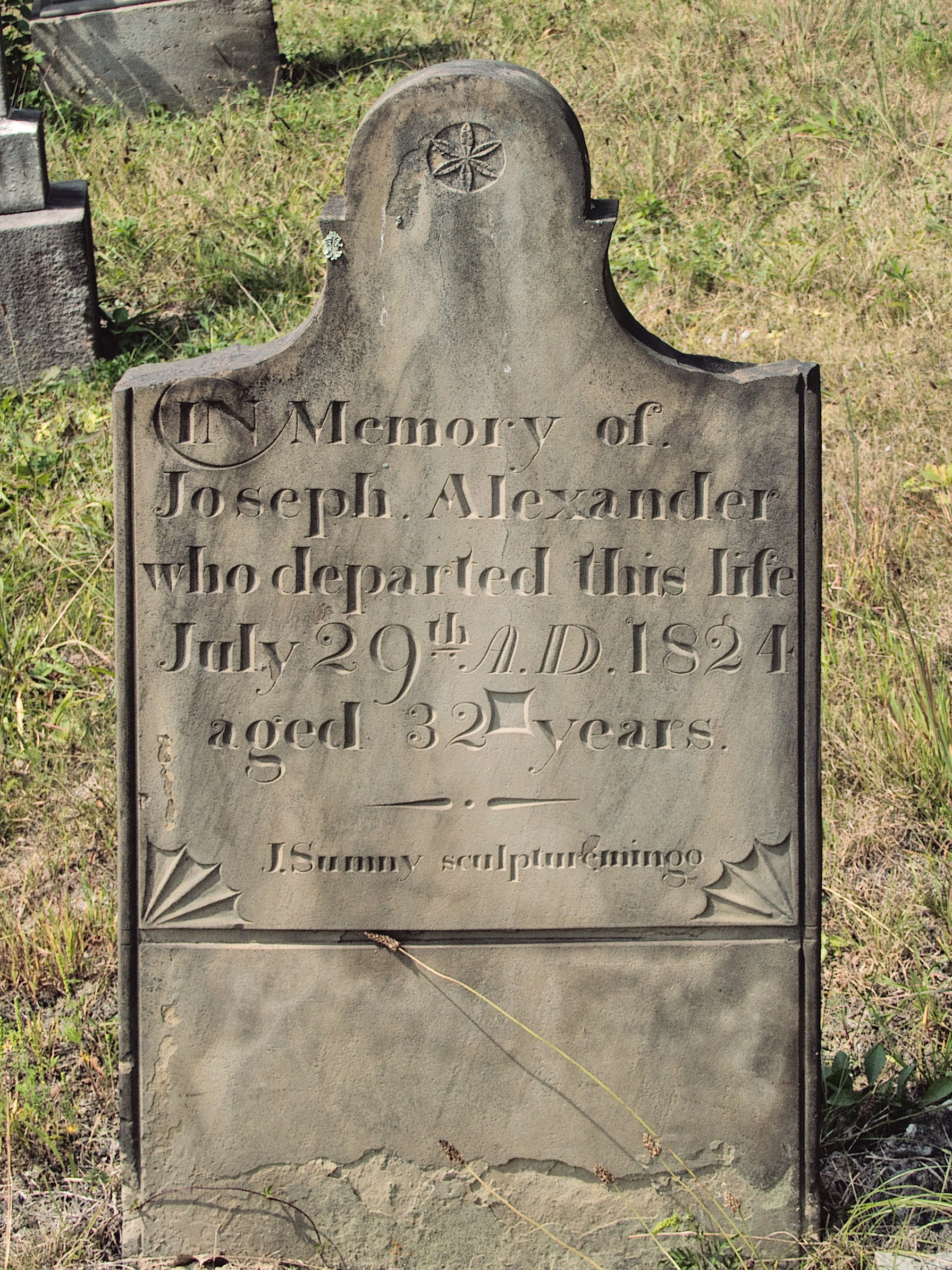
Very few of the stonecutters who worked around here before 1840 (or after, for that matter) signed their work. But occasionally one who was particularly proud of one of his productions would put his mark on it, although—oddly—none of them seem to have made a habit of it. J. Sumny, for example, signed this stone:

The signature “J.Sumny sculpture,mingo” is prominent. “Mingo” was a common term for local American Indian tribes; it is probably the name of a settlement—perhaps Mingo Creek, south of Finleyville, where there is still a church whose congregation was heavily involved in the Whiskey Rebellion.

This one of only two stones visibly signed by J. Sumny, but we can identify others by him in the same graveyard.

Elisabeth Law’s is also certainly one of his;

In addition to the fan ornaments in the corners, note the characteristic ornamental dash after the main inscription and the distinctive ordinal (“26th”) with the superscript “th” underlined, and a double comma under the underline. (Distinctive, but not unique: at least one less artistic stonecutter in the same cemetery also used the underline and double comma for abbreviations.)

Though it lacks the ornaments, Elisabeth Jeffery’s stone is also by J. Sumny:

Again we see the characteristic ordinal and ornamental dash, as well as the backslant in the line that identifies the relations of the deceased.

Moses Coulter McDowell’s tombstone shows all the same quirks, though the shape of the stone itself is fashionably Gothic, like most of the rest of J. Sumny’s stones (the Joseph Alexander stone above is damaged, but probably had the same Gothic spikes). Moses was another child taken away by the same scarlet-fever epidemic that killed Elizabeth Jeffery; it must have been a profitably busy time for stonecutters.

Again we see that distinctive way of forming ordinals (and the abbreviation “Janr.”)

Hardly a family in the Bethany Presbyterian Church was spared by this scarlet-fever epidemic. The winter of 1831 was a somber time in the little settlement. Catharine Herriott also died, and was given a very fine stone by J. Sumny:

It is a rare thing to be able to identify one of these local craftsmen by name, but J. Sumny’’s signature on one stone has allowed us to attribute a number of others to the same artist.

Added: J. Sumny continued to practice in this area for some years, and Father Pitt has found another signature of his, this time on a very plain stone. Father Pitt is inclined now to believe that he signed all his works, but almost always near the bottom of the stone, so that most of the signatures are under the ground by now. Indeed, the first time Father Pitt photographed the James Hastings tombstone from 1840, the signature was not visible:

But having fortunately returned just after the cemetery received one of its infrequent mowings, he found the signature that had been obscured by vegetation. We see here that, by 1840, he was spelling his name “Sumney”:

Recognizing that the style of J. Sumny (or Sumney) had changed somewhat over the years, Father Pitt is now inclined to say that probably half the early settlers’ tombstones in this graveyard were inscribed by him.

A marble recording angel whose businesslike attitude suggests to Father Pitt that she is checking boxes on a printed form. There are no inscriptions on the monument and no Bayer grave markers near it, so Father Pitt cannot date it except to say that it looks like the sort of thing that would have been put up in the beginning of the twentieth century. It is even possible that the plot was never used; we have seen examples of families that bought cemetery plots and put up monuments to themselves, and then moved elsewhere.

in memory of
George Dickson
Who died Dec. the 8th A.D.1817
in the 83d, year of his age.
Also of
Rachel Dickson his wife
Who died May A.D. the 20th
1798 in the 47th year of her age.

These are probably the parents of the Agness Dickson who died in 1799 and is buried next to them. Their stone was cut by the same craftsman who cut Agness’ stone, whom we call the Master of the Curly G. Here, however, he has done much more elaborate work, which may be explained by his having had eighteen years of experience since Agness’ stone. The decorations are something new, and the individual letters seem more neatly made.

This tombstone gives us very good evidence of how our early stonecutters did their work. We can still see the lines scratched into the stone with a straightedge to align the letters. But it is equally plain that the stonecutter did not first trace the letters with chalk or any other impermanent material: he made his lines, and then he just started writing. If it were not so, he would not have been taken by surprise when he came to the end of a line and had no room for the E in “wife.” He would not have left out the day of the month in Rachel’s inscription, then realized his mistake, shrugged, and stuck it in after “A.D.” And this seems to be the almost universal practice of the stonecutters of two centuries ago: they never drew the inscription first before cutting it, but launched straight into cutting the letters, dealing with errors in any clumsy way that occurred to them.

Now, it is quite possible that Agness’ stone was cut at the same time as this one, rather than when she died in 1799. In favor of that proposition we have these arguments:

  1. Both stones were cut by the same craftsman (but, on the other hand, local craftsmen often worked for decades in the same cemetery).
  2. Rachel, who died in 1798, apparently did not have a stone until her husband George died, so it is reasonable to suppose that Agness might not have had one either.

There are enough differences between the work on this stone and the work on Agness’, however, including the decorations and (in Father Pitt’s eyes) much neater individual letters, to suggest that the stonecutter might have been considerably older and more experienced when he cut this stone. Old Pa Pitt regards the matter as worthy of further investigation.